It looks like an ordinary bicycle, until you notice the thick downtube and the quiet hum as it climbs a hill without any visible effort from the rider. The secret is a box of cells hidden in the frame, a battery pack that stores enough energy to push a rider twenty or thirty miles with barely a pedal stroke.
An e-bike battery is not a single battery at all. It is dozens of small lithium-ion cells, each about the size of a finger, welded together into a pack, wired to a brain that watches every cell, and sealed inside a tough case that must survive rain, vibration, and the occasional fall.
Making a good pack is a careful business, because lithium-ion cells store a great deal of energy in a small space, and a badly made pack can overheat or fail. Every weld, every wire, and every test exists to make sure the pack is safe as well as powerful. Here is how an e-bike battery is made.
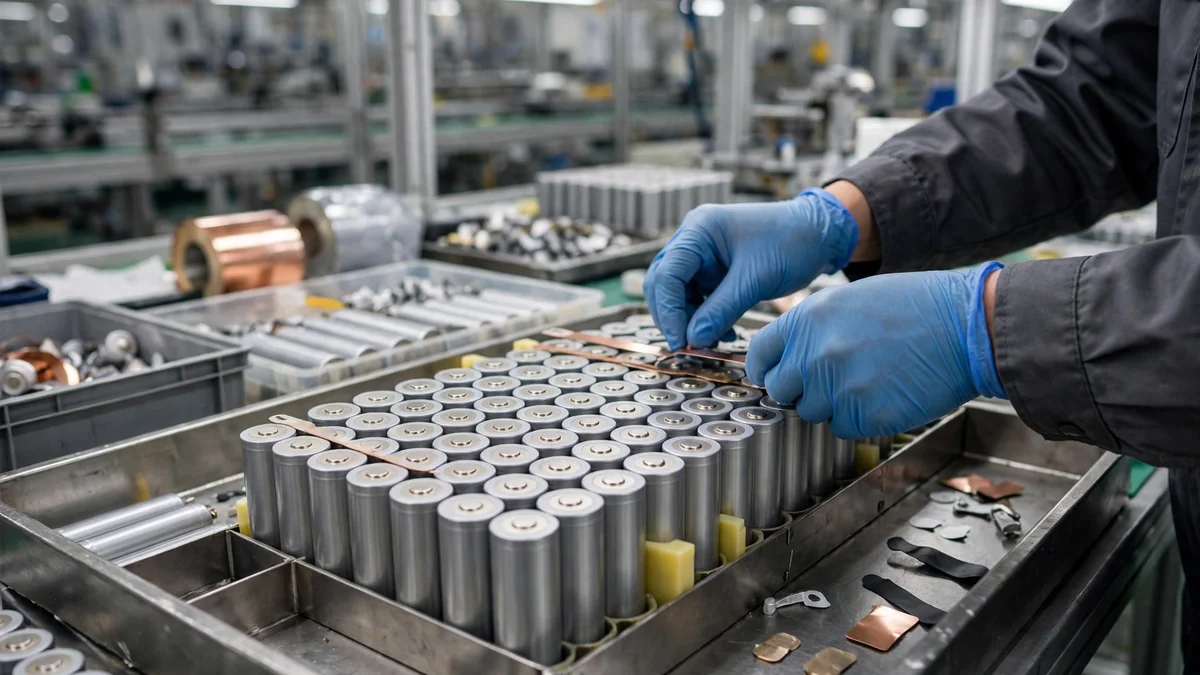
How an E-Bike Battery Is Made
Step 1: Testing and sorting the cells
The pack starts with individual 18650 or 21700 lithium-ion cells, the same cylindrical format used in power tools and electric cars. Each cell is tested before it is used: its voltage is measured, its capacity is checked, and its internal resistance is recorded. Cells that do not match are set aside, because a pack is only as good as its weakest cell, and a single weak cell will drain faster than its neighbours and drag the whole pack down.
Step 2: Arranging the cells and spot-welding the pack
The matched cells are placed into a plastic holder in a precise arrangement, often ten in series and four or five in parallel, which sets the pack’s voltage and capacity. Then comes the most delicate job in the whole build: spot welding. Thin nickel strips are welded across the tops and bottoms of the cells, joining them into a single electrical unit. Each weld is a brief pulse of current, hot enough to fuse the metal but short enough not to heat the cell inside.

Step 3: Fitting the battery management system
Next the pack gets its brain, the battery management system, or BMS. This small circuit board watches every group of cells, measuring voltage and temperature, and it steps in if anything goes wrong. If one group charges too high, the BMS bleeds off the extra energy. If the pack gets too hot, it cuts the power. If the voltage drops too low, it stops the bike before the cells are damaged.
Step 4: Wiring, fusing, and sealing the case
The wired pack is fitted with a fuse, a charge port, and a discharge connector, and then it is placed inside its case. The case is usually aluminium or tough plastic, shaped to fit the bike’s frame, and it is sealed against rain and dust with gaskets and screws. Some packs are potted, filled with a soft compound that holds the cells still and cushions them against vibration. Once sealed, the pack looks like a simple box, but inside it is a carefully arranged system, and the way the finished battery behaves on the bike is explained in how an e-bike battery works, from the first pedal stroke to the last mile of range.
Step 5: Charging, testing, and grading the pack
Every pack is charged and discharged at least once before it leaves the factory, a process called formation or grading. The pack is cycled on a test rig that records exactly how much energy it holds, how evenly the cells behave, and whether the BMS cuts in at the right voltages. Packs that hold less than their rated capacity, or whose cells drift apart, are pulled aside for investigation. The pack is also tested for vibration and for a short drop, to make sure nothing inside has come loose. Only a pack that passes every test is given its label, with its voltage, capacity, and serial number printed on the case.
Step 6: Final inspection and matching to the bike
The last step is to match the pack to the bike it will power. The pack’s voltage must suit the motor and controller, its capacity must match the range the bike promises, and its connector must fit the frame. The pack is charged to a storage level, usually around half full, for shipping, and it is packed with its charger and manual. When it reaches the bike factory, it is slotted into the frame and tested once more as part of the finished e-bike. The numbers behind the finished pack are laid out in the e-bike battery specs explained, and the larger packs that power electric cars use the same ideas at a bigger scale, as covered in how an EV battery pack is made.
E-Bike Battery Specs
| Specification | Typical range |
|---|---|
| Cell format | 18650 or 21700 lithium-ion |
| Voltage | 36 V or 48 V, most common |
| Capacity | About 400 to 750 Wh |
| Cells per pack | About 40 to 65 cells |
| Weight | About 2.5 to 4.5 kg |
| Charge cycles | About 500 to 1,000 full cycles |
| Charging time | About 3 to 6 hours, standard charger |
| Protection | BMS, fuse, sealed case, temperature cut-off |
What Does an E-Bike Battery Cost?
A replacement e-bike battery is estimated at roughly $300 to $900, depending on capacity, brand, and voltage, with large high-capacity packs estimated at $1,000 or more. The cells are estimated at the largest share of the cost, followed by the BMS, the case, and the labour of assembly and testing. A new e-bike typically includes the battery in its price, and the battery is estimated at roughly a third of the cost of the whole bike. All prices are estimates only and vary widely by brand, capacity, and market. A cheap pack with unmatched cells may cost half as much, but it will usually last half as long.
A Rare Fact
The cells inside an e-bike battery are close cousins of the cells in a laptop, and the first e-bikes used heavy lead-acid batteries that weighed more than the rest of the bike put together. The switch to lithium-ion in the 2000s is what made e-bikes practical, because it cut the battery weight by two thirds while tripling the range. Today, a single e-bike pack holds about the same energy as a small car battery from the 1990s, in a box the size of a water bottle. Some manufacturers are now testing packs that can be swapped in seconds at a roadside station, so a rider never has to wait for a charge at all.

An e-bike battery is easy to take for granted, a silent box that just works until it does not. Behind it is a small factory of careful work: tested cells, precise welds, a watchful circuit board, and a sealed case. Get any of those wrong and the pack fails early, or fails dangerously. Get them right, and a few kilograms of cells will carry a rider up hills for years. That is a remarkable return for a box most riders never even look inside.