The courier leans into the hill on a wet Tuesday morning, a crate of parcels strapped to the rack behind him, and the bike does something that still feels faintly like cheating. His legs are turning at a comfortable, unhurried pace, yet the bike climbs at a speed that would leave a fit rider on an ordinary bicycle gasping. There is no roar, no gear whine, just a low, steady hum from somewhere near the back wheel. By the top of the rise he is not even breathing hard.
That hum is a small electric motor doing a very large job. Tucked into the rear hub or bolted around the bottom bracket, it weighs about as much as a bag of sugar and produces more torque than the rider’s legs ever could. Brochures throw numbers at you — 250 watts, 85 newton-metres, 48 volts — and leave you to guess which of them actually matter when you are loaded up, facing a hill, with rain in your eyes.
Those numbers describe real physics: how hard the motor pushes, how fast it spins, and how long it lasts before heat forces it back. Once you can read them, you can tell a commuter motor from a cargo-hauling one at a glance.

Hub Motors and Mid-Drive Motors
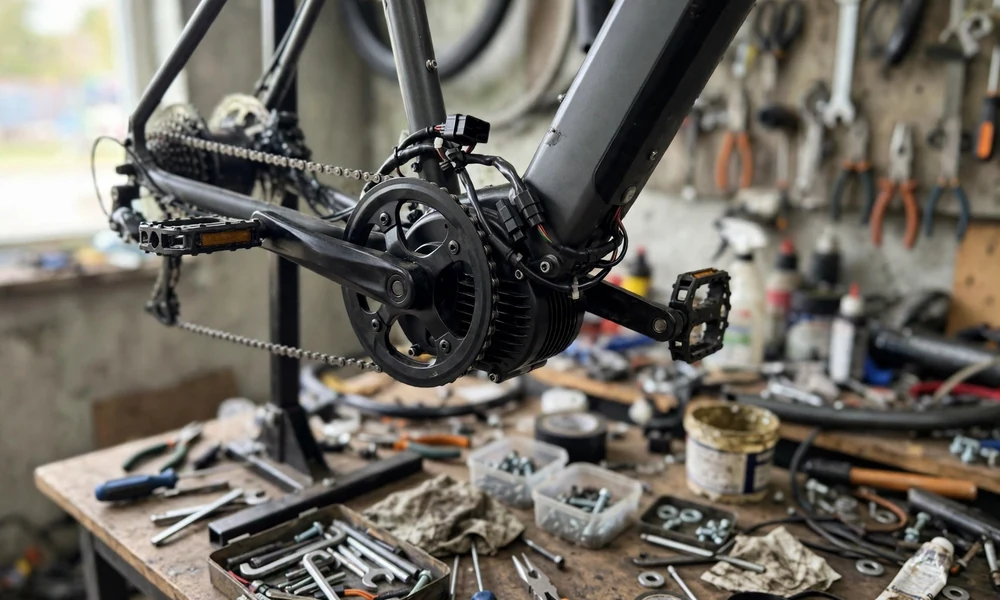
Before the numbers, the shape. Most e-bike motors fall into two families. A hub motor lives inside the front or rear wheel, usually the rear, and drives the wheel directly. It is simple, quiet, sealed against the weather, and cheap to build — which is why it dominates commuter bikes and folding bikes. A mid-drive motor sits at the pedals, around the bottom bracket, and drives the chain, so it can use the bike’s gears the way your legs do. That makes it stronger on steep climbs and better at hauling heavy loads, but it wears chains faster and costs more.
Neither is better everywhere: hubs suit flat city riding, mid-drives suit hills and heavy loads. The spec sheet tells you which kind of riding a motor was built for — if you know where to look. The basic physics behind both is the same machine explained in our guide to how an electric motor works.
What the Numbers Mean
Power: the headline wattage
Power, in watts, is the first number on every spec sheet and the least useful on its own. In much of Europe and the UK, road-legal e-bikes are limited to 250 watts of continuous rated power, while bikes sold in the United States commonly advertise 500 or 750 watts. But rated power is a legal and thermal label, not a measure of how the bike feels. A motor rated at 250 watts can briefly produce far more during a hard climb, as long as it does not overheat. What matters is sustained power: what it can hold for minutes without throttling back.
Torque: the number that moves you
Torque, measured in newton-metres, is the twisting force the motor applies, and it is the number that decides how a bike feels from a standstill. A city hub motor might make 40 to 50 newton-metres, enough for gentle starts on flat roads. A good mid-drive makes 65 to 85, and the strongest cargo and mountain motors reach 90 to 120. If you carry children, groceries, or a trailer, torque matters more than wattage.
Voltage: the push behind the power
Voltage is the electrical pressure feeding the motor, and most e-bikes run at 36 or 48 volts. A 48-volt system pushes the same power with less current, which means less heat in the wires and the controller, and usually a livelier feel at higher speeds. A 36-volt bike is fine for short, flat commutes, but for hills and heavy loads, 48 volts is the safer bet. The battery behind those volts is covered in our guide to e-bike battery specs.
Cadence and speed sensing
How the motor knows when to help is a spec that rarely gets a headline but shapes the ride. Cheaper systems use a cadence sensor, which simply detects that the pedals are turning and switches the motor on at a fixed level. It can feel jerky — full power or nothing. Better systems use a torque sensor, which measures how hard you are pedalling and matches your effort proportionally. Push gently and the assist is gentle; stand on the pedals and the motor surges with you. Torque sensing is the single biggest difference between a bike that feels like a machine and one that feels like a stronger version of you.
Efficiency and heat
No motor turns all its electricity into motion. A good e-bike motor converts roughly 75 to 85 percent of its input energy into forward push, and the rest becomes heat in the copper windings. On a long climb that heat builds up, and the controller will eventually cut power to protect the motor. Motors with better cooling and larger windings hold their output longer. It is the same thermal battle fought at larger scale in our guide to the best electric motors for EVs, where sustained output separates the good from the great.
Electric Bike Motor Specs
| Specification | Typical range |
|---|---|
| Rated power | 250 watts (EU/UK) to 750 watts (US) |
| Peak power | 500 to 1,500 watts, briefly |
| Torque | 40 to 120 newton-metres |
| Voltage | 36 or 48 volts nominal |
| Motor type | Rear hub, front hub, or mid-drive |
| Sensor type | Cadence or torque sensing |
| Efficiency | 75 to 85 percent |
| Weight | 2.5 to 4.5 kilograms |
| Top assisted speed | 25 km/h (EU/UK) or 32 to 45 km/h (US classes) |
How to Read a Motor Spec Sheet
Start with torque and motor position, not wattage. A mid-drive making 85 newton-metres will out-climb a hub motor rated at twice the watts, because the mid-drive works through the gears. Check the sensor and voltage too — torque sensing for daily riding, 48 volts for hills — and ask about sustained output and heat. A motor that holds its power for a ten-minute climb is worth more than one that peaks high and fades after thirty seconds.
What Does an E-Bike Motor Cost?
A replacement e-bike motor is estimated at $200 to $400 for a basic hub motor, $400 to $800 for a quality mid-drive unit, and $800 to $1,500 or more for a high-torque cargo or mountain motor with its controller. Prices are estimates only and vary by brand and power.
A Rare Fact
The first electric bicycles appeared in the 1890s — decades before the petrol car became common — and one early design, patented in the United States in 1895, used a hub motor built directly into the rear wheel. The idea was sound, but the lead-acid batteries of the day were so heavy and so short-lived that the concept sat on the shelf for nearly a century. Your e-bike is not a new invention; it is a Victorian idea that finally got the battery it was waiting for.

An e-bike motor is a small machine with a big job, and its spec sheet is a plain-language map once you know the landmarks. Torque, voltage, sensor, and sustained output tell the whole story. Read those four numbers, and the wattage on the brochure can take care of itself.


