A submarine’s propeller is the one part of the boat that can give it away. Every other noise — the reactor pumps, the crew’s footsteps, the hum of the electrics — can be muffled, mounted on springs and hidden behind insulation. But the propeller works in open water, spinning in the sea itself, and every bubble it sheds and every pulse of pressure it throws off travels for kilometres through the ocean. So the materials of a submarine propeller are chosen for one quality above all others: silence.
That silence starts with bronze. Not the bronze of statues and bells, though the family is the same, but nickel-aluminium bronze — a copper alloy with aluminium, nickel, iron and manganese — cast in a single piece the size of a small house, machined to a mirror finish, and balanced so precisely that it spins without a tremor. But the material is no secret, and it is the material that makes the shape possible: strong enough to carry the full power of the boat, and resistant enough to seawater that it can spend years submerged without pitting.

The Materials Behind the Submarine Propeller
The headline material is nickel-aluminium bronze, usually the alloy known as NAB, which is roughly 80 percent copper with about 10 percent aluminium, 5 percent nickel and 5 percent iron, plus a little manganese. It is strong, it resists corrosion in seawater better than almost any other copper alloy, and — critically — it resists cavitation erosion, the pitting caused by tiny bubbles collapsing against the blade surface thousands of times per second.
Step 1: Choosing the bronze
Nickel-aluminium bronze wins because of what it does not do. Ordinary manganese bronze is strong but corrodes in seawater; stainless steel resists corrosion but cavitates badly and is hard to cast in the huge, complex shape of a propeller; titanium is superb but so expensive and so difficult to machine that only a few boats use it. Nickel-aluminium bronze sits in the sweet spot: its aluminium content forms a thin, self-healing oxide film on the surface, its nickel adds strength and toughness, and its iron content refines the grain so the metal stays ductile even in cold, deep water.
Step 2: Casting the propeller
A submarine propeller is cast, not forged, because no press in the world could forge a blade that shape. The mould is built in a foundry pit, layer by layer, from sand and resin, reproducing the blade geometry to within millimetres. Molten bronze is poured at over 1,000 degrees Celsius in a single continuous pour that can take hours, and the casting is left to cool for days, sometimes weeks, because cooling too fast would lock stresses into the metal that could crack a blade under load. The same slow, careful casting that produces a submarine pressure hull in steel is what produces the propeller in bronze, and both are judged by the same standard: no hidden flaws.
Step 3: Machining the blades to a mirror
Each blade is machined on a huge five-axis milling machine, often the largest machine tool in the country that built it, cutting the bronze to tolerances measured in fractions of a millimetre. The blade’s shape is not a simple twist: it is skewed — swept back like a scimitar — so that each part of the blade enters the hull’s wake at a different moment, spreading the pressure pulse over time instead of delivering it all at once. That skew is what makes the propeller quiet, and it only works if the machining is exact.

Step 4: Balancing the propeller
A submarine propeller spins at a few hundred revolutions per minute, and at that speed an imbalance of a few hundred grams would shake the whole stern of the boat. So the finished propeller is mounted on a balancing machine, spun up, and checked with vibration sensors. Material is removed from the heavy side — never added, because a welded-on patch would disturb the flow — and the propeller is spun again, and again, until the vibration disappears. It is the same discipline that keeps a yacht propeller smooth at speed, taken to the extreme a silent boat demands.
Step 5: Fitting the hub and the shaft
The propeller is fitted to a tapered stainless steel shaft with a keyless hydraulic fit: the hub is heated or the shaft is cooled, the propeller is pressed on under immense force, and as the temperatures equalise the joint locks with a grip no bolt could match. The shaft itself is usually a high-strength stainless steel, chosen for corrosion resistance and fatigue strength, and it passes through the hull in a stern tube sealed by face seals that keep the sea out while the shaft turns.
Step 6: Fighting cavitation and corrosion
Cavitation is the propeller’s worst enemy: when the blade moves fast enough, the pressure on its back drops below the vapour pressure of water, bubbles form, and when they collapse they hammer the bronze with microscopic jets that can eat through a blade in months. The defence is mostly shape — the skew, the blade area and the slow turning speed all keep the pressure up — but the material helps too, because nickel-aluminium bronze resists cavitation erosion far better than most metals.
Step 7: Testing the silence
Before a submarine goes to sea, its propeller is tested in a cavitation tunnel: a loop of water driven past the spinning propeller at full scale, with hydrophones listening for the first whisper of cavitation. The tunnel is one of the most secretive facilities in any navy, and the data it produces — the exact speed at which the propeller first makes noise — is one of the boat’s most closely guarded numbers. When it passes, the boat can run at patrol speed with a propeller that makes less noise than the sea itself, and the same quiet engineering that hides a submarine propeller in production is what keeps it hidden at sea.
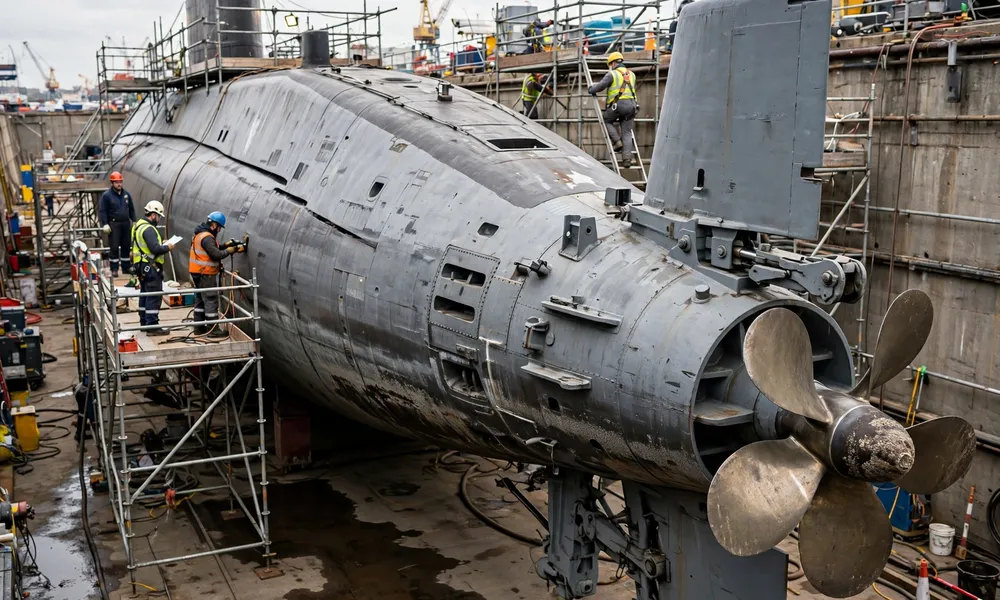
Submarine Propeller at a Glance
| Specification | Detail |
|---|---|
| Main material | Nickel-aluminium bronze (NAB) |
| Typical composition | ~80% copper, ~10% aluminium, ~5% nickel, ~5% iron |
| Weight | Tens of tonnes for a large nuclear submarine |
| Blade count | Classified; typically 5–7 highly skewed blades |
| Turning speed | A few hundred rpm at patrol speed |
| Shaft | High-strength stainless steel, keyless hydraulic fit |
| Corrosion defence | Self-healing oxide film plus sacrificial anodes |
What Does It Cost?
A submarine propeller costs several million dollars (estimate) to cast, machine and balance, with the foundry work and the months of machining and hand-finishing accounting for most of it. The bronze itself is only a fraction of the price; the value is in the precision.
A Rare Fact
Submarine propellers are so sensitive that some navies machine them in rooms kept at a constant temperature, because a change of a few degrees makes the bronze expand enough to throw the machining out of tolerance. The propeller is the one part of the submarine that the whole world can see when the boat is in dry dock, and it is the part that tells an expert the most.