Open a foldable phone and you are watching a piece of metal do something metal is not supposed to do: bend, in the same place, two hundred thousand times, and come back straight. The hinge is the phone’s spine and its weakest point at the same time. It has to fold flat, hold the phone open at any angle, keep the two halves aligned to a fraction of a millimetre, and survive being dropped, sat on and opened one-handed a hundred times a day.
Inside that hinge, no bigger than a matchbox, sit gears, cams, springs and plates made from materials chosen for opposite virtues: some parts must be hard enough never to wear, others flexible enough to bend without breaking, others light enough to keep the phone pocketable. The star is a nickel-titanium alloy that remembers its shape, the workhorse is a hardened stainless steel, and the quiet hero is a carbon-fibre-reinforced plate that keeps the whole assembly stiff without adding weight.

The Materials Behind the Foldable Phone Hinge
The headline materials are stainless steel for the gears and the hinge frame, a nickel-titanium shape-memory alloy for the flexible elements, and an ultra-thin glass and polymer stack for the screen that folds over it. The hinge plates are often a zirconium-based amorphous metal — a metallic glass that is stronger than steel and springs back without deforming — and the whole mechanism is lubricated with greases that must not migrate onto the display.
Step 1: The steel frame and gears
The hinge’s skeleton is stainless steel, usually a precipitation-hardening grade that can be machined to shape and then aged in an oven to reach a hardness close to that of a knife blade.
Step 2: The shape-memory alloy
The most remarkable material in the hinge is nitinol, an alloy of roughly equal parts nickel and titanium that can be bent and will spring back to its original shape when warmed, and that can flex far further than steel without taking a permanent set. In a foldable phone it is used in the flexible plates and the spring elements that support the screen through the fold, because it can be bent thousands of times without fatiguing the way steel would.
Step 3: The metallic glass plates
Some foldable hinges use plates of amorphous metal, often called liquid metal, a zirconium-based alloy cooled so fast that its atoms never form a crystal structure. In the hinge it forms the thin, stiff plates that support the folding screen and spread the load across the fold, so the screen is never bent around a sharp edge. The plates are polished to a mirror finish, because a scratch on a metallic glass plate is a stress concentration, and a stress concentration is where a crack starts — the same reason a foldable display is handled in a clean room, not on a bench.
Step 4: The cam and the hold-open spring
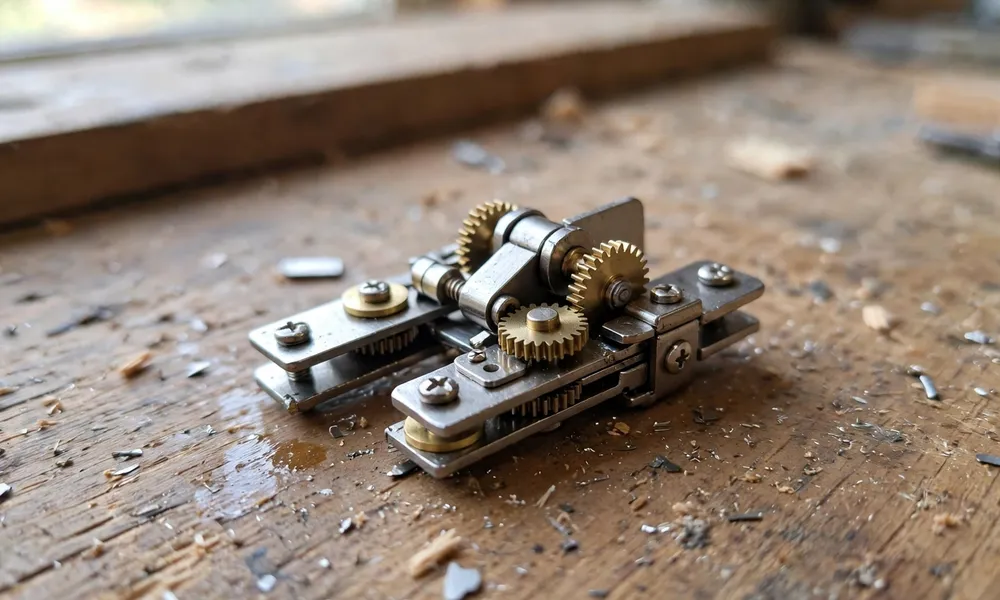
A foldable phone must stay open at any angle — flat for reading, half-open for a video call, closed in a pocket — and that is the job of the cam and the torsion spring. The cam is a hardened steel profile that the spring follows as the hinge turns, with detents — shallow notches — at the angles the phone is meant to hold. The spring itself is wound from high-carbon piano wire, heat-treated to a precise temper, and it is the part that takes the most cycles: every open and close winds and unwinds it. The cam surface is polished and coated with a low-friction material, often a diamond-like carbon coating, so the hinge feels smooth after a hundred thousand cycles instead of gritty.
Step 5: Keeping dust and grit out
The first foldable phones died of dust. A single grain of sand in the hinge could scratch the screen from behind or jam a gear, and the gap the hinge needs to fold is also a gap that dust can enter. Modern hinges are sealed with tiny brushes — fibres of nylon and PTFE that sweep the gap as the phone folds — and with elastomer gaskets that close the opening when the phone is shut.
Step 6: The folding screen’s support
The screen that folds over the hinge is a stack of ultra-thin glass, only tens of microns thick, bonded to polymer layers and a stainless steel support plate with a lattice of holes — a pattern that lets the steel bend where the fold is and stay rigid everywhere else. The support plate is the hinge’s partner: it carries the screen, keeps it flat when the phone is open, and flexes with it when it folds. The whole stack is less than a millimetre thick, and every layer is chosen so that it bends at the same radius as its neighbours — if one layer bends tighter than the next, it delaminates, and the screen bubbles. The precision of that stack is why a smartphone titanium frame and a foldable hinge are engineered together, not separately.
Step 7: Testing the fold two hundred thousand times
Before a foldable phone ships, its hinge is folded by robots in a test lab, hundreds of thousands of times, at different temperatures — in a freezer, in an oven, in a humidity chamber — because a hinge that works at room temperature can seize in the cold and a grease that flows in summer can stiffen in winter. A hinge that passes two hundred thousand folds in the lab is rated for about five years of ordinary use, and the test is the reason the most expensive foldables now promise that number on the box. The same relentless cycling that proves a foldable phone hinge is so expensive is what proves it will survive in a pocket.

Foldable Phone Hinge at a Glance
| Specification | Detail |
|---|---|
| Frame and gears | Precipitation-hardening stainless steel |
| Flexible elements | Nitinol (nickel-titanium shape-memory alloy) |
| Support plates | Zirconium-based amorphous metal (metallic glass) |
| Spring | High-carbon piano wire, heat-treated |
| Cam coating | Diamond-like carbon for low friction |
| Dust defence | Nylon / PTFE sweeper brushes and elastomer gaskets |
| Rated life | Typically 200,000 folds (about 5 years of use) |
What Does It Cost?
The hinge is the most expensive mechanical part of a foldable phone, costing tens of dollars per unit (estimate) — many times the cost of the frame in a conventional phone — because of the nitinol, the metallic glass and the precision machining. A replacement hinge fitted by the manufacturer can cost several hundred dollars (estimate), which is why foldable phones carry premium prices and why a damaged hinge usually means a damaged screen as well.
A Rare Fact
Nitinol, the shape-memory alloy in the hinge, was discovered by accident in a US naval laboratory in the 1960s, when a researcher bent a strip of the alloy and watched it straighten itself as it warmed in his hand. The alloy’s name is an acronym of its origins: nickel, titanium, Naval Ordnance Laboratory.


