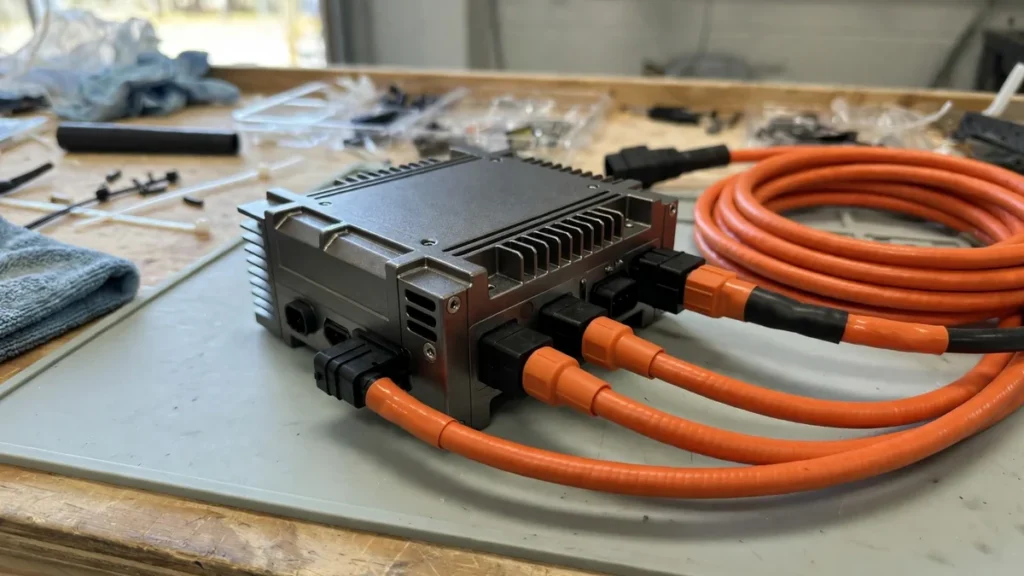
Press the accelerator in an electric car and something invisible happens a hundred times a second. The battery holds direct current, a steady one-way flow. The motor needs alternating current, a flow that reverses direction many times a second. The part that translates one into the other, in a box the size of a shoebox, is the inverter — and it is the hardest-working piece of electronics in the car.
The inverter never appears in a sales brochure, but its spec sheet decides how fast the car accelerates, how far it goes on a charge, and how quietly it does both. The numbers are electrical: power, voltage, switching frequency, efficiency, and the temperature the box can survive. Each one is a compromise, and each one is getting better every year.
This guide explains the key numbers on an EV inverter spec sheet in plain English: what power rating really means, why voltage matters, how efficiency turns into range, and which figures are worth comparing between cars.
Decoding the Inverter: The Numbers Behind the Translation
1. Power rating: how much the inverter can pass
Power rating is measured in kilowatts, and it is the maximum power the inverter can deliver to the motor — typically 150 to 400 kW in a modern electric car, and more than 500 kW in the fastest ones. It is the ceiling on acceleration: a motor cannot produce more power than the inverter can feed it, so the inverter’s rating and the motor’s rating are usually matched. The way the inverter works, step by step, is explained in how the EV inverter works.
2. Voltage: 400 volts, 800 volts, and why it matters
Voltage is the electrical pressure the inverter is built for, and modern EVs run at either around 400 volts or around 800 volts. The difference shows up everywhere: for the same power, doubling the voltage halves the current, which means thinner cables, less heat, and faster charging. An 800-volt inverter is a more demanding piece of engineering — its components must survive higher voltages without arcing — but it is the reason the fastest-charging cars can add hundreds of kilometres of range in under twenty minutes. The spec sheet quotes both the nominal voltage and the maximum the inverter can tolerate, and the gap between them is the safety margin.
3. Efficiency: the percentage that becomes range
Efficiency is the share of the battery’s energy that reaches the motor, and it is the number that turns directly into range. A modern inverter is 97 to 99 percent efficient, which sounds like there is nothing left to gain — but one percent of a 100 kWh battery is a kilowatt-hour, and a kilowatt-hour is several kilometres of driving. The materials that make that last percent possible are the subject of the EV inverter materials engineering guide.
4. Switching frequency: the hum you cannot hear
Switching frequency is measured in kilohertz, and it is how many times per second the inverter’s transistors turn on and off to build the alternating current. A typical silicon inverter switches at 10 to 20 kHz; a silicon carbide inverter can switch at 50 kHz or more. Higher frequency means smoother power, a quieter motor, and smaller, lighter filters — but it also means more heat in the transistors, so the frequency is a trade-off against cooling.
5. Silicon carbide vs silicon: the material that changed the game
The transistors inside the inverter are made of silicon, or of silicon carbide, and the spec sheet names which one. Silicon carbide handles higher voltages, switches faster, and wastes less energy as heat, which is why it has become the standard in the best inverters. A silicon carbide inverter can be smaller and lighter than a silicon one of the same power, and it runs cooler, which means less cooling hardware and more range. The material costs more, but the savings elsewhere in the car usually pay for it. The factory that builds these inverters is shown in how the EV silicon carbide inverter is made.
6. Cooling: the heat that has to go somewhere
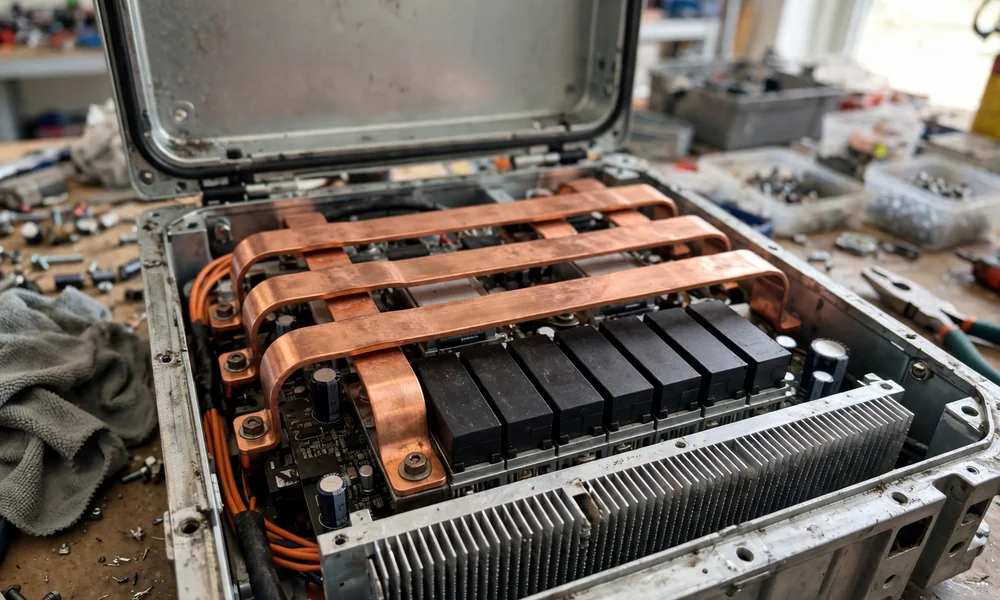
Even at 98 percent efficiency, a 300 kW inverter wastes 6 kW as heat — enough to warm a small house — and that heat has to go somewhere. The spec sheet quotes the cooling method, usually a liquid loop shared with the battery and motor, and the maximum coolant temperature the inverter can tolerate. Cooling is the inverter’s real limit: the transistors can only pass as much power as the cooling can carry away, so a better-cooled inverter is a more powerful inverter.
7. Weight and size: the shoebox that shrinks every year
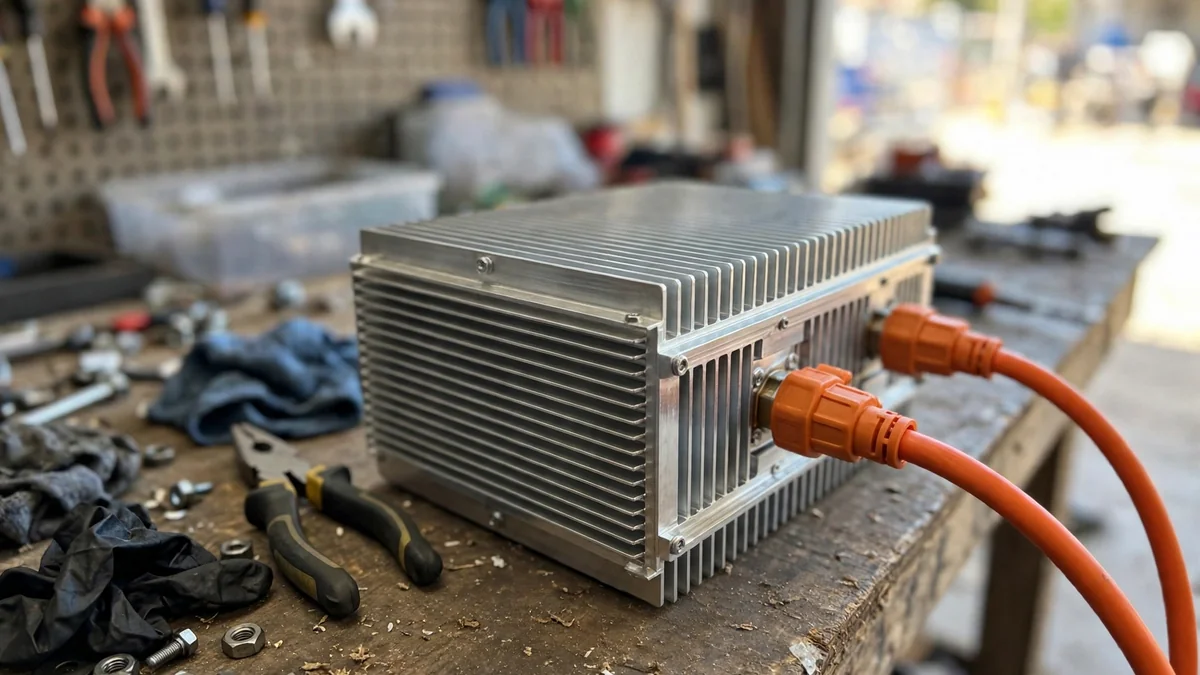
A modern inverter weighs roughly 10 to 20 kilograms and is about the size of a shoebox, and both numbers shrink with every generation. Power density — kilowatts per kilogram or per litre — is the figure engineers compare, and it has roughly doubled in a decade as silicon carbide and better cooling have taken hold. A smaller inverter leaves more room for the battery, the cabin, or the luggage, and it is one of the reasons electric cars keep getting roomier inside while the drivetrain gets smaller. Weight saved here is weight that does not need to be accelerated, braked, or carried.
EV Inverter Specs
| Specification | Typical range |
|---|---|
| Power rating | 150 to 400 kW, 500+ kW in performance cars |
| Voltage | 400 V or 800 V architecture |
| Efficiency | 97 to 99% |
| Switching frequency | 10 to 20 kHz silicon, 50+ kHz silicon carbide |
| Semiconductor | Silicon or silicon carbide |
| Cooling | Liquid cooling loop |
| Weight | 10 to 20 kg |
| Power density | Roughly doubling every decade |
What Does an EV Inverter Cost?
An EV inverter is estimated at roughly $500 to $2,000 for a mainstream car, and $2,000 to $5,000 or more for a high-performance silicon carbide unit. The power modules inside are the most expensive part, estimated at $200 to $800, and the silicon carbide chips inside them are the reason the price has stayed high even as the rest of the car has got cheaper. All prices are estimates only and vary widely by power rating, semiconductor type, and volume. The inverter is a small share of the car’s price, but it is the part that most directly turns battery energy into motion.
A Rare Fact
The first electric cars of the 1890s had no inverter at all, because their motors ran on direct current straight from the battery — and they were slow, inefficient, and hard to control. The alternating-current motor, which needs an inverter, was invented by Nikola Tesla in the 1880s, but it took a century of power electronics before an inverter small and efficient enough for a car existed. The modern EV inverter is a descendant of the equipment that drove factory motors and trains, shrunk from a cabinet the size of a wardrobe into a box that fits under a seat.

The spec sheet is the honest version of the acceleration figure. Power rating tells you the ceiling, voltage tells you how fast it charges, efficiency tells you how much of the battery becomes motion, and switching frequency tells you how quietly it all happens. The inverter is the part nobody sees and everybody relies on, and its numbers are the ones that decide how an electric car actually feels.