On a cold morning in Norway, a family loads their electric car for a 400-kilometre drive to a cabin in the mountains. They stop once, plug in, and twenty minutes later they are back on the road with enough charge for the rest of the trip. Nobody thinks about the small silver box between the battery and the motor, but that box, the inverter, is the reason the stop took twenty minutes instead of two hours.
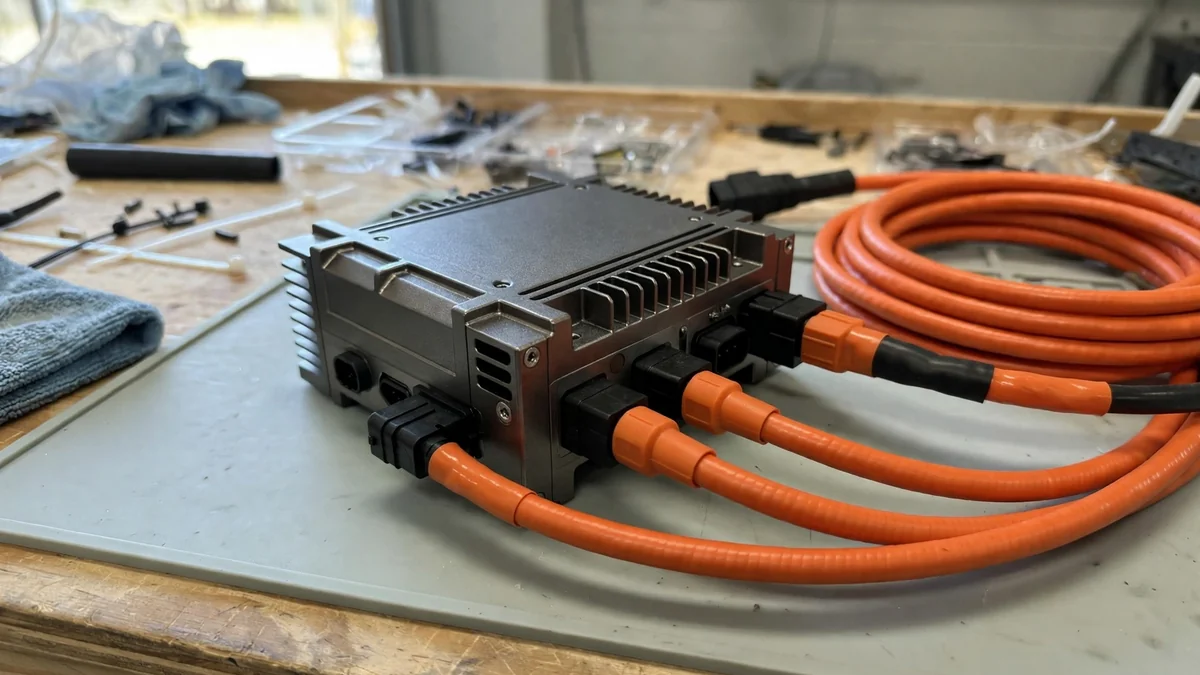
The inverter’s job is translation. The battery stores direct current, a steady one-way flow, and the motor needs alternating current, a flow that switches direction thousands of times a second. The inverter builds it by switching transistors on and off, and every switch wastes a little energy as heat. The less it wastes, the further the car goes and the faster it charges.
Silicon carbide is the material that changed the arithmetic. It lets the transistors switch faster, run hotter, and waste less than the silicon they replaced, and it has quietly become the heart of the best electric drivetrains on the road. This guide explains the numbers on a silicon carbide inverter spec sheet in plain English.
The Numbers That Matter on a Silicon Carbide Inverter
1. Power rating: the ceiling on acceleration
Power rating is measured in kilowatts, and it is the maximum power the inverter can deliver to the motor — typically 150 to 400 kW, and more than 500 kW in the fastest cars. It is the ceiling on acceleration: a motor cannot produce more power than the inverter can feed it. A conventional EV inverter follows the same logic, but a silicon carbide unit passes the same power through a smaller, lighter box.
2. Voltage: 400 volts, 800 volts, and why it matters
Voltage is the electrical pressure the inverter is built for, and modern EVs run at either around 400 volts or around 800 volts. For the same power, doubling the voltage halves the current, which means thinner cables, less heat, and faster charging. Silicon carbide is what makes 800-volt systems practical: its chips can block far higher voltages than silicon without breaking down, giving a comfortable safety margin.
3. Efficiency: the percentage that becomes range
Efficiency is the share of the battery’s energy that reaches the motor, and a silicon carbide inverter typically manages 98 to 99.5 percent, a point or two better than a silicon one. That sounds like almost nothing, but one percent of a 100 kWh battery is a kilowatt-hour, and a kilowatt-hour is several kilometres of driving. Silicon carbide switches with less resistance and loses less energy per switch. The cells that supply that energy are covered in the EV battery cell specs guide.
4. Switching frequency: faster, smoother, quieter
Switching frequency is measured in kilohertz, and it is how many times per second the inverter’s transistors turn on and off to build the alternating current. A silicon inverter typically switches at 10 to 20 kHz; a silicon carbide inverter can switch at 50 kHz or more, and some reach beyond 100 kHz. Higher frequency means smoother power, a quieter motor, and smaller, lighter filters. Silicon carbide loses so little per switch that the trade-off lands in its favour.
5. Junction temperature: how hot the chips can run
Junction temperature is the temperature inside the transistor chip itself, and it is one of silicon carbide’s biggest advantages. A silicon chip is typically limited to around 150 degrees Celsius; a silicon carbide chip can run at 175 degrees or more, with some rated to 200 degrees. That headroom matters most when the driver wants full power — a long climb, a fast-charging stop, or repeated hard acceleration.
6. Power density: kilowatts per kilogram
Power density is the figure engineers compare when they want to know how much inverter you get for the weight and space, measured in kilowatts per kilogram or per litre. A modern silicon carbide inverter reaches roughly 30 to 50 kW per kilogram, about double the density of the silicon units of a decade ago. The motor’s own density story is told in the EV motor winding specs guide.
Silicon Carbide Inverter Specs
| Specification | Typical range |
|---|---|
| Power rating | 150 to 400 kW, 500+ kW in performance cars |
| Voltage | 400 V or 800 V architecture |
| Efficiency | 98 to 99.5% |
| Switching frequency | 50 to 100+ kHz |
| Maximum junction temperature | 175 to 200 °C |
| Coolant temperature | 65 to 85 °C |
| Power density | 30 to 50 kW per kg |
| Cooling | Liquid cooling loop |
| Weight | 8 to 15 kg |
How a Silicon Carbide Inverter Works
The inverter’s job sounds simple — turn direct current into alternating current — but it is choreography performed tens of thousands of times a second.
Step 1: The battery feeds in direct current. High-voltage DC, typically 400 or 800 volts, arrives from the battery through thick orange cables and enters the DC bus, where capacitors smooth out any ripples.
Step 2: The controller reads the driver’s demand. A control board samples the accelerator position, the motor’s speed, and the battery’s state many thousands of times a second, and calculates the exact current the motor needs.
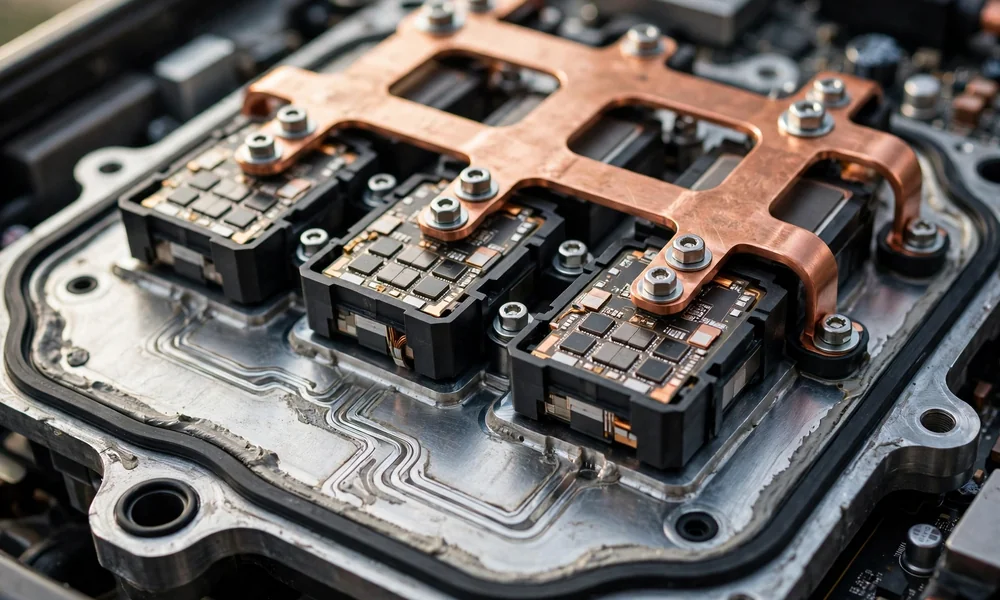
Step 3: The silicon carbide transistors switch. Six or more silicon carbide MOSFETs open and close in a precise sequence, chopping the DC into pulses. Because silicon carbide switches so fast and with so little resistance, the losses stay small.
Step 4: The pulses become a sine wave. Filters and the motor’s own inductance smooth the chopped pulses into a near-perfect three-phase sine wave, the current an AC motor is designed to drink.
Step 5: The motor turns, and braking reverses the flow. When the driver lifts off, the process runs backwards: the motor becomes a generator, the inverter rectifies its AC back into DC, and the energy flows into the battery.
Step 6: The cooling loop keeps it alive. Liquid coolant circulates through a cold plate under the power modules, carrying away the small amount of heat that remains, so the chips stay cool even at full power.
What Does a Silicon Carbide Inverter Cost?
A silicon carbide inverter is estimated at roughly $800 to $2,500 for a mainstream electric car, and $2,500 to $6,000 or more for a high-performance 800-volt unit. The power modules are the most expensive part, estimated at $300 to $1,200, because the silicon carbide wafers they are cut from cost several times more than silicon wafers of the same size. The premium is shrinking as wafer production scales up. All prices are estimates only.
A Rare Fact
Silicon carbide was first made by accident. In 1891, the American inventor Edward Acheson was trying to make artificial diamonds by heating clay and carbon in an electric furnace, and instead he produced glittering blue-black crystals so hard they could cut glass. He sold it as an abrasive, and for a century that is almost all it was used for. It took until the 1990s to grow crystals pure enough for electronics, and twenty more years to make them cheap enough for a car.
The spec sheet is the honest version of the acceleration figure. Power rating tells you the ceiling, voltage tells you how fast it charges, efficiency tells you how much of the battery becomes motion, and switching frequency tells you how quietly it all happens. Silicon carbide does not change what the inverter does; it changes how well it does it.


