Your phone is sitting on the table, screen dark, doing nothing at all — and yet it is working harder than almost anything else you own. Every few milliseconds it listens to the air, checking for a signal from a tower you cannot see, ready to turn an invisible wave into a video call, a message, or a map. The part doing that listening is smaller than your thumbnail, and it is one of the most complicated objects ever built in large numbers. It is the 5G modem chip.
A 5G modem chip does not do one job. It catches radio waves, translates them into numbers, corrects the errors the air itself introduces, and hands clean data to the rest of the phone — then does the whole thing in reverse when you send something back. This is how that tiny chip pulls it off, step by step.

How a 5G Modem Chip Works
Step 1: The antenna catches a whisper
Everything starts at the antenna, a strip of metal printed into the edge of the phone or built into its frame. A 5G tower broadcasts radio waves in every direction, and by the time they reach your phone they are unimaginably faint — a billion times weaker than when they left the tower. The antenna’s job is to catch that whisper. It does not understand anything it catches; it only turns the passing wave into a tiny flickering voltage and passes it on.
Step 2: The radio front end cleans and boosts the signal
That faint voltage first reaches the radio front end, a cluster of amplifiers and filters between the antenna and the modem. A low-noise amplifier boosts the signal without adding much of its own hiss, because any noise added here can never be removed later. Filters strip away everything that is not the wanted channel, leaving a narrow slice of spectrum. The way the whole chip is built to survive this abuse is covered in how a 5G modem chip is made, where the silicon, the packaging and the testing are each pushed to the edge of what is possible.
Step 3: Downconversion turns radio into baseband
Radio waves at 5G frequencies oscillate billions of times a second, far too fast for a digital chip to count directly. So the modem mixes the signal down to a much lower frequency, a process called downconversion. A local oscillator inside the chip generates a steady reference tone, and a mixer combines it with the incoming signal to produce a slower copy carrying exactly the same information. This slower copy is the baseband signal — the bridge between the analogue world of waves and the digital world of ones and zeros.
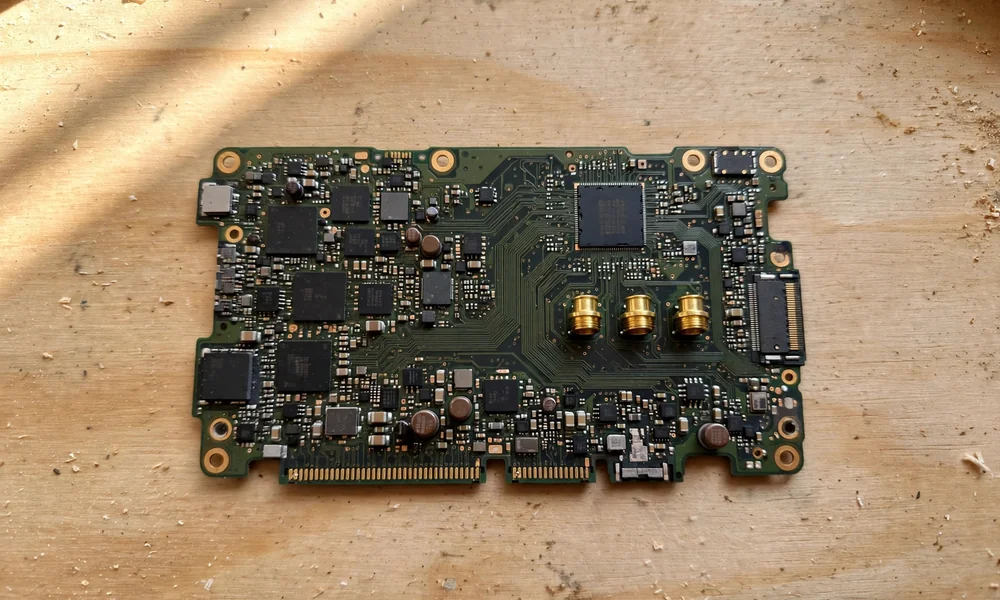
Step 4: The analogue-to-digital converter takes a snapshot
Next the baseband signal meets the analogue-to-digital converter, or ADC. Millions of times a second, the ADC measures the height of the wave and writes the measurement down as a number. Those numbers are the first truly digital form of your data. The converter must be both fast and precise, or the numbers it writes down are wrong. In a 5G modem it runs at gigahertz speeds while drawing only milliwatts, a balance that takes years of design work to achieve. From here on, everything is arithmetic.
Step 5: The digital signal processor decodes the data
The stream of numbers flows into the digital signal processor, the modem’s number-crunching heart. Here the chip unpicks the modulation scheme — the pattern of wave shapes the tower used to encode bits — and turns it back into ones and zeros. 5G uses dense modulation, packing as many as ten bits into a single symbol, so the processor must distinguish between more than a thousand subtly different wave shapes. It also untangles MIMO, where several antennas send different streams at once on the same frequency. This is the heaviest maths in the phone, and it runs continuously on a chip the size of a fingernail.
Step 6: Error correction repairs the damage
The air is a hostile place for data. Walls reflect signals, rain absorbs them, and other phones crowd the same airwaves. So the tower does not send raw data: it sends data wrapped in error-correcting codes, extra bits that let the receiver spot mistakes and fix them. The modem’s decoder checks every block, and when a few bits arrive scrambled — as they always do — it works out what they should have been and repairs them. The materials that make this precision possible are explained in the materials engineering of the 5G modem chip, from the silicon to the packaging that keeps it cool.
Step 7: The data reaches your apps — and the trip reverses
Finally the clean, checked data is handed to the phone’s application processor, which turns it into the video, the message or the web page you actually see. But the modem’s work is two-way. When you send a photo or speak on a call, the whole chain runs in reverse: your data is coded, modulated, converted from digital back to analogue, mixed up to radio frequency, amplified, and pushed out of the antenna toward the tower. If the signal weakens, the modem asks the tower for a slower, sturdier modulation, trading speed for reliability so the connection never simply dies.
5G Modem Chip Specifications
| Specification | Typical figure |
|---|---|
| Manufacturing process | 4 nm class silicon |
| Frequency bands | Sub-6 GHz and millimetre-wave |
| Peak download speed | Up to around 10 Gbps (theoretical) |
| MIMO support | 4×4 MIMO, massive MIMO |
| Modulation | Up to 1024-QAM |
| Power draw | Milliwatts at idle, a few watts at peak |
How Much Does a 5G Modem Chip Cost?
There is no shop price for a modem chip, because they are sold in bulk to phone makers, not to the public. Industry estimates put a flagship 5G modem at roughly $40 to $90 per unit in volume, depending on the model, the bands it supports and the order size — these are estimates, not list prices. The full story is in why the 5G modem chip is so expensive, from the cost of the fab to the years of testing behind every unit.
A Rare Fact About the 5G Modem Chip
Here is something few people realise: your phone’s modem is constantly talking to the tower even when you are doing nothing at all. Every few milliseconds it measures the signal, reports back on its quality, and negotiates which band and beam it should use next. In millimetre-wave 5G, the tower forms a narrow beam of radio aimed directly at your phone, and the modem must track that beam as you walk, turn, or put the phone in your pocket — a conversation held in radio, thousands of times a second, by a chip you will never see.
So the next time a video starts instantly on a train, remember what is happening inside the glass in your hand: an antenna catching a whisper, a front end cleaning it, a mixer slowing it down, a converter numbering it, a processor decoding it, and a decoder repairing it — all in the blink of an eye, a thousand times a second.


