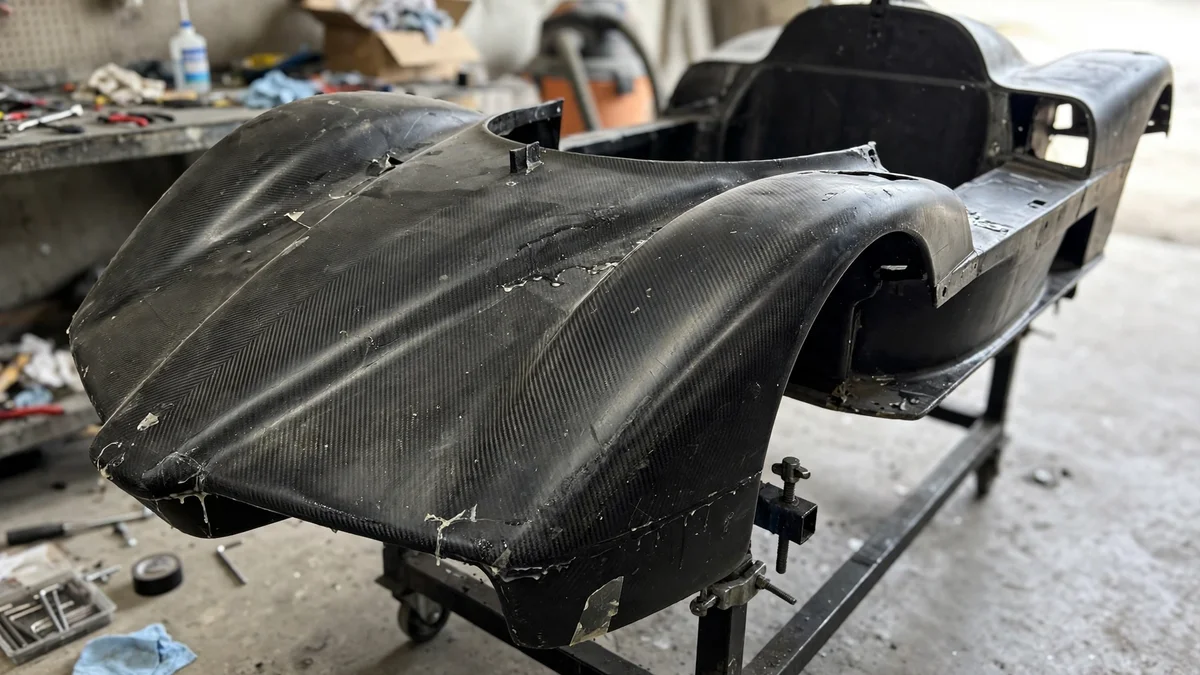
Take the body off a hypercar and you are left with something that looks less like a car and more like a black bathtub with wheels. That is the chassis, the skeleton everything else hangs from, and it is the single most important part of the car. It carries the engine, the suspension, the driver, and the fuel, and it has to do it while weighing less than a grown man.
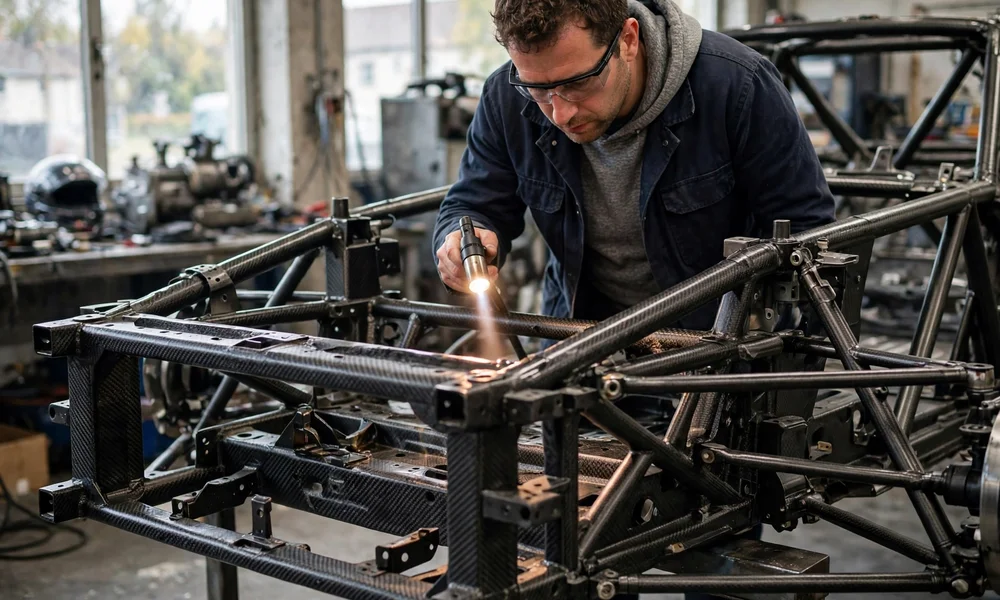
Most hypercar chassis are built from carbon fibre, a material made of threads thinner than hair, woven into cloth and glued together with resin. The result is stronger than steel at a fraction of the weight, but it is also unforgiving: it must be laid up by hand, baked in a giant oven, and checked for flaws no eye can see. Here is how a hypercar chassis works, step by step.
How a Hypercar Chassis Works
Step 1: The monocoque carries everything
At the heart of a hypercar chassis is the monocoque, a single rigid tub that wraps around the driver like a shell. Unlike an old-fashioned car, which bolts its body onto a separate frame, a hypercar has no separate frame at all: the tub is the frame, the floor, and the safety cell in one piece. The engine bolts to the back of it, the suspension bolts to its corners, and the driver sits inside it, protected on all sides. Because everything is one piece, there are no joints to flex, and the car responds to the steering instantly. The same idea rules Formula 1, where the survival cell is the heart of the car, as explained in how a Formula 1 monocoque works.
Step 2: Carbon fibre gives strength without weight
The tub is made from carbon fibre, and the numbers explain why. A carbon fibre panel can be five times stronger than steel at the same weight, and it is far stiffer, which means it bends less under load. That stiffness is what makes a hypercar feel so precise: when the suspension pushes on the chassis, the chassis does not bend, so all of the movement goes into the springs and dampers where it belongs.
Step 3: The tub is laid up by hand
Building the tub starts with sheets of carbon fibre cloth, called prepreg, which arrive already soaked in resin and kept cold until they are used. Skilled workers cut the cloth into patterns and lay it into a mould, layer by layer, sometimes hundreds of layers thick in the places that take the most load. Each layer is placed at a different angle so the finished tub is strong in every direction, and every layer is rolled flat to push out air bubbles that would become weak spots.

Step 4: The autoclave bakes it solid
Once the layers are in the mould, the whole thing goes into an autoclave, a giant pressurised oven. Inside, the temperature climbs to around 120 to 180 degrees Celsius while the pressure squeezes the layers together, forcing the resin to flow into every gap and bond the fibres into one solid piece. The bake can last for hours, and the temperature is raised and lowered on a precise schedule, because heating too fast traps bubbles and cooling too fast leaves stresses inside the part.
Step 5: The suspension bolts straight to the tub
The suspension has nowhere else to go, so it bolts directly to the carbon tub through metal inserts that were baked into the layers during lay-up. These inserts spread the enormous loads from the wheels across a wide area of carbon, because a single bolt pulling on bare carbon fibre would tear straight through it. The front suspension usually mounts to the nose of the tub and the rear suspension to the engine cradle behind it, and the geometry of those mounting points decides how the car handles. Getting them right is a job for the same engineers who design the suspension itself, covered in how a hypercar suspension works.
Step 6: Crash structures absorb the impact
A stiff tub is only half of crash safety. In front of and behind the tub sit crash structures, carefully designed boxes of carbon fibre and aluminium that are meant to be destroyed. In a heavy impact they crush progressively, turning the energy of the crash into broken fibres and heat over a distance of half a metre or more, so the driver inside the tub feels a survivable deceleration rather than a sudden stop. The tub itself is built to stay intact, and the seat, the belts, and the headrest are all mounted to it so they move with the driver rather than against them.
Step 7: The bodywork shapes the air around it
The chassis does not work alone. The body panels that bolt onto it are shaped to manage the air, and the tub itself forms the floor of the car, where carefully shaped tunnels speed the air underneath and suck the car onto the road. The stiffness of the tub matters here too, because the aerodynamic loads at 200 miles per hour are enormous, and a flexing floor would change the shape of those tunnels and cost the car grip. The bodywork and the chassis are therefore designed together, not one after the other, as described in how a hypercar aerodynamic body works. When the two work as one, the chassis is invisible to the driver, and that is exactly the point.
Hypercar Chassis Specs
| Specification | Typical figure |
|---|---|
| Construction | Carbon fibre monocoque tub |
| Tub weight | Roughly 70 to 100 kilograms |
| Torsional stiffness | Around 30,000 to 50,000 Nm per degree |
| Autoclave cure | Around 120 to 180 degrees Celsius under pressure |
| Crash structures | Carbon fibre and aluminium, front and rear |
| Suspension mounting | Metal inserts baked into the carbon layers |
| Typical build time | Several days of hand lay-up per tub |
What a Hypercar Chassis Costs
A single carbon fibre monocoque tub for a hypercar is estimated to cost the maker roughly 150,000 to 300,000 dollars, though the exact figure is an estimate and varies with the size of the car, the number of layers, and how much of the work is done by hand. That is more than most family cars cost in total, and it is one of the reasons hypercars cost what they do. The moulds alone cost hundreds of thousands of dollars to make, and they are used for only a small number of cars, so every tub carries a share of that cost too.
A Rare Fact About the Hypercar Chassis
Here is a detail most drivers never hear: a hypercar chassis is so stiff that engineers measure its flex in fractions of a degree, and a tub that twists by just one degree under full cornering load would be considered a failure. Yet that same tub is designed to be destroyed in a crash, shattering in a controlled way that eats up energy. It is a strange double life, rigid as a diamond in normal driving and deliberately fragile in an accident, and it is the reason hypercar drivers can walk away from crashes that would have been unsurvivable in a normal car. The tub protects the driver by being both the strongest and the most expendable part of the car at once.


