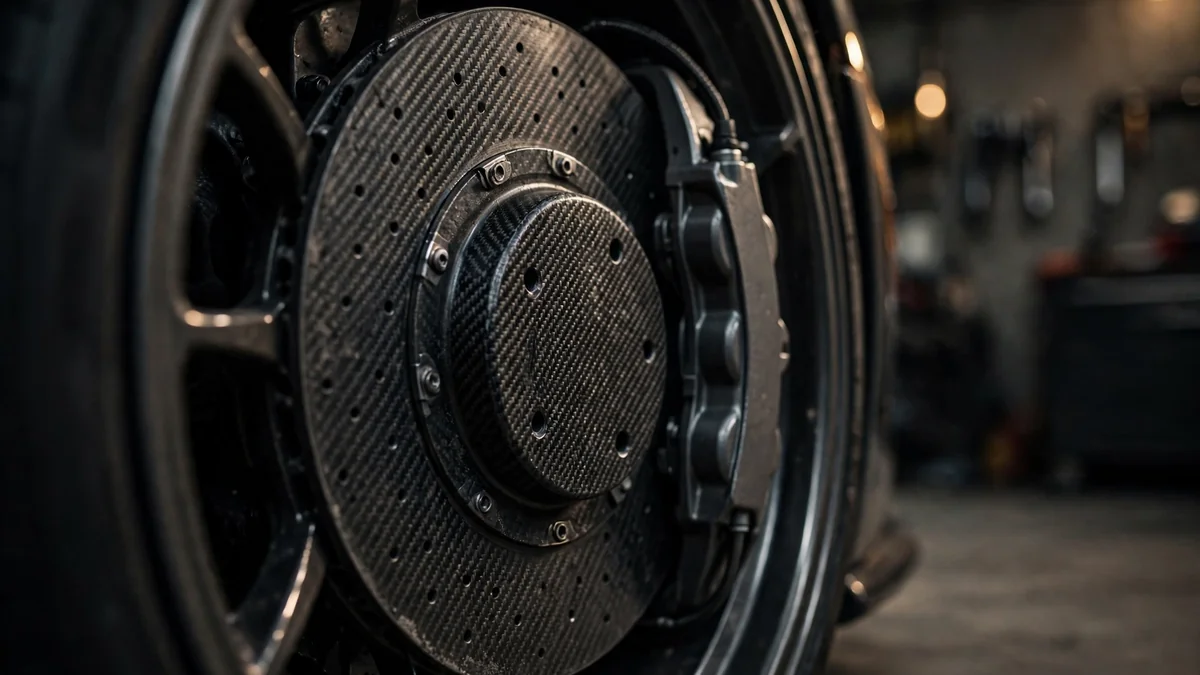
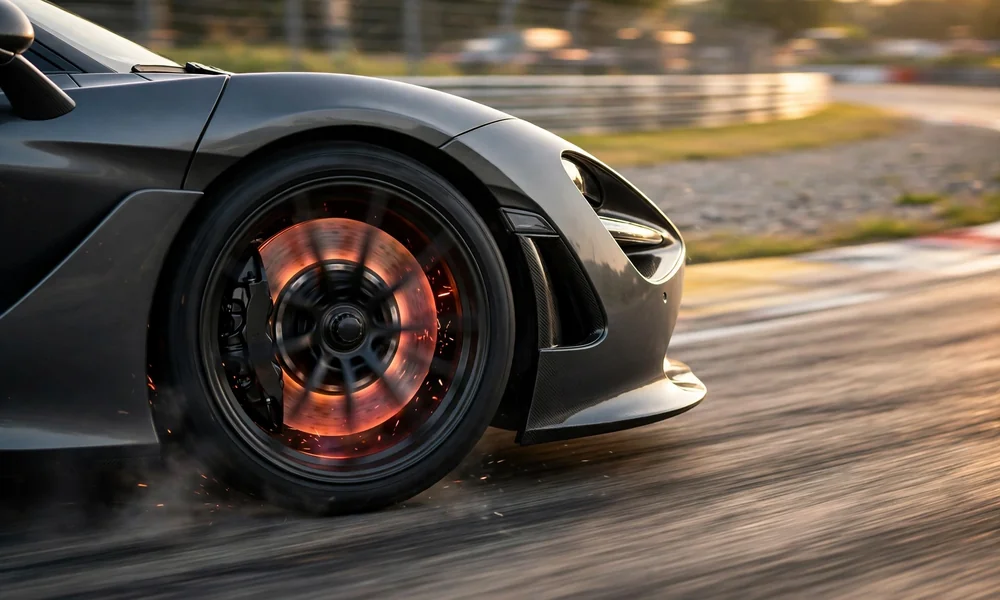
There is a moment on every fast lap when the driver stops trusting the engine and starts trusting the brakes. The car is doing 300 kilometres per hour, the corner is a wall of noise and colour, and the only thing between speed and disaster is a disc of black, woven material that glows orange with heat and refuses to fade. That disc is carbon-ceramic, and it is the most extreme brake ever fitted to a road car.
A normal brake disc is cast iron. It is heavy, it rusts, and when it gets hot — really hot, the way it does on a mountain descent or a racetrack — it starts to lose its grip. Engineers call that fade, and fade is what carbon-ceramic was invented to kill. A carbon-ceramic disc barely notices temperatures that would warp a steel disc. It is lighter, it lasts far longer, and it keeps stopping, lap after lap, with the same firm pedal.
The catch is the making of it. A carbon-ceramic brake disc takes weeks to produce, passes through furnaces hotter than a volcano’s throat, and costs more than some entire cars. This is how it is made — and why it costs what it does.
How It’s Made
Step 1: Weaving the carbon fibre
It starts as cloth — not metal, but carbon fibre fabric, woven from threads of pure carbon. Workers layer the cloth into a disc-shaped mould, stacking sheet upon sheet until the preform is thick enough to become a brake rotor. The weave matters: it gives the finished disc its strength in every direction, and it is the same family of material thinking that shapes a car’s structure, where carbon monocoque production turns woven fibre into a chassis stronger than steel at a fraction of the weight.
Step 2: Baking the carbon core
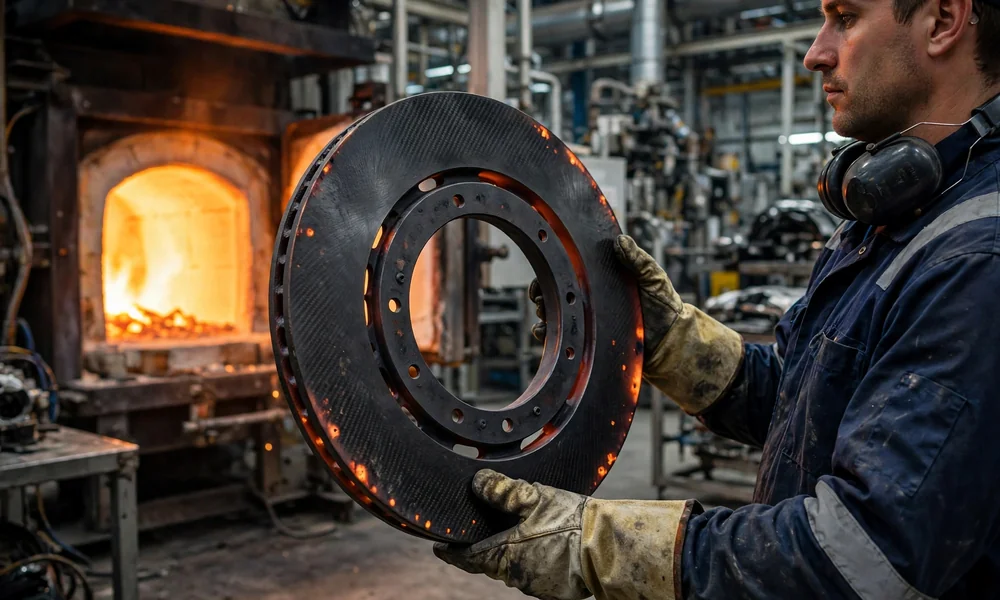
The layered preform is placed in a furnace and heated in an oxygen-free atmosphere. This process, called carbonisation, burns away everything that is not carbon and fuses the fibres into a solid, porous carbon disc. The temperature climbs past 1,000 degrees Celsius, and the disc shrinks as it transforms. What comes out is a rough, dark ring — light, brittle, and still a long way from a brake.
Step 3: Silicon infiltration
Here is the step that makes it ceramic. The carbon disc is heated again, this time with silicon, at temperatures approaching 1,700 degrees Celsius. The molten silicon seeps into the pores of the carbon and reacts with it, forming silicon carbide — a ceramic as hard as it is heat-resistant. The disc is now a true composite: carbon fibre for toughness, silicon carbide ceramic for heat and wear resistance. This is the moment a pile of cloth becomes a brake that can survive glowing red-hot.
Step 4: Machining and drilling
The siliconised disc is brutally hard, so machining it takes diamond-tipped tools and patience. The friction surface is ground flat to within a hair’s breadth, cooling holes and slots are drilled to vent gas and dust, and the centre — the bell that bolts the disc to the wheel hub — is fitted, usually in aluminium to save weight. Every hole is chamfered by hand, because a sharp edge in a ceramic disc is a crack waiting to happen. The precision here is the same discipline that shapes a hypercar’s bodywork, where active aerodynamics depends on parts made to tolerances no eye can see.
Step 5: Balancing and inspection
A brake disc spins at wheel speed, so an imbalance of even a few grams would shake the car at high speed. Each disc is spin-balanced, then inspected with X-rays and ultrasound to find hidden cracks or voids inside the ceramic. A disc that fails is scrapped outright — there is no repairing a carbon-ceramic rotor. The surviving discs are weighed and matched in pairs, so the left and right brakes on a car behave identically.
Step 6: Fitting the pads and calipers
The disc is only half the system. Carbon-ceramic discs run with special pads, and the calipers that squeeze them are often huge — six-piston monobloc units machined from a single block of aluminium. The pads, calipers, and discs are matched as a set, then the whole system is bedded in on a test rig, where it is heated and cooled in cycles to settle the friction surfaces. Heat management is critical here, just as it is everywhere in a performance car: the engineers who plan cooling for sustained performance treat the brakes as one of the hottest parts of the whole machine.
Specs
| Specification | Typical value |
|---|---|
| Disc diameter | 390–410 mm (front, hypercar) |
| Disc weight | About 6–7 kg, vs about 12 kg for steel |
| Main materials | Carbon fibre, silicon carbide ceramic |
| Peak operating temperature | Up to around 1,000°C |
| Manufacturing temperature | About 1,700°C during silicon infiltration |
| Typical lifespan | 150,000–200,000 km in road use |
| Production time per disc | Up to around 3 weeks |
What Does It Cost?
As a factory option on a supercar, carbon-ceramic brakes typically add an estimated $8,000–$20,000 to the price, depending on the car — and on some hypercars they cost far more. A full replacement set of discs and pads can be estimated at $15,000 or more, which is why the title of this article is only a small exaggeration: the brakes on a top hypercar can genuinely cost more than a decent used car. Those figures are estimates, and they vary by brand and model, but they explain why this technology stays in the world of supercars and racing. The consolation is longevity: in normal road use, a carbon-ceramic disc can outlast the car it is fitted to, while a steel disc might be replaced several times over the same distance.
A Rare Fact
Carbon brakes were not invented for road cars at all. They were first developed for aircraft — Concorde, the supersonic airliner, used carbon brakes to stop from landing speeds no other airliner faced — and from there they spread to Formula 1, then to the fastest road cars on Earth. There is one quirk that still surprises new owners: carbon-ceramic brakes can feel weak when they are cold. They need heat to work at their best, so the first stop on a frosty morning can feel oddly soft — the opposite of what you would expect from the most expensive brakes money can buy.


