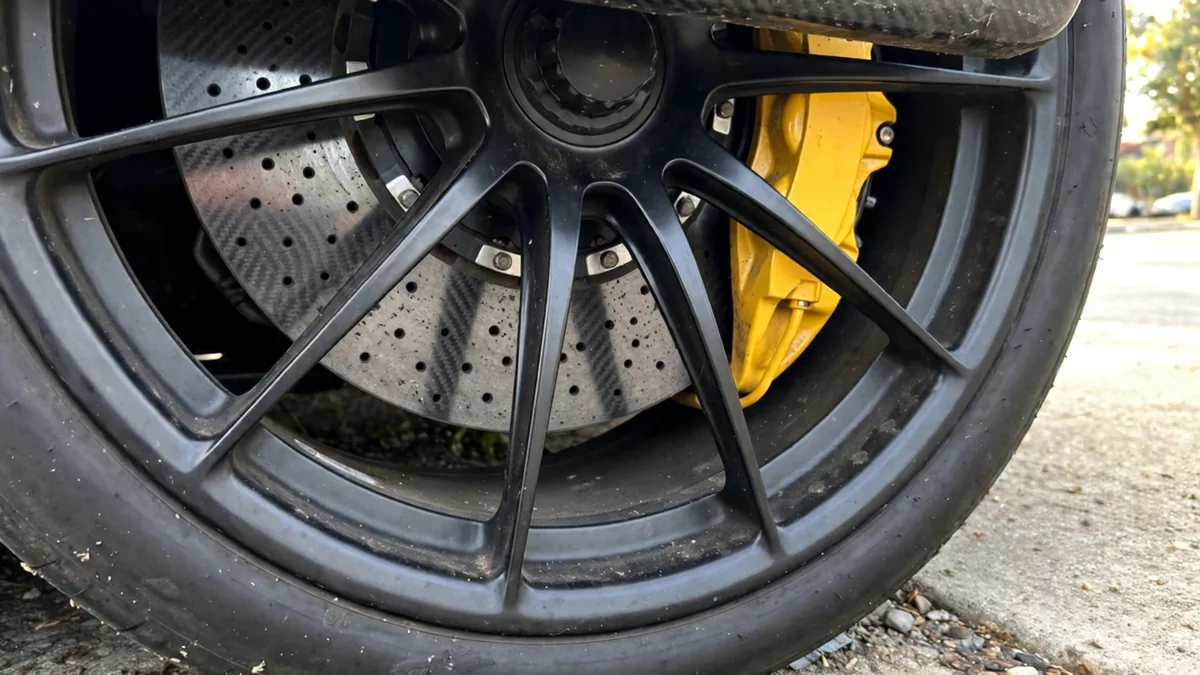
Stand next to a hypercar at a standstill and look through the wheel, and the brake disc behind it does not look like a brake disc. It is a carbon-ceramic disc, and it is the reason a car that can reach 200 miles per hour can also stop from that speed, lap after lap, without its brakes giving up.
Every brake is a machine for turning speed into heat. Press the pedal, the pads squeeze the disc, friction slows the wheel, and the kinetic energy of a moving car becomes thermal energy in the disc. The problem is what happens next: the disc has to get rid of that heat before the next corner, and if it cannot, the brakes fade, the pedal goes soft, and the car stops less for the same push.
How Hypercar Carbon-Ceramic Brakes Work
1. The disc: carbon fibre locked in silicon carbide
It is a ceramic matrix composite, a material engineers call C/SiC, carbon-fibre-reinforced silicon carbide. The porous carbon that remains is then infiltrated with liquid silicon, which reacts to form silicon carbide, a ceramic so hard it rates 9 to 9.5 on the Mohs scale, just below diamond. A carbon-ceramic rotor weighs roughly half as much as a cast-iron rotor of the same size, typically 8 to 9 kilograms for a front disc against 15 or more for iron, and that weight saving is unsprung weight, the weight the suspension has to control, so it improves handling as well as braking. The making of the disc takes weeks of high-temperature processing, which is why a set costs as much as a used car, and the steps of that long manufacturing process are laid out in the guide to how carbon-ceramic brakes are made, from the fibre preform to the finished disc.
2. The friction pair: pads, grip and the coefficient that matters
A disc does nothing on its own. It needs pads, and the pad and the disc together are the friction pair, the two surfaces whose grip decides how hard the car can stop. The coefficient of friction is the number that describes that grip: a cast-iron disc with ordinary pads manages about 0.35 to 0.45, while a carbon-ceramic disc with its matched pads holds 0.6 or higher once it is warm. But the more important difference is what happens as the temperature climbs: an iron disc and its pads lose grip as they overheat, the pad material glazes, the disc warps, and the pedal has to travel further for the same result. A carbon-ceramic disc keeps its friction almost flat across a huge temperature range, working from cold on a morning drive and still gripping at 1,000 degrees Celsius, with peak tolerance above 1,200 degrees, after repeated stops from high speed.
3. The caliper and the hydraulics: turning a foot into tonnes of force
The pads are held by the caliper, a rigid aluminium or titanium clamp that sits over the edge of the disc and does not rotate with it. Inside the caliper are pistons, usually four or six, sometimes more on a hypercar, and when the driver presses the pedal, a master cylinder pushes brake fluid through steel lines to those pistons, which squeeze the pads against both faces of the disc. The caliper must be stiff, because any flex wastes pedal travel and makes the pedal feel vague, so hypercar calipers are machined from a single billet of aluminium and braced against the suspension upright.

4. Heat: soaking it up, shedding it, and surviving it
Heat is the whole story of braking. A hypercar braking from 200 miles per hour must dispose of tens of megajoules of energy in a few seconds, and the disc is the heat sponge that soaks it up. A carbon-ceramic disc does this better than iron for two reasons. First, the ceramic matrix absorbs thermal energy into its crystalline structure without expanding at the same rate as metal, so it resists warping and cracking even after repeated thermal shock, the violent heating and cooling of a lap. There is a limit, and it is worth knowing: carbon-ceramic discs can be damaged by a single severe thermal shock, such as a cold disc being hammered from very high speed on a track, and a cracked disc cannot be repaired, only replaced, at a cost that makes owners wince.
5. Cold bite, squeal and the daily compromises
Carbon-ceramic brakes have a reputation for being poor when cold, and the reputation comes from their racing cousins. Pure carbon-carbon discs, the kind used in Formula 1, do not begin to work properly until they are very hot, which is fine at a Grand Prix and useless on a cold morning. Carbon-ceramic discs were developed to fix exactly that: they work from cold, and a hypercar can be driven out of a garage on a winter morning with brakes that feel normal. And they are expensive in a way that changes how the car is owned: a replacement set of discs and pads can cost 8,000 to 20,000 dollars, and a stone chip or a kerb strike can crack a disc that would only have scratched an iron one. Carmakers accept these compromises because the benefits are so large on the cars that carry them: less unsprung weight, no fade, and a pedal that feels the same on lap twenty as it did on lap one. The suspension that has to manage those lighter, harder-braking wheels is part of the same system, and the way it is engineered to keep the tyre pressed to the road under braking is covered in the guide to how hypercar suspension works.

6. Where the technology came from, and where it sits in the car
Carbon-ceramic brakes arrived in road cars from motorsport, and their history explains their character. Racing carbon brakes were developed for aircraft and then for Formula 1, where stopping from 200 miles per hour twenty times a lap is the job description. The road version keeps the lightness and the heat tolerance, and adds the cold performance and the durability that a road car needs. They sit inside wheels that are themselves engineered around them: the wheel must clear a disc that can be 420 millimetres across, the cooling ducts must feed it, and the suspension must be tuned for the lower unsprung weight. The turbocharged engine that gives the car its speed and the brakes that take it away are two halves of the same performance equation, and the way the forced-induction side of that equation is built is covered in the guide to hypercar turbocharger specifications.
The result is a brake that does not feel like a compromise. It stops the car, lap after lap, with the same short, firm pedal, and it does it while weighing half as much as the iron disc it replaced and lasting several times longer. But for a car whose whole purpose is to go very fast and then stop, again and again, there is still nothing better.


