Open the floor of a modern electric car and you will find a flat slab of battery, and in a growing share of those cars the chemistry inside that slab is lithium iron phosphate, LFP for short. It is not the most powerful battery chemistry, and it is not the newest. It is the one that carmakers keep coming back to because it is cheap, it lasts an extraordinarily long time, and it is very hard to set on fire.
Here is what an LFP battery is, how it works inside an electric car, and where it wins and where it gives ground.
What a Lithium Iron Phosphate EV Battery Is
1. The chemistry: iron, phosphate and a very stable crystal
A lithium-ion battery works by shuttling lithium ions back and forth between two electrodes. When the battery charges, ions move from the cathode to the anode, a graphite electrode, and park themselves in its layers; when it discharges, they travel back, and the flow of electrons through the outside circuit is the power that turns the motor. In an LFP cell the cathode is lithium iron phosphate, a material whose crystal structure is called olivine: the iron and phosphorus atoms lock into a tight framework that barely changes shape as lithium ions move in and out. The chemistry also contains no nickel and no cobalt, two metals that are expensive and supply-constrained, while iron and phosphate are abundant and cheap, and that is the foundation of the LFP cost advantage.
2. The numbers: energy, voltage and what they mean on the road
Energy density is the headline number for any electric car battery, and it is the one place LFP concedes ground. A typical LFP cell stores roughly 95 to 170 watt-hours per kilogram, and the newest cells from makers such as CATL reach about 205 watt-hours per kilogram, while a high-nickel NMC cell can exceed 300. But the gap has narrowed, and it is partly offset by a quirk of the chemistry: an LFP battery can be charged to 100 percent every day without harm, while an NMC battery is usually kept to 80 percent to protect its life, so the usable range of the two is closer than the headline numbers suggest. The cell’s own numbers are set out in the guide to EV battery cell specifications.
3. Why it lasts: cycle life and calendar life
Cycle life is LFP’s strongest card. A cycle is one full charge and discharge, and a typical LFP cell is rated for 2,500 to 9,000 cycles before its capacity falls to 80 percent, with many cells lasting far beyond that under gentle conditions. An NMC cell in the same test typically manages a few hundred to a few thousand, so for a car, that difference is the difference between a battery that outlasts the vehicle and one that becomes a resale worry. The reasons are the stable crystal already described, plus the fact that the cathode does not shed metal ions into the electrolyte the way nickel-rich materials do. The practical result is that carmakers can offer long warranties on LFP cars with confidence, and fleet operators, who run their vehicles hard every day, have been among the earliest adopters.

4. Why it is safer: heat, stability and thermal runaway
The other great advantage of LFP is thermal and chemical stability, which is the polite way of saying it is much harder to make burn. Every lithium-ion battery can, if badly damaged or badly charged, go into thermal runaway, a chain reaction where one overheating cell heats its neighbours until the whole pack is involved. In LFP the phosphate-oxygen bond in the cathode is extremely strong, so the material does not release oxygen when it gets hot, and without free oxygen the fire cannot feed itself. In laboratory heating tests, an LFP cell went into thermal runaway at around 195 degrees Celsius, against about 170 for an NMC cell, and once it did, its temperature rose far less. Solid-state batteries promise even better safety, but they are still a laboratory and pilot-line technology, while LFP is shipping in millions of cars today, as the guide to how a solid-state battery is made explains in the manufacturing challenges that still stand in the way.
5. Charging: fast, full, and cold-sensitive
An LFP battery charges quickly, and it likes being filled up. Because the chemistry tolerates full charges, owners are told to charge to 100 percent regularly, which also lets the battery management system balance the cells, a job that can only be done near the top of the charge. The cells accept high charging currents without the rapid degradation that a high-nickel cell would suffer, so many LFP cars can hold high fast-charging speeds for longer. The weak spot is the cold: at low temperatures the lithium ions move sluggishly through the cathode, the internal resistance climbs, and charging too fast can plate metallic lithium onto the anode, permanently reducing capacity. Carmakers deal with this by heating the pack before and during charging in winter, which costs some energy but protects the battery.
6. Inside the pack: cells, modules and the management system
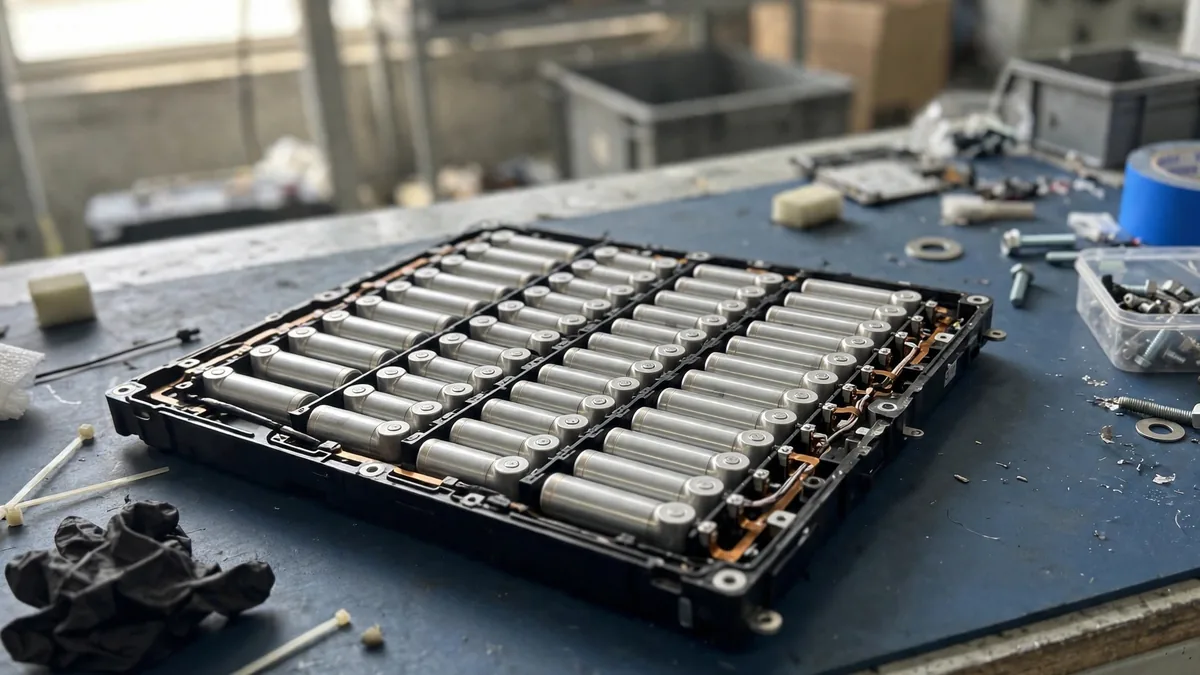
An LFP cell on its own is a small thing, a pouch or a cylinder or a prismatic can holding a few amp-hours. A car pack assembles hundreds or thousands of them into modules, and the modules into a pack, with cooling plates, busbars, fuses and sensors woven through. BYD’s Blade Battery is the most famous variation: long, thin LFP cells laid flat and used as structural members of the pack itself, so the pack becomes part of the car’s floor and crash structure, and the space that would have been wasted on module housings goes to more cells instead. The pack also has to be built to survive a crash, a flood and a decade of vibration, and the steel or aluminium case, the seals and the crash structure around it are as much a part of the battery as the cells. The way a pack is assembled, cell by cell into a finished unit, follows the same logic as any large battery build, and the steps of putting those cells together are laid out in the guide to how an EV battery pack is made, from the first cell to the sealed, tested pack.

That is the shape of the LFP story: a battery built from cheap, abundant materials, arranged in a crystal that barely moves, holding less energy per kilogram than its rivals but keeping what it holds for far longer, and staying calm when other chemistries would not. The newest cells keep closing the range gap, with energy density climbing from about 180 to 205 watt-hours per kilogram in the latest generation, without a rise in cost. It is the battery for the cars that need to be affordable, durable and safe, which turns out to be most of them.