Put a normal piece of ceramic in a furnace and it does what ceramics have always done: it cracks. Heat it fast, cool it fast, and the brittle material shatters along invisible fault lines. That is why, for most of history, ceramics were for cups and tiles, not for machines that live inside fire. Ceramic matrix composites changed the rule. They take the heat resistance of a ceramic and weave a skeleton of fibres through it, so that when a crack starts, it meets a fibre, bends, and stops. The result is a material that can sit in temperatures that melt aluminium and soften steel, yet still carry a load.
You have probably met one without knowing it. The brake disc of a supercar, glowing orange at the end of a long straight, is a ceramic matrix composite. So are the heat shields that protect spacecraft on re-entry, the turbine parts inside the newest jet engines, and the clutch plates of racing cars.

How It Works
Step 1: Weaving the fibre skeleton
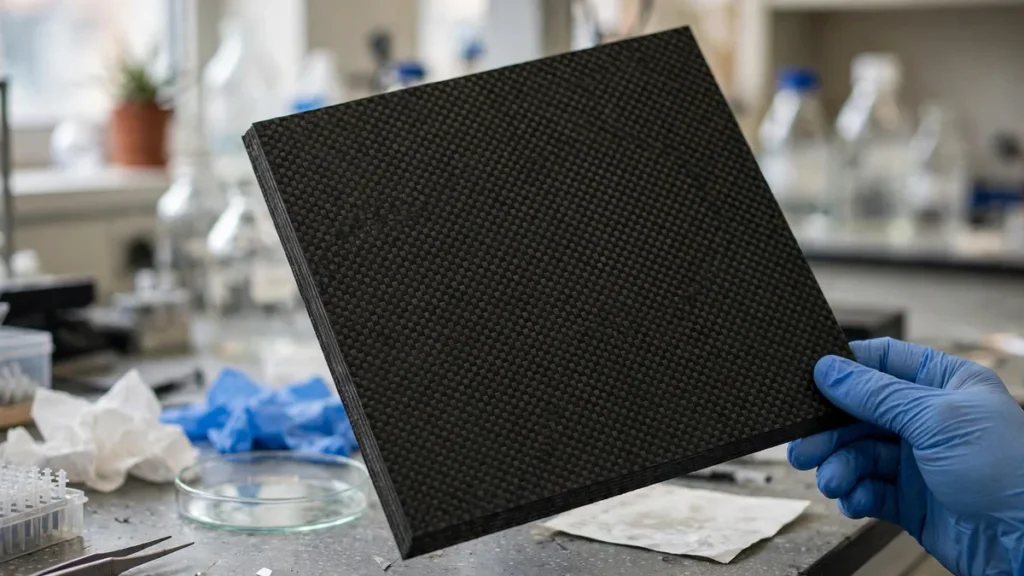
Every ceramic matrix composite starts as cloth. Fine fibres of silicon carbide or carbon, each thinner than a human hair, are woven into sheets on looms much like the ones that make fabric. The weave matters enormously: a plain weave gives strength in two directions, while a three-dimensional weave locks the layers together so the finished part cannot peel apart. The sheets are cut to shape and stacked, layer upon layer, into a preform — a soft, flexible version of the final part that can still be bent and trimmed. At this stage the material is closer to a sweater than to a brake disc, and it can be handled with bare hands.
Step 2: Holding the fibres apart
Before the ceramic arrives, the fibres get a whisper-thin coating, usually of carbon or boron nitride. This coating is the secret of the whole material. Without it, the ceramic would grip the fibres so tightly that a crack would snap straight through both, and the composite would be as brittle as a tile. With it, the fibres can slip a fraction of a millimetre inside the ceramic when a crack passes, soaking up the energy and stopping the crack in its tracks.
Step 3: Filling the gaps with ceramic
Now the preform goes into a furnace, and the ceramic matrix is grown around the fibres rather than poured over them. In the most common method, a gas containing silicon and carbon is pumped through the hot preform, and silicon carbide slowly deposits onto every surface, filling the spaces between the fibres over days or even weeks. In another method, the preform is soaked in a liquid resin that is then baked until it turns to ceramic, and the soaking is repeated until the pores are full. Either way, the part emerges as a single solid piece: hard, dark, and surprisingly light. Carbon fibre curing follows a related logic, using heat and pressure to turn a soft lay-up into a rigid structure.
Step 4: Firing it hotter than it will ever work
The part is then fired at temperatures above anything it will meet in service — often beyond 1,000°C. This final bake finishes the ceramic, locks the fibres in place, and burns away anything left over from the earlier steps. The firing shrinks the part slightly, so the moulds and the preform are made oversized to compensate.

Step 5: Machining the impossible
A finished ceramic matrix composite is harder than most cutting tools, so machining it is a slow and expensive business. Diamond-coated tools grind away material a fraction of a millimetre at a time, and cooling fluid is sprayed constantly to stop the part cracking from the heat of cutting. Holes for bolts are usually formed during the weaving stage rather than drilled afterwards, because drilling through the fibre layers can cause delamination. This is why parts are designed, from the very first sketch, to need as little machining as possible. The lessons of machining difficult materials like titanium apply here too, only more so.
Step 6: Testing to destruction
Before a ceramic matrix composite part goes into service, it is tested in ways that would destroy almost anything else. Samples are heated white-hot and plunged into cold water, loaded until they bend, and vibrated for thousands of hours. Engineers listen for the tiny cracking sounds that reveal how the fibres are sharing the load, and X-ray scans check for hidden voids inside the ceramic. A brake disc that passes will stop a car from high speed again and again without fading; a turbine part that passes will spin inside a jet engine at temperatures that would melt its metal predecessor. The same obsession with a structure that must not fail drives carbon monocoque production, where a single shell has to protect a driver at racing speed.
At a Glance
| Specification | Detail |
|---|---|
| Typical fibres | Silicon carbide or carbon |
| Matrix material | Silicon carbide ceramic |
| Working temperature | Up to around 1,200°C, depending on type |
| Density | Roughly 2.0–2.5 g/cm³, about a third of steel |
| Key strength | Heat resistance plus crack tolerance |
| Main weakness | Expensive to make, hard to machine |
| Where you find it | Brakes, jet engines, spacecraft heat shields |
What Does It Cost?
Ceramic matrix composites are among the most expensive structural materials in regular use. A set of ceramic composite brake discs for a high-performance road car is typically an option priced at roughly $8,000–$15,000, and a full replacement set can cost far more once labour is included (estimate). The raw materials are not the problem — it is the time: growing the ceramic matrix can take weeks in a furnace, and every part must be machined with diamond tooling and inspected in detail. In jet engines the cost is justified because the material lets turbines run hotter, and a hotter turbine burns less fuel on every flight. As production volumes rise, prices are falling, but a composite part will always cost far more than the metal part it replaces.
A Rare Fact
The heat shield of a returning spacecraft is a ceramic matrix composite that works by design in a way that sounds like failure: its surface is meant to crack. When the shield hits the atmosphere at many times the speed of sound, tiny cracks spread through the ceramic — and the fibres inside bridge each crack, holding the shield together while the heat is carried away. A material that was invented to stop cracks is, at the edge of space, used precisely because it can crack safely.

That is the quiet trick of the ceramic matrix composite. It does not try to be unbreakable. It accepts that ceramics crack, and it builds a web of fibres into the material so that cracking becomes a slow, controlled event instead of a catastrophe. Woven like cloth, grown like a crystal, fired like pottery and machined like a gemstone, it is a material made of contradictions — and it is quietly holding together some of the hottest, fastest machines humans have ever built.