In a laboratory in the 1990s, a researcher held up a piece of black material so light it barely registered on the scales, and then watched it support a load that should have snapped it. The material was made from carbon nanotubes, tiny cylinders of carbon atoms rolled up like a sheet of chicken wire, and on paper they were the strongest material ever measured. The problem was turning that strength on paper into strength in a real object.
That gap between promise and practice is the story of the carbon nanotube composite. For thirty years, engineers have been learning how to take these microscopic tubes, each one fifty thousand times thinner than a human hair, and lock them into a resin matrix so their strength becomes the strength of a panel, a tube or a frame. The results are now appearing in real machines: bicycle parts, aircraft panels, sporting goods and electronics, where a small addition of nanotubes makes an ordinary composite tougher, stiffer and able to conduct electricity.
The Materials Behind the Composite
A carbon nanotube is a single layer of carbon atoms arranged in hexagons and rolled into a tube, typically one to fifty nanometres across and thousands of times longer than it is wide. A single-walled nanotube is one tube alone; a multi-walled nanotube is several tubes nested inside each other like Russian dolls. Measured on its own, a nanotube has a tensile strength around one hundred times that of steel at a sixth of the weight, and it conducts electricity and heat better than copper.
The matrix that holds the nanotubes is usually an epoxy resin, the same family of polymers used in ordinary carbon fibre parts, though thermoplastics such as nylon and PEEK are used where the part must survive heat or be reshaped. The resin’s job is to transfer load into the nanotubes and hold them in place, and the bond between tube and resin decides everything. Bare nanotubes clump together and slide past each other, so manufacturers treat their surfaces, adding chemical groups that grip the resin like tiny hooks.
Most commercial nanotube composites today are hybrids, combining nanotubes with ordinary carbon fibre. The carbon fibre carries the main loads, while a small loading of nanotubes, often less than one percent by weight, toughens the resin between the fibres, stopping the tiny cracks that would otherwise spread through a panel. It is a quiet, practical use of an exotic material, and it is how graphene and nanotube composites are actually reaching the market, not as pure nanotube structures but as upgrades to materials engineers already trust.
Step 1: Growing the nanotubes
Nanotubes are grown by chemical vapour deposition, where a carbon-containing gas such as methane is passed over a metal catalyst at around 700 degrees Celsius. Carbon atoms from the gas assemble on the catalyst particles and grow into tubes, which emerge as a black, sooty powder or as a forest of aligned tubes standing on a surface. The catalyst is usually iron, cobalt or nickel, and the temperature, gas flow and catalyst size decide whether the tubes are single-walled or multi-walled, long or short, clean or contaminated with stray carbon.
Step 2: Dispersing the tubes in resin
Dispersion is the hardest step in the whole process. Nanotubes love to clump together in tangled bundles, and a clump in the finished part is a weak spot, not a strong one. Manufacturers break the bundles apart with high-shear mixing, ultrasound or three-roll mills, spreading the tubes evenly through the liquid resin. The mixture turns thick and black, and the viscosity rises sharply even at low loadings, which is why most composites use less than one percent nanotubes by weight.

Step 3: Laying up the composite
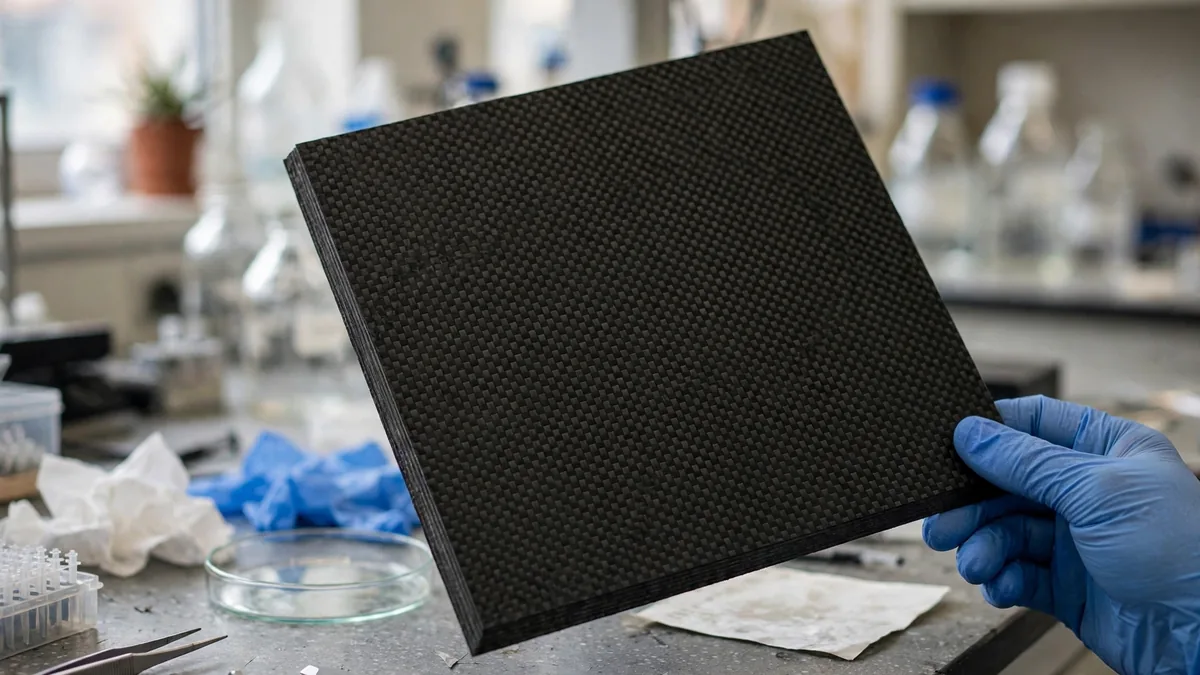
The nanotube-loaded resin is combined with carbon fibre cloth, either by soaking the cloth in the resin or by infusing it under vacuum in a mould. The plies are laid up by hand or by machine, each layer placed at a chosen angle so the finished part is stiff in the directions that matter. For parts that use nanotubes alone, without carbon fibre cloth, the resin can be cast, sprayed or moulded into shape directly. Either way, the part now looks like an ordinary black composite, and nothing about its appearance reveals the nanotubes inside.
Step 4: Curing under heat and pressure
The laid-up part is sealed in a vacuum bag and cured in an oven or autoclave, where heat and pressure drive the resin to cross-link into a hard solid. A typical cure runs at 120 to 180 degrees Celsius for several hours, squeezing out air bubbles and forcing the resin into every gap between the fibres. The nanotubes, locked in place by the hardened resin, can now share the loads the part carries.
Step 5: Testing the finished part
Finished parts are tested far harder than ordinary composites, because the promise of nanotubes is performance. Samples are pulled, bent and impacted while engineers measure stiffness, strength and toughness against identical parts made without nanotubes. Electrical conductivity is checked too, since a nanotube composite can bleed away static charge or shield electronics from interference, a property ordinary carbon fibre lacks.
Specifications
| Tube diameter | Approximately 1 to 50 nanometres |
| Tube type | Single-walled or multi-walled carbon nanotubes |
| Tensile strength | Up to around 100 times that of steel by weight |
| Typical loading | Less than 1 percent by weight in commercial composites |
| Matrix resin | Epoxy, nylon or PEEK thermoplastic |
| Growth method | Chemical vapour deposition at around 700 degrees Celsius |
| Cure temperature | Approximately 120 to 180 degrees Celsius |
| Extra properties | Electrical conductivity and static dissipation |
Price
Carbon nanotubes are still expensive, and that limits where they are used. High-purity nanotubes can cost hundreds of dollars per kilogram (estimate), compared with tens of dollars for carbon fibre, so a nanotube composite part typically costs 20 to 50 percent more than the same part without nanotubes. That premium buys toughness and electrical conductivity rather than a dramatic weight saving, so the material appears where those properties matter: aerospace panels, high-end sporting goods and electronics housings.
Rare Fact
A carbon nanotube is so small that a single gram of them, stretched end to end, would reach far enough to wrap around the Earth, yet that same gram is barely visible as a pinch of black powder. The strongest material ever measured is also one of the lightest, and the challenge of the last thirty years has been not making it, but persuading it to work together in something big enough to hold in your hand.
The next time you pick up a piece of black composite and wonder what makes it different from the carbon fibre of twenty years ago, the answer may be hiding inside it at a scale no eye can see. A fraction of a percent of nanotubes, spread evenly through the resin, can stop a crack, carry a current and stiffen a panel, and that quiet upgrade is how one of the most remarkable materials ever discovered is finally earning its place in the machines around us, from carbon fibre weaves to the ceramic composites of the future.


