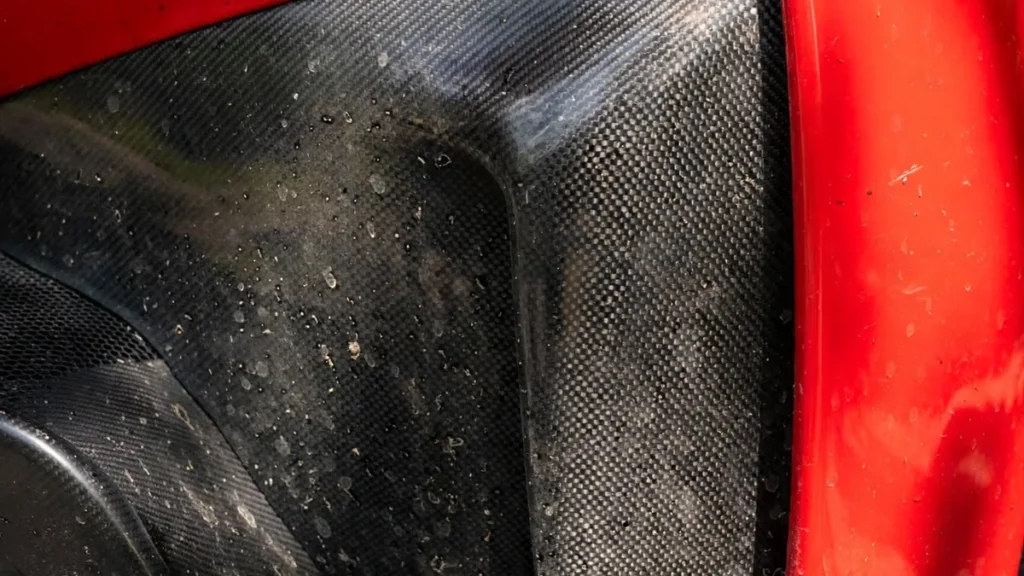
In a clean, bright workshop, a woman in gloves lifts a sheet of black cloth — woven carbon fibre, light as paper — and lays it into a curved mould. She smooths it down with her hands, presses out the air, and lays another sheet on top, this time turned at an angle. Then another, and another. Hour by hour, layer by layer, a shape grows in the mould: a racing car panel, a bicycle frame, a piece of an aeroplane wing. It is not machined, not welded, not cast. It is laid up, by hand, one layer at a time.
That is composite layup, and it is how the strongest, lightest structures in the world are made. A composite is two materials working together — strong fibres held in a plastic resin — and the layup is the careful, deliberate stacking of those fibres in exactly the directions the part will need strength.

How Composite Layup Works
A composite gets its strength from fibres — carbon, glass or aramid — embedded in a resin that holds them in place and transfers loads between them. The fibres are strong in tension, like a rope; the resin is weak on its own, but together they make a material that is stiff, strong and light. The composite layup process is the art of stacking those fibre layers, called plies, in a mould in the right order and the right directions, then curing the resin so the whole stack hardens into a single solid part.
Step 1: Designing the ply stack
Before anyone touches a sheet of fibre, engineers design the layup on a computer. Each ply has a direction — the direction its fibres run — and the strength of the finished part depends entirely on which way the fibres point. Get the stack wrong and the part will be weak in exactly the direction that matters most.
Step 2: Preparing the mould
The mould is the shape the part will take, and it has to be flawless. It is usually made of metal or composite itself, polished smooth, and coated with a release agent — a waxy layer that stops the resin from sticking to it. Any scratch or speck of dust on the mould will show up on the finished part, so the mould is cleaned and inspected before every layup. The quality of the mould decides the quality of the part, and composite shops treat their moulds like treasure.

Step 3: Cutting and laying the plies
Now the hands-on work begins. Sheets of carbon fibre — either dry cloth, or prepreg, cloth already soaked in resin — are cut to shape, often by a computer-controlled cutting machine, and laid into the mould one at a time. Each ply is placed in its designed direction, smoothed down with rollers and hands, and pressed into the curves of the mould. Air trapped between plies is the enemy: a bubble becomes a void in the finished part, a weak spot that can grow into a crack. Workers use rollers, scrapers and vacuum to pull the air out as they go, and they check each ply before the next goes on.
Step 4: Adding the core and details
Many composite parts are not solid. They are sandwich structures: two thin, strong skins of carbon fibre with a lightweight core between them, usually a honeycomb or a foam. The core makes the panel enormously stiff for very little weight — the same reason a cardboard box with a corrugated middle is stronger than a flat sheet. During layup, the core is placed between the skin plies, along with inserts for bolts and fittings, and extra reinforcement where holes will be drilled. This is also when the part gets its details: the edges are built up, the mounting points are added, and everything that will be needed later is laid into the stack.
Step 5: Bagging and curing
With the layup complete, the whole mould is sealed under a vacuum bag — a tough plastic film taped down around the edges, with a pump sucking the air out from under it. The vacuum presses the plies together, squeezes out the last air and excess resin, and holds everything tight while the part cures. For prepreg, the mould then goes into an oven or an autoclave, a pressurised oven, where heat and pressure cure the resin: the liquid resin cross-links into a hard solid, locking the fibres in place. A typical cure runs at 120 to 180 degrees Celsius for several hours. Autoclave curing adds pressure as well as heat, which squeezes out even more voids and produces the highest-quality parts — the kind used in aircraft.
Step 6: Trimming, drilling and inspection
The cured part comes out of the mould with rough edges, and those are trimmed with diamond tools — carbon fibre eats ordinary cutting tools for breakfast. Holes are drilled with special bits, and the part is checked for defects. Ultrasound can find hidden voids and delaminations, the separation of plies that is the most feared defect in composites, because it is invisible from the outside.

Composite Layup at a Glance
| Specification | Typical value |
|---|---|
| Fibre types | Carbon, glass, aramid |
| Resin types | Epoxy, polyester, vinyl ester |
| Ply thickness | 0.1–0.3 mm per ply |
| Cure temperature | 120–180 °C for prepreg |
| Autoclave pressure | Up to 7 bar |
| Weight saving vs steel | Up to 50–70% |
| Best for | Aircraft parts, racing cars, bicycles, boats, sports gear |
What Composite Layup Costs
Carbon fibre itself can cost roughly $20 to $100 per kilogram as an estimate, many times the price of steel, and the labour is skilled and slow — a complex hand layup can take days. A finished composite part can cost ten times its metal equivalent. The payback comes in weight: on an aircraft, every kilogram saved burns less fuel for the life of the plane, and on a racing car, less weight means faster lap times. Vacuum infusion offers a cheaper route for larger, simpler parts, but for the highest-performance components, hand layup in an autoclave is still the standard.
A Rare Fact
Carbon fibre is five times stronger than steel by weight, yet a single carbon fibre is thinner than a human hair — about five to ten microns across. A carbon fibre bicycle frame is made from thousands of these microscopic fibres, woven into cloth and laid up by hand, and the finished frame can weigh less than a kilogram while supporting a rider sprinting at full power. The first carbon fibre was made in the 1960s for military aircraft, and it was so expensive that only defence budgets could afford it. Today it is in tennis rackets, fishing rods and bicycle frames — and the layup techniques that built fighter jets now build the bike you ride on a Sunday morning.
So the next time you pick up something that feels impossibly light for how strong it is — a bicycle, a tennis racket, a piece of a racing car — turn it over and look at the weave. Those tiny black squares are the fibres, and each layer was placed by hand, in a direction someone chose, for a load someone calculated. It is not a material that comes out of a machine. It is a material that is built, layer by layer, by people who know exactly where the strength needs to go.