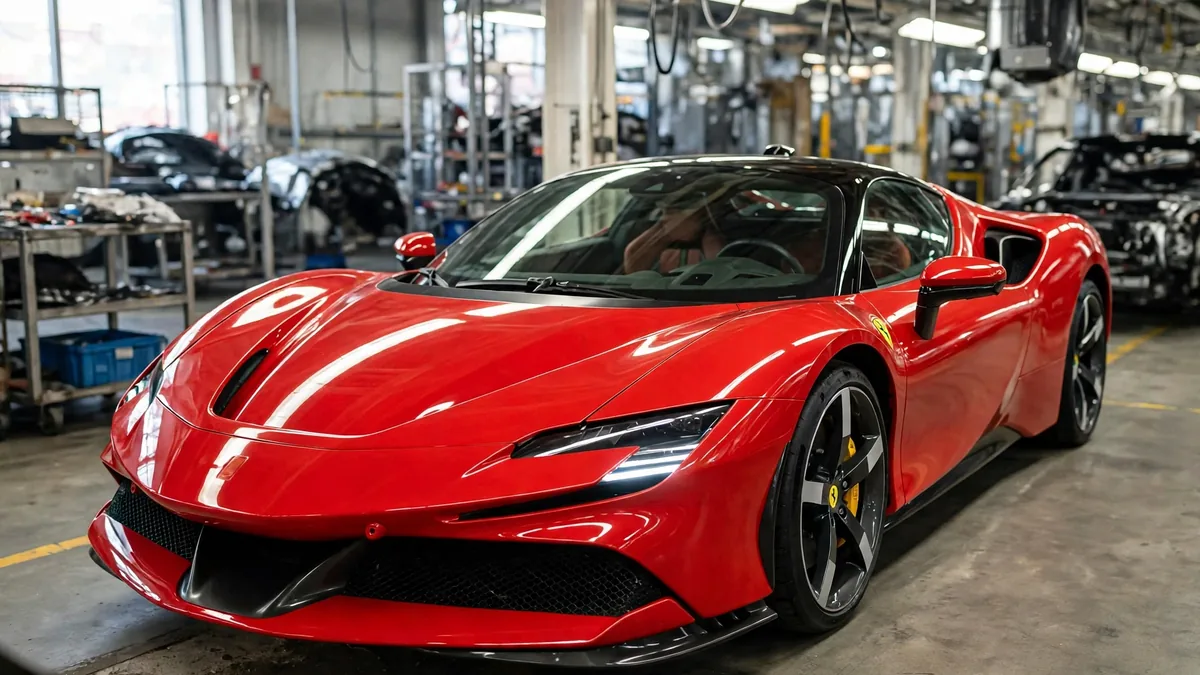
The Ferrari factory in Maranello is not a place where cars roll off a line in the thousands. It is a low-volume plant where a small number of highly skilled people build a small number of very complex cars, and the SF90 is the most complex of them all. Building a plug-in hybrid in a factory designed for petrol engines meant new stations, new clean areas, new tests, and new skills.
A production line is a sequence of promises. Each station does one job, checks it, and passes the car on, so a fault found late costs far more than a fault found early. The SF90’s line is built around that idea, with the hybrid system — the battery, the motors and the electronics — given its own stations and its own tests before it ever meets the car.
This is a look at the factory and its process: the line, the tolerances, and the tests every SF90 must pass before it leaves Maranello.
Inside the Factory
Step 1: A line built for low volume and high complexity
The Maranello line that builds the SF90 moves slowly by car-industry standards, because each car carries so much hand work. Instead of a fast conveyor with robots doing almost everything, the line is a series of stations where technicians work on the car for extended periods, with robots handling the heavy and repetitive jobs. The line is also flexible, because Ferrari builds several models in the same plant, and the SF90’s hybrid stations sit alongside stations for purely petrol cars. The result is a factory that looks more like a workshop than a mass-production plant.
Step 2: Body and paint, before the car becomes a hybrid
Long before any hybrid part is fitted, the body is made and painted. Panels are formed, bonded and checked on jigs that hold them to fractions of a millimetre, because the battery, motors and cooling pipes must fit into spaces measured in centimetres. The painted body then goes through inspection under bright lights, where even a tiny flaw in the paint means rework. Only a body that passes is allowed onto the main line. The discipline of shaping body panels in the first place is its own craft, and the turbocharger line that feeds the SF90’s engine shows the same low-volume care in the turbocharger line behind hypercar speed.
Step 3: The powertrain is built away from the line
While bodies are being painted, the powertrain is assembled in a separate area: the V8, the three motors and the gearbox are built up as a complete unit before they meet the car. Engine assembly is largely hand work, with a single technician following each engine through much of its build and signing off on every stage. The battery pack is assembled in its own clean area, away from dust and metal swarf, because a single speck inside a battery cell can cause a fault. Each cell is tested before it is fitted, and the finished pack is charged, discharged and checked for leaks before it is released.
Step 4: The marriage, powertrain meets body
The moment the car comes together is called the marriage. The complete powertrain is lifted into the chassis from below, and the body is lowered over it, and the two meet with tolerances measured in millimetres. Technicians then connect everything that ties the systems together: the orange high-voltage cables, the cooling lines for the battery and the motors, and the wiring looms that let the car’s computers talk to all three power sources at once. Every connection is checked as it is made, because a loose high-voltage connector or a pinched cooling hose would only show up later, under load, when it is far harder to fix.

Step 5: Wiring, software and calibration
Once the hardware is in, the car gets its software. The control systems are loaded and calibrated: the computers that decide how power is split between the engine and the motors, how the battery charges and discharges, and how the brakes blend friction and regeneration. Calibration is done on the car, not just on a bench, because the software has to match the exact car it is running on — the precise battery, the precise motors, the precise sensors. The power electronics that make this possible are built on their own line, as shown in how EV power electronics are wired for the road.
Step 6: The rolling road and the test track
A finished SF90 is tested more thoroughly than almost any car on the road. First it goes onto a rolling road, where its wheels spin against drums while engineers measure power, braking and the hybrid system’s behaviour at every speed. The battery is charged and discharged repeatedly, the motors are run at full power, and every warning light and cooling fan is checked. Then the car is driven on Ferrari’s Fiorano test track by professional test drivers, who check the handling, the brakes and the way the car switches between electric and petrol power. Keeping a thousand-horsepower car cool through all of this is a factory problem too, and the cooling line behind a 1,000-horsepower hypercar shows how the cooling system is built to survive it.
Step 7: Final inspection and sign-off
The last station is inspection, and it is the slowest of all. The car is checked panel by panel, inside and out, under lights that show every flaw. The interior is inspected, the paint is checked again, and every function is run through once more: the lights, the screens, the charging port, the driving modes. Only when every check passes is the car signed off, and the sign-off is a real person’s name on a real record, not a stamp. It is slow and expensive, and it is why a factory like this builds hundreds of cars a year rather than hundreds of thousands — and why each one costs what it does.
The Line at a Glance
| Stage | What happens |
|---|---|
| Body and paint | Panels formed, bonded, painted, inspected |
| Powertrain build | V8, motors and gearbox built off the line |
| Battery build | Cells tested, pack assembled in a clean area |
| Marriage | Powertrain lifted in, body lowered over it |
| Software | Systems loaded and calibrated on the car |
| Testing | Rolling road, then Fiorano test track |
| Sign-off | Full inspection, named sign-off, record kept |

Why the Factory Matters
The SF90’s factory matters because the car could not exist without it. A plug-in hybrid supercar needs clean rooms for batteries, precise jigs for a crowded chassis, software engineers on the line, and test drivers on a track next door — and Maranello had to build all of that around a plant designed for simpler cars. The tolerances, the tests and the sign-off are what turn a collection of expensive parts into a Ferrari, and they are the reason the SF90 feels like one machine rather than several systems bolted together. That is the point of the line in Maranello.