In a quiet workshop, a sheet of dry carbon cloth lies on a mould, covered by a plastic bag. A pump starts to hum, the bag tightens down onto the cloth, and then a valve opens. Resin creeps across the fibres like water soaking into a sponge, slow and silent, filling every gap.
Vacuum infusion makes composite parts, from boat hulls to aircraft panels, by letting air pressure press resin into dry fibres. Its materials are chosen for flow, for strength and for the one thing that can ruin a part: air trapped where resin should be. Every layer in the stack is a compromise between cost, quality and control.
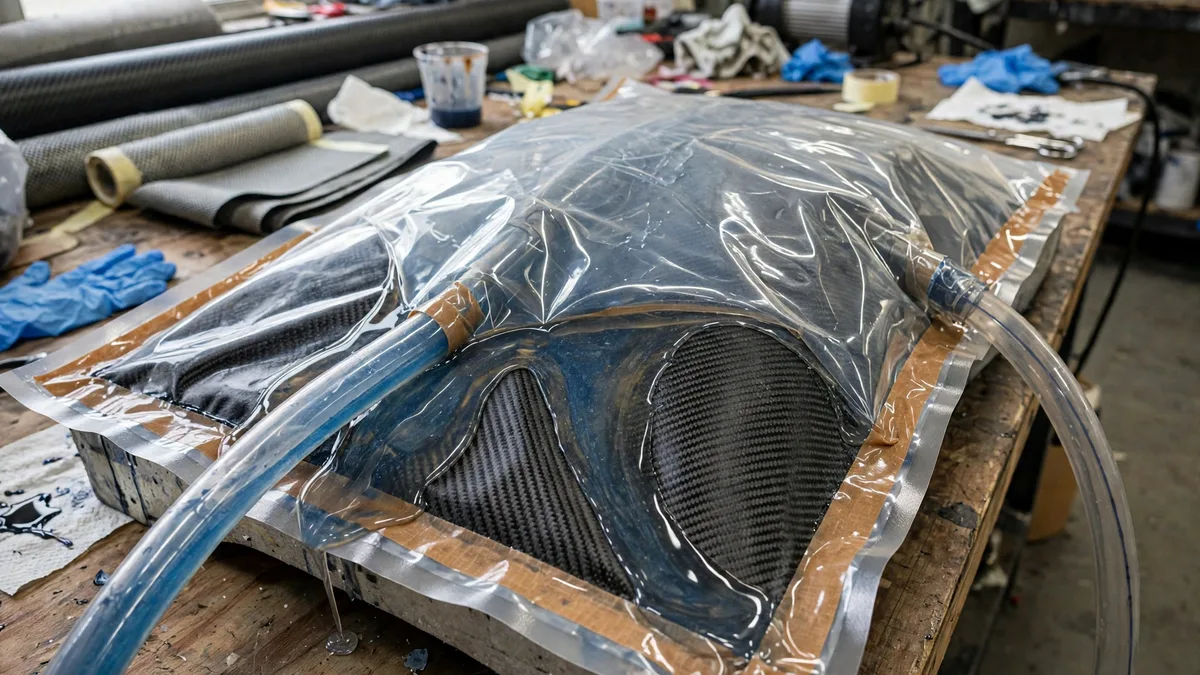
The Materials Behind the Vacuum Infusion
An infusion stack has five layers that matter: the fibre reinforcement, the resin that binds it, the mould it takes its shape from, the consumable layers that guide the resin, and the bag that seals the stack. Each layer uses different materials, and each fails in its own way when the resin does not flow.
Carbon and glass fibre: the strength in the cloth
The reinforcement is usually carbon fibre or glass fibre, woven into cloth or stitched into mats. Carbon fibre is chosen where a part must be light and very stiff, as in racing yachts and aircraft, while glass fibre is chosen where cost matters more than weight. The fibres are drawn into fine strands, then woven into sheets that can be cut and laid onto a mould.
Fibre fails by breaking and by poor wetting. A fibre bent too sharply snaps, and a snapped fibre carries no load. Worse, resin that does not reach a dry patch leaves a void, and a void is a weak spot that can start a crack. Fibres are laid flat, kept free of dust and moisture, and handled with gloves, because oil from a fingerprint can stop the resin from bonding.
Epoxy and vinyl ester resin: the glue that hardens
The resin is usually epoxy or vinyl ester, a liquid that hardens into a solid plastic when mixed with a hardener. Epoxy is chosen for its strength, its grip on the fibres and its resistance to water and heat, while vinyl ester is chosen for its lower cost and faster cure. The resin is mixed in careful proportions, degassed, and fed into the stack while the vacuum pulls it along.
Resin fails by curing too fast, too slow, or not at all. A resin that cures too fast gels before it has filled the part, leaving dry patches, while a resin mixed in the wrong ratio stays soft and weak. Heat speeds the cure, and a thick section can overheat and crack. Resin is mixed by weight and used within its working time. A part that has cured badly cannot be fixed; it must be thrown away.
Mould materials: the shape the part remembers
The mould is usually made from glass fibre composite, aluminium or steel, built to the shape of the finished part. Composite moulds are cheap to make and easy to change, aluminium is chosen for its smooth finish and its ability to be heated, and steel is chosen for large moulds that must last. The mould surface is polished and coated with a release agent, so the finished part lifts off cleanly.
Moulds fail by wear and by distortion. A composite mould flexes under vacuum, and a mould that flexes makes a part that is the wrong shape. Aluminium moulds dent easily, and a dent becomes a bump on every part made from it. Steel moulds are heavy and slow to heat, but they hold their shape for years. Moulds are inspected, polished and re-coated between parts. The carbon fibre weave laid on that mould is only as good as the surface beneath it.

Flow media and peel ply: the guides for the resin
Above the fibres sit the consumable layers: a peel ply that protects the surface, and a flow medium, a loose plastic mesh that gives the resin a fast path across the part. Peel ply peels off after curing, leaving a clean surface ready for bonding, while the flow medium lets resin race across the stack. Both are cut to size, laid flat, and thrown away after one use.
These layers fail by blocking the flow. A flow medium crushed under the vacuum stops carrying resin, and a peel ply that wrinkles leaves a crease in the part. A mesh laid with a gap becomes a dry stripe, and a mesh laid double becomes a resin-rich stripe that is weak and heavy. The consumables are checked before the bag goes on, because once the resin starts flowing, nothing in the stack can be moved.
Vacuum bag film: the seal that makes it work
The whole stack is sealed under a bag made from tough plastic film, usually nylon or a multi-layer film, held down by sealant tape. The film is airtight, it stretches over curves without tearing, and it survives the heat of curing. The bag is laid over the stack, taped to the mould, and the pump draws the air out until the bag presses down hard on the fibres.
Bag film fails by leaking and by tearing. A pinhole lets air in, and the air becomes a bubble in the resin. A sharp edge can cut the film, and a bag that tears during infusion ruins the part. The bag is leak-tested before the resin is mixed, and any leak is patched with tape. A bag that holds its vacuum is the difference between a perfect part and a workshop full of scrap.

Materials at a Glance
| Material | Where it is used | Why it was chosen | How it fails |
|---|---|---|---|
| Carbon and glass fibre | Reinforcement cloth | Carbon is light and stiff, glass is cheap | Snaps when bent, dry patches leave voids |
| Epoxy and vinyl ester resin | Matrix that binds the fibres | Strong, grips fibres, resists water and heat | Cures too fast or too slow, wrong mix stays soft |
| Composite, aluminium, steel | Moulds | Composite is cheap, aluminium is smooth, steel lasts | Flexes, dents and distorts, spoiling the part shape |
| Peel ply and flow medium | Consumable layers | Peel ply leaves a clean surface, mesh speeds flow | Crushed mesh blocks resin, wrinkles crease the part |
| Nylon bag film | Vacuum bag | Airtight, stretches over curves, survives heat | Pinholes leak air, tears ruin the infusion |
Vacuum Infusion at a Glance
| Specification | Detail |
|---|---|
| Reinforcement | Carbon or glass fibre cloth, cut and laid dry |
| Resin | Epoxy or vinyl ester, mixed by weight |
| Mould | Composite, aluminium or steel, polished |
| Consumables | Peel ply and flow medium, single use |
| Vacuum bag | Nylon film, sealant tape, leak-tested |
| Failure to watch | Dry spots, resin curing wrong, bag leaks, mould wear |
A Rare Fact
Vacuum infusion was first used to make large boat hulls, because the old way, laying resin on cloth by hand with a roller, was slow, messy and full of air bubbles. The vacuum method was so much cleaner that boat builders adopted it quickly, and then aircraft and wind turbine makers followed. A single infusion can now make a wind turbine blade longer than a passenger jet, in one piece, with no joints at all. The EV battery pack uses the same composite thinking, light shells protecting heavy cells, and the carbon-ceramic brakes show the other end of the same idea, where carbon is baked into a material that can stop a car from racing speed.


