The alarm sounds at two in the morning, somewhere in the middle of the Atlantic. On the bridge of a cruise ship carrying four thousand people, the captain gives an order nobody ever wants to hear, and within minutes orange boats are swinging out over the black water on davits. Passengers in lifejackets file to their muster stations, crew members count heads, and the lifeboats wait, ready to be lowered. It is a scene every cruiser rehearses in the safety drill on day one, and almost nobody ever sees for real. That is exactly the point. A cruise ship lifeboat is built for a day its makers hope never comes, and every part of it, from the hull to the engine to the rations stowed under the seats, is designed around one job: keep people alive at sea until rescue arrives.
Modern cruise lifeboats look nothing like the open wooden rowing boats of the Titanic era. Today they are enclosed, motorised, self-righting survival capsules, bright orange so they can be spotted from the air, and big enough to carry 150 people or more. They must survive a drop of several metres into the sea, float upright in heavy weather, and keep their occupants sheltered, fed, and warm for days. International rules demand that a cruise ship carry enough lifeboat capacity for every person on board, plus extra, and that each boat can be launched with a full load in minutes.
How a Cruise Ship Lifeboat Is Made
Step 1: Moulding the hull. The hull starts life in a large mould, where layers of glass fibre matting and resin are laid up by hand or sprayed into shape. The laminate is built up in stages, with extra reinforcement around the keel, the gunwales, and the points where the falls, the cables that lower the boat, attach. Once cured, the shell is lifted from the mould and checked for voids, thin spots, and cracks. A lifeboat hull has to be light enough to be hoisted and strong enough to survive being dropped into the sea fully loaded, so the laminate schedule is followed exactly.
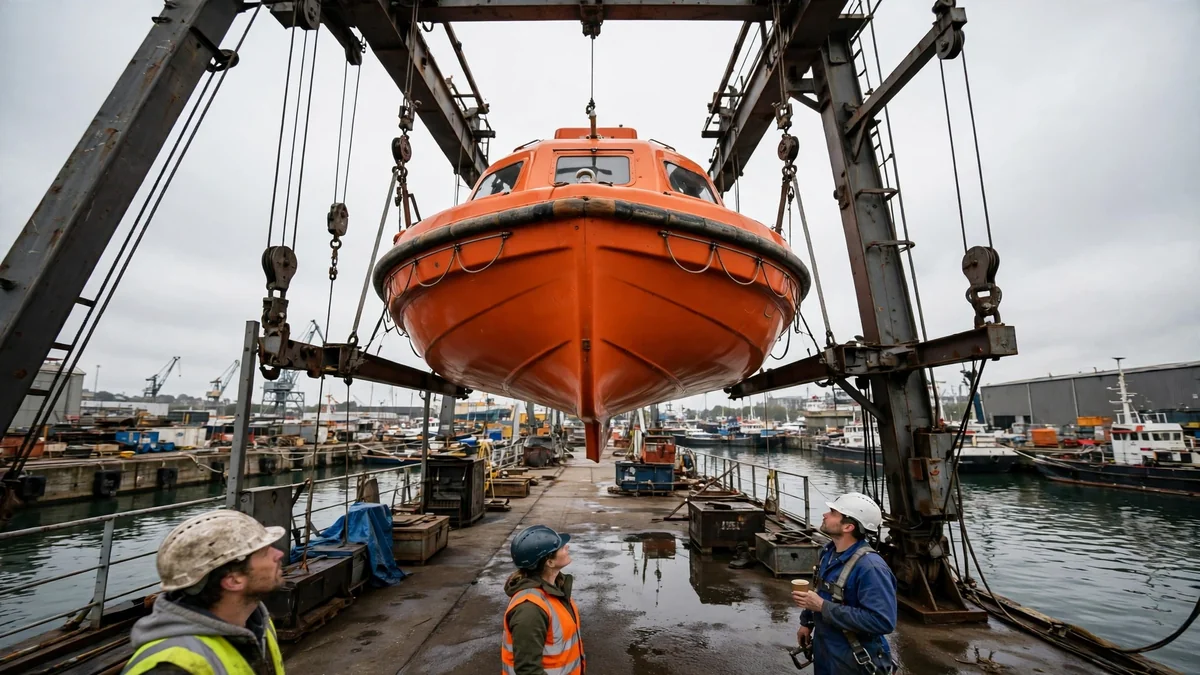
Step 2: Fitting the canopy and seats. The enclosed canopy is moulded in the same way, then bolted and sealed to the hull to make a watertight shell with small windows and a hatch at each end. Inside, rows of moulded seats are fixed to the floor, each with a seatbelt, and the layout is planned so the boat can be boarded quickly and the weight stays balanced. The canopy is what turns a boat into a survival capsule: it keeps waves out, holds warmth in, and protects people from sun and spray for days on end.
Step 3: Installing the engine and steering. A compact diesel engine is mounted low in the hull, connected to a propeller or a waterjet, with fuel tanks sized for at least 24 hours of running. The engine must start first time after months of sitting idle in salt air, so it is kept simple, rugged, and easy to service. Steering comes from a small wheel or tiller linked to the rudder, and a hand pump stands by as a backup if the powered systems fail.
Step 4: Adding safety and survival equipment. This is the step that separates a boat from a lifeboat. Crews fit lifejackets, a first aid kit, flares, a searchlight, a radar reflector, an emergency radio, a sea anchor to slow drifting, a bailer, oars, and a painter line for towing. Under the seats go sealed rations and fresh water, calculated per person for the expected survival time. The inventory is checked against an international list, and nothing is allowed to be missing or out of date when the boat leaves the yard.
Step 5: Testing for self-righting and flooding. The finished boat is put through its hardest trials. It is capsized in a test tank to prove it rights itself with a full load, flooded to check it stays afloat, and dropped from its davit height into the water to prove the hull and fittings hold. The engine is run, the steering is tested, and the release gear is tripped again and again.

Step 6: Certification and delivery. Finally, an independent surveyor inspects the boat, checks the paperwork, and witnesses a launch test. Only then does the lifeboat get its certificate, a serial number, and a place on a ship’s davit. Once on board, the crew inspects it weekly, runs the engine regularly, and lowers it in drills so everyone knows how it works. The boat will sit there for years, mostly ignored, waiting for a day that may never come, and that is precisely how it is meant to be.
Cruise Ship Lifeboat Specs
| Specification | Typical figure |
|---|---|
| Capacity | 100 to 370 people |
| Length | 7 to 13 metres |
| Hull material | Glass-reinforced plastic |
| Engine | Diesel, 30 to 70 horsepower |
| Speed | 6 knots |
| Survival provisions | Food and water for several days |
| Launch method | Gravity davit or free-fall |
Free-fall lifeboats, which slide down a ramp and plunge into the sea, are common on cargo ships and offshore platforms, while cruise ships mostly use davit-launched boats lowered gently on cables. Either way, the specification is the same: the boat must work with a full load, in bad weather, with no help from the ship it left behind.
How Much Does a Cruise Ship Lifeboat Cost?
A single large cruise ship lifeboat costs an estimated $150,000 to $500,000, depending on size, capacity, and equipment, with davit systems adding substantially more. A big cruise ship may carry twenty or more boats, so the total lifeboat fit can run into several million dollars, an estimated $3 million to $10 million for a large vessel. Servicing is a yearly cost too: inspections, engine runs, replacement of time-expired rations and flares, and crew drills all add up to an estimated tens of thousands of dollars per ship per year. These are estimates, and prices vary by maker, region, and the exact specification ordered.
Nobody buys a lifeboat because it looks good. It is a regulatory cost, a moral one, and an insurance one all at once, and the cruise lines that maintain them properly treat the spend as non-negotiable. The history of shipping is full of disasters where the boats were too few, too small, or too poorly maintained, and the rules written after each one are the reason today’s boats are enclosed, motorised, and counted to the last seat.
A Rare Fact About Lifeboats
Here is a detail few passengers know: a modern enclosed lifeboat is designed to right itself even if a wave flips it upside down with a full load of people inside. The canopy is shaped and weighted so the boat is unstable when inverted, and the weight of the engine low in the hull helps roll it back upright. It is a strange piece of engineering to test, since it means deliberately capsizing a boat full of weighted dummies, but it has saved lives in real accidents where boats were swamped in heavy seas.

Lifeboats are the quiet insurance policy of every cruise, and they sit alongside the rest of the ship’s engineering in ways passengers rarely notice. The same ship that lowers them uses an azipod system to steer without a rudder, and the bridge that orders a launch is itself a feat of construction, as shown in how a modern ship bridge is built. Even the waterjet systems on smaller craft, explained in what a waterjet propulsion system is, share the same idea: simple, rugged propulsion that works when it matters.


