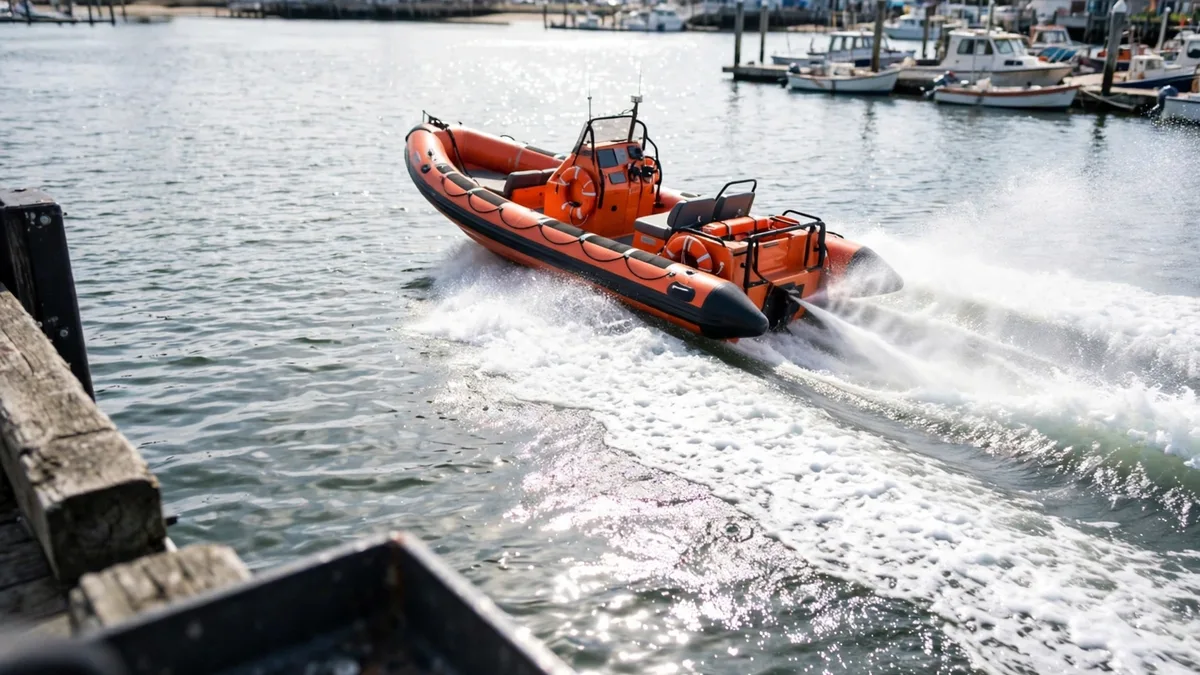
A rescue boat is barrelling toward a swimmer in trouble, and it does something a normal boat cannot. It stops, turns on the spot, and backs away from the rocks without ever lifting a propeller out of the water — because it has no propeller at all. Beneath the hull is a smooth intake and a nozzle, and the boat is being pushed by water itself, sucked in at the front and fired out at the back in a powerful jet. There is nothing spinning in the open water, nothing to tangle in a rope or injure a swimmer, and the boat can run in water barely deeper than its own hull.
That is a waterjet propulsion system. It is the marine equivalent of a jet engine, except that instead of air it moves water, and instead of burning fuel to make thrust it uses a pump to accelerate a stream of seawater backwards. The reaction pushes the boat forwards, exactly as a jet pushes an aircraft. The idea is simple to state and tricky to get right, which is why waterjets were once a niche choice and are now standard on fast ferries, patrol boats, rescue craft, and personal watercraft around the world.
The Pump That Pushes the Boat
At the heart of a waterjet is an impeller, a fan-like rotor enclosed in a housing inside the hull. Water enters through an intake grate on the bottom of the boat, is scooped up into the housing, and is accelerated by the spinning impeller, which is driven by the engine through a shaft. The water then passes through a stator — a set of fixed vanes that straighten the swirling flow — and exits through a nozzle at the stern at high speed.
The nozzle is more than just an exit. Its shape decides how the jet behaves: a narrow nozzle gives a fast, thin jet for top speed, while a wider one gives a slower, fatter jet for pulling power at low speed. Many systems can change the nozzle shape, or fit a reversing bucket that drops down behind the nozzle and deflects the jet forward, throwing the boat into reverse without ever changing the direction the impeller spins. That bucket is what lets a waterjet boat stop in a startlingly short distance and then back away, all while the engine keeps running in the same direction.
Why Water, and Why a Jet
The physics is the same as any jet: throw mass backwards, and you move forwards.The trade-off is efficiency: at low speed, a propeller, with its big slow blades, is usually more efficient than a jet, because it moves a large mass of water slowly rather than a small mass quickly.
There is also the question of what is under the boat. A propeller is a spinning blade in open water, vulnerable to ropes, nets, and debris, and dangerous to anyone in the water nearby. A waterjet’s impeller sits inside the hull, behind an intake grate, so there is nothing to snag and nothing to injure. For a rescue boat working among swimmers, or a boat operating in a river full of floating debris, that enclosed design is not a luxury. It is the reason the boat can do its job at all, and it is the same thinking that drives the design of other enclosed propulsors, including the systems compared in the guide to the main ship propulsion systems.
From Intake to Nozzle, Step by Step
Follow a drop of water through the system and the design becomes clear. It enters through the intake, a flush opening in the hull bottom, covered by a grate that keeps out large debris while letting water flow freely. The intake is shaped to feed the water smoothly into the pump, because turbulent water entering the impeller wastes energy and can cause cavitation — the formation of tiny vapour bubbles that collapse violently and can erode metal over time. Getting the intake right is one of the hardest parts of waterjet design, and a badly shaped one can ruin an otherwise good unit.
Inside the pump, the impeller spins at high speed, driven by the engine. Its blades are curved and closely spaced, and they fling the water outward and backwards, adding energy to the flow. The stator vanes behind the impeller straighten the swirl, turning rotational energy into straight-line thrust. The water then converges into the nozzle, speeding up as the passage narrows, and exits as a coherent jet. The whole path is short, smooth, and enclosed, which is why a waterjet can be so compact for the power it delivers.
The Kinds of Waterjet You Will Find
Waterjets come in sizes from the tiny unit in a personal watercraft to the massive installations on a fast ferry, and the design changes with the scale. Small units often use a single-stage axial impeller, a simple fan that works well at moderate speeds. Larger units may use a mixed-flow impeller, which combines axial and centrifugal action to move more water at higher pressure, and they may have two stages for the very largest installations. The materials change too: aluminium and stainless steel for smaller units, high-strength alloys and composites for the largest, where the loads are enormous and corrosion is a constant enemy.
There is also a hybrid world where waterjets meet other ideas. Some fast ferries pair waterjets with a hull designed to ride on the surface, and some patrol boats use jets alongside a small propeller for low-speed work. The waterjet is not the answer to every propulsion question, and the best designers know when to use it and when to use something else — a judgement that also applies to the choice of propeller, whose design is covered in the guide to how a submarine propeller works. The underwater world rewards the right tool for the job, not the loudest one.
Where Waterjets Earn Their Keep
The classic waterjet jobs are the ones where safety and manoeuvrability matter most. Lifeboat and rescue services use them because they can work close to people in the water without risk, and because they can run in shallow water and over sandbanks where a propeller would strike the bottom. Harbour ferries use them because they can dock and turn in tight spaces, and because they can run a fast service with a shallow draught. Military patrol boats use them for the same reasons, plus the fact that a waterjet has a smaller underwater signature than a propeller, which matters when quiet matters.
The Trade-Offs, Honestly Stated

A waterjet propulsion system, then, is a pump that thinks it is a jet engine: it takes water in, speeds it up, and throws it out behind, and the boat moves forward on the reaction. It is a clean, compact, and remarkably manoeuvrable way to push a boat, and once you have watched a waterjet craft spin on the spot and back away from a quay, you will never look at a propeller the same way again. The propeller it replaces is itself a study in careful design, as the guide to yacht propeller specifications explains.