Stand on the bridge of a large ship at dawn and the first thing you notice is the view. A wall of glass wraps around you, the sea stretches to the horizon in every direction, and below the windows a long row of consoles glows softly with charts, radar and engine readings. It is also the room where every decision is made, and the factory builds it as a workplace where a tired officer at three in the morning must find the right control without thinking.
That room is the ship’s bridge, and building one is a job of two halves. The first half is steel: the wheelhouse structure, the window frames and the wings that stretch out over the ship’s sides so the crew can see along the hull. The second half is fitting out: consoles, screens, wiring and chairs, installed in a space that has to stay dry, quiet and cool while the ship around it is still being built.
A modern bridge carries no wheel like the ones in old films. Steering is done with a small lever or a touchscreen, and the charts are electronic. Our guide to how a ship bridge is made explains the parts and the layout; this is the production story — how a bridge goes from bare steel to a working command centre.
Building a Ship Bridge
Step 1: Building the wheelhouse structure
The bridge begins as steel. The wheelhouse is a box built high on the ship’s superstructure, its walls stiffened against wind and weather, its roof strong enough to carry masts, antennas and lifeboat gear. The front wall is where the work is hardest: it must hold a row of large windows, each one angled to stop reflections and glare, and the frames between them must be slim enough not to block the view. Workers weld the structure, check it for square, and paint it, and the whole wheelhouse is often built as a single block on the ground and lifted onto the ship by crane, complete with its windows already fitted.
Step 2: Fitting the windows
The windows are the bridge’s most important feature, and they are fitted with great care. Each pane is a thick sheet of toughened, laminated glass, angled slightly forward at the top so that rain runs off and the glass does not reflect the bridge lights back at the crew at night. The panes are set into rubber gaskets and steel frames, sealed against wind and driving rain, and fitted with wipers and heated elements to keep them clear in bad weather. On a large ship the bridge glass can be a metre and a half tall, and the crew’s whole working life is spent looking through it.

Step 3: Installing the consoles
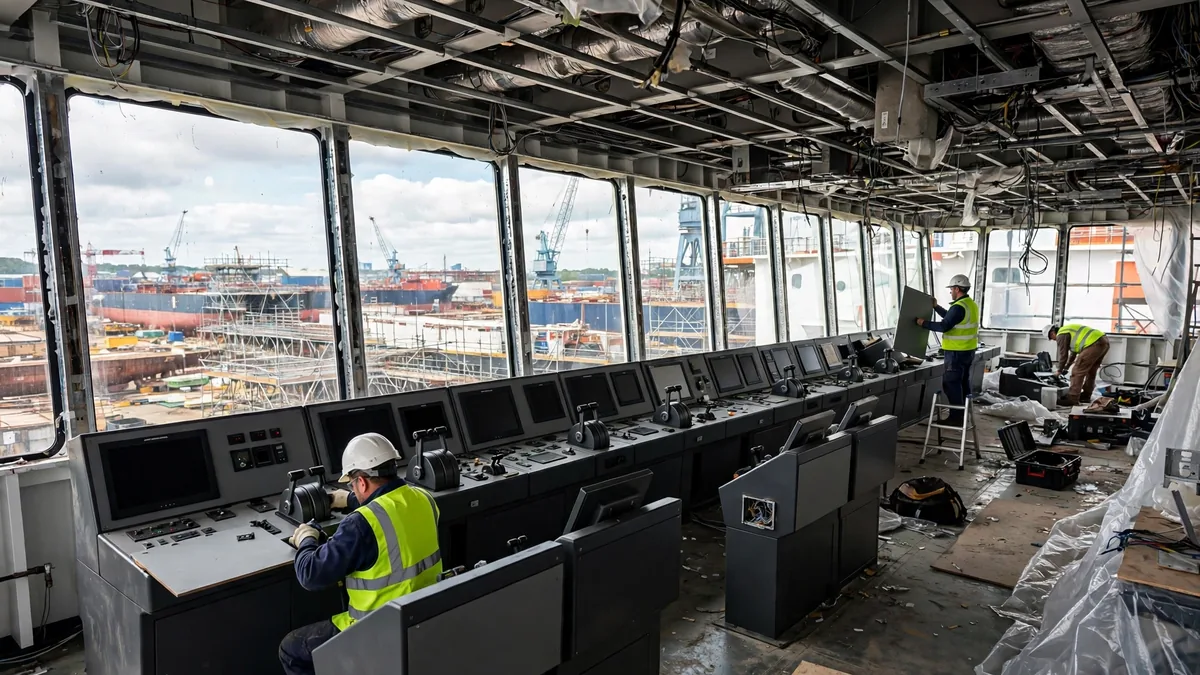
With the windows in, the consoles arrive. These are the long, low desks that hold the radar, the electronic charts, the steering controls and the engine displays, and they are built in the factory as complete units, wired and tested before they ever reach the ship. On board, they are lifted into place, bolted to the deck, and levelled, because a console that rocks in a seaway is a console nobody trusts. The layout is planned around the people who will use it: the most important displays sit directly in front of the watchkeeper, the steering station sits on the centreline, and everything is within reach from a single chair.
Step 4: Wiring the systems
Behind the consoles lies a forest of cables. Power, data and signal cables run from every console down through the deck to the equipment rooms below, and the factory routes them in trays and conduits, labelled at both ends, with slack left for the ship’s movement. The bridge’s systems talk to each other over networks, and the wiring has to be neat enough that a fault can be found in minutes, not hours.
Step 5: Fitting the equipment and seating
The screens, radios and instruments go in next, along with the smaller things that make a bridge workable: the chairs, the chart table, the lockers, the blinds and the heating and cooling. The chairs are built to a marine standard, with a high back, armrests and a footrest, because a watchkeeper sits in one for hours at a time. At this stage the bridge stops looking like a building site and starts looking like a workplace, and the yard’s inspectors begin their checks of the finished space.
Step 6: Testing, trials and handover
The last step is proving that the bridge works as a whole. The yard runs through a checklist of every system, and then the ship goes to sea for trials, where the bridge crew test the steering, the radar and the navigation systems in real conditions. Any problem found on trials — a reflection in the glass, a display that washes out in sunlight, a control in the wrong place — is fixed before delivery. The bridge of a yacht is a smaller cousin of the same idea, as covered in our guide to yacht navigation bridge specs, and the rudder the bridge controls is built to its own heavy standard, as described in our guide to inside ship rudder production. When the ship is handed over, the bridge is ready for its first watch.
Ship Bridge Specs
| Specification | Typical range |
|---|---|
| Bridge width | About 20 to 30 metres across on a large cargo ship |
| Window height | About 1.2 to 1.6 metres of toughened laminated glass |
| Window angle | Tilted forward at the top to cut glare and reflections |
| Main consoles | Navigation, steering, engine and communication consoles |
| Visibility | Near 360 degrees from the bridge, including bridge wings |
| Steering | Lever or touchscreen control, with manual backup |
| Charts | Electronic chart display, with paper charts as backup where required |
| Fit-out time | Several weeks from bare steel to working bridge |
What Does a Ship Bridge Cost?
Fitting out the bridge of a large cargo ship is estimated to cost roughly $3 million to $10 million, depending on size, the number of consoles and the level of navigation equipment fitted. Prices are estimates only and vary by yard, ship type and equipment chosen.
A Rare Fact
On a large ship, the bridge wings stretch out beyond the sides of the hull so the crew can look straight down at the waterline when the ship is docking. From the centre of the bridge, the side of the ship is invisible — it falls away below the windows — so without the wings, the crew would be steering blind in the last few metres, which are the metres that matter most.

The bridge is the ship’s thinking room, and it is built like one: quiet, bright, and laid out so that the right answer is always the easy one to reach. The factory that builds it spends weeks on details a passenger would never notice — the angle of a window, the height of a console, the label on a cable — because those details are what a tired officer relies on at three in the morning, in rain, with a coastline somewhere ahead.


