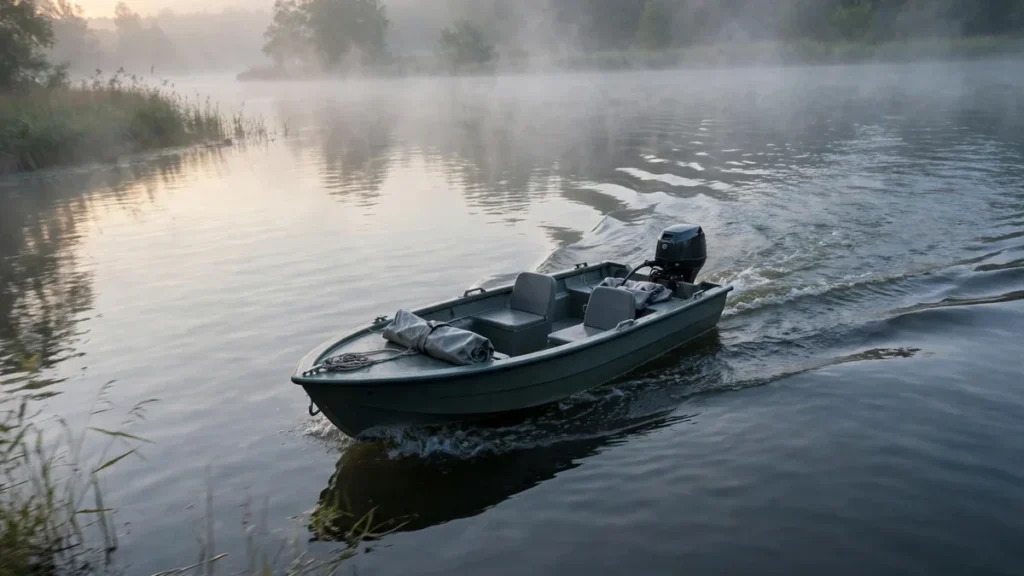
On a small electric boat, the wheel often does not move. The boat holds its course across a flat lake while the driver watches the water, checks the fishing rod, or simply sits back. Nobody is steering. A small computer is doing it instead, reading the compass and the GPS many times a second and nudging the motor to keep the bow on the line the driver chose.
That is electric boat autopilot: a self-steering system built for day boats, tenders, fishing boats and small cruisers, rather than for big yachts. It is simpler and cheaper than a yacht system, and it is shaped by the way small electric boats actually work. This guide explains how it works, from the sensors to the steering, and what it can and cannot do.

What autopilot does on a small electric boat
At its simplest, an autopilot holds a heading. The driver points the boat where they want to go, presses a button, and the system takes over the steering. If wind or a wave pushes the bow off course, the autopilot notices within a second and steers back. It does not speed the boat up or slow it down unless the driver asks it to; its job is direction, not throttle.
Most systems for small electric boats do a little more than hold a heading. They can follow a route made of waypoints tapped into a chart screen, steer the boat in a slow circle around a fishing spot, or hold the boat in one place against wind and current.
The sensors: knowing where the boat is
An autopilot can only steer well if it knows where the boat is pointing and where it is going. The first sensor is a heading compass, usually a small electronic unit that measures the boat’s direction many times a second. On a small boat it is often a solid-state compass with no moving parts, bolted down low in the hull where it is steady and away from the motor’s magnets.
The second sensor is GPS, which tells the system the boat’s position, speed over the ground, and the direction it is actually travelling. Heading and GPS direction are not the same thing: the bow can point one way while wind and current push the boat sideways.
The brain: from heading to steering commands
Between the sensors and the steering sits a small control unit, the brain of the system. It runs a loop: read the heading, compare it with the course the driver set, work out how far off the boat is, and send a steering correction. Then it reads again, and again, many times a second. The loop never stops while the autopilot is engaged.
The clever part is how much correction to apply. Steer too gently and the boat drifts off in a crosswind. The control unit adjusts its response to the boat’s speed and the sea state, steering firmly at slow speed, when the rudder has little bite, and gently at cruising speed, when a small movement is enough.
The steering: moving the rudder or the motor
On a small electric boat there is often no separate rudder at all. Many electric boats steer by turning the whole outboard motor or pod drive, so the autopilot’s job is to turn the motor. A compact electric actuator, a small motor with a screw or a belt drive, pushes the steering arm left or right on the control unit’s command. It draws its power from the same battery bank that drives the boat.
Boats with a rudder work the same way, with the actuator connected to the rudder stock or the tiller instead. The steering gear on a small boat is lighter than on a yacht, and how electric boat steering works explains the linkages and the forces involved in more detail. What matters for autopilot is that the actuator is strong enough to hold the motor against the water, and precise enough to make the small corrections the control unit asks for.
Holding position and following a route
The most useful trick on a small electric boat is position holding, sometimes called a virtual anchor. The driver taps a spot on the chart, and the autopilot uses GPS to keep the boat over it, steering and adjusting thrust to cancel out wind and current.
Route following works the same way on a larger scale. The driver taps a series of waypoints along a channel or around a bay, and the autopilot steers from one to the next, turning at each point. The system watches the cross-track error, the distance between the boat and the line between waypoints, and steers to close it. It is a convenience, not a substitute for lookout: the autopilot cannot see another boat, a swimmer, or a floating log.

Power, range and the electric advantage
Autopilot fits electric boats well because everything on board already runs on the same battery. The sensors, the control unit and the steering actuator draw only a small amount of power, far less than the propulsion motor, and there is no hydraulic pump to keep running. On a calm day the whole autopilot system uses less energy than a cabin light left on.
There is a subtler advantage too. An electric motor answers instantly and can be run at very low speed without stalling, so the autopilot can make fine adjustments that a petrol engine would struggle with. How an electric boat motor works covers the motor itself, and the same instant response that makes the motor pleasant to drive makes it easy for a computer to steer.
Docking help and the limits
Some small-boat systems add a docking mode, which uses GPS and a short-range sensor to creep the boat towards a pontoon at walking pace, turning the motor to keep the boat straight while the driver controls the throttle. It is a helper, not a replacement for the driver, and it only works in calm conditions with a clear approach. In wind, or in a crowded marina, the driver takes over.
The limits matter more than the features. Autopilot does not watch for obstacles, it does not know the depth, and it will happily steer a boat onto a sandbank if the route says so. A driver who treats it as a lookout is asking for trouble.
Who it is for
Electric boat autopilot suits drivers who spend long stretches going in a straight line: crossing a lake, running a channel, or trolling slowly for fish. It suits solo boaters, who cannot steer and handle a rod or a fender at the same time, and it suits anyone who finds constant steering tiring on a long day. It is least useful on short hops in a busy harbour, where the driver is steering constantly anyway.
The yacht version of the same idea works on a different scale, with bigger steering loads, longer passages and energy management across the whole boat, as explained in how electric yacht autopilot works. The small-boat system is the same loop, shrunk down: sensors, a brain, and an actuator, keeping a little boat on a straight line while its driver looks at the water instead of the wheel.