The boat slipped away from the pontoon at first light, and the only sound was water moving past the hull. There was no diesel rumble, no blue puff of exhaust, no vibration through the deck boards. The skipper pushed the throttle forward with two fingers, the boat gathered speed, and the harbour fell behind in silence.
An electric boat motor works on the same idea as the motor in an electric car, but the sea changes everything. The motor has to live in salt water and damp air, push against water instead of air, and keep working for hours at a steady load, because a boat cannot pull over to the side of the road.
Under the deck, the system is a chain: the battery stores the energy, the controller shapes it, the motor turns it into spin, and the propeller turns the spin into thrust. This is how that chain works, from the battery bank to the wake behind the boat.

How an Electric Boat Motor Works
The motor works in four stages: the battery bank stores the energy, the controller turns it into the right kind of power, the motor spins the shaft, and the propeller pushes the water.
Step 1: The battery bank below deck
Everything starts with the battery, a bank of lithium cells housed in a sealed compartment low in the hull, where the weight keeps the boat stable. A typical electric boat carries 10 to 100 kilowatt-hours, depending on its size, and the bank is wired to deliver 48 or 96 volts to the motor. The compartment is ventilated and fitted with a battery management system that watches every cell for heat and imbalance, because a battery fault at sea is far harder to deal with than one on land.
Step 2: The controller shapes the power
Between the battery and the motor sits the controller, a sealed box of power electronics that turns the battery’s direct current into the alternating current the motor needs. It is the boat’s throttle: by changing the frequency of the current, it decides how fast the motor spins, and by changing its strength, it decides how hard the motor pulls. The numbers it reports are the same kind of figures explained in electric boat motor specs explained, where power, torque, and efficiency decide how far a charge will take the boat.
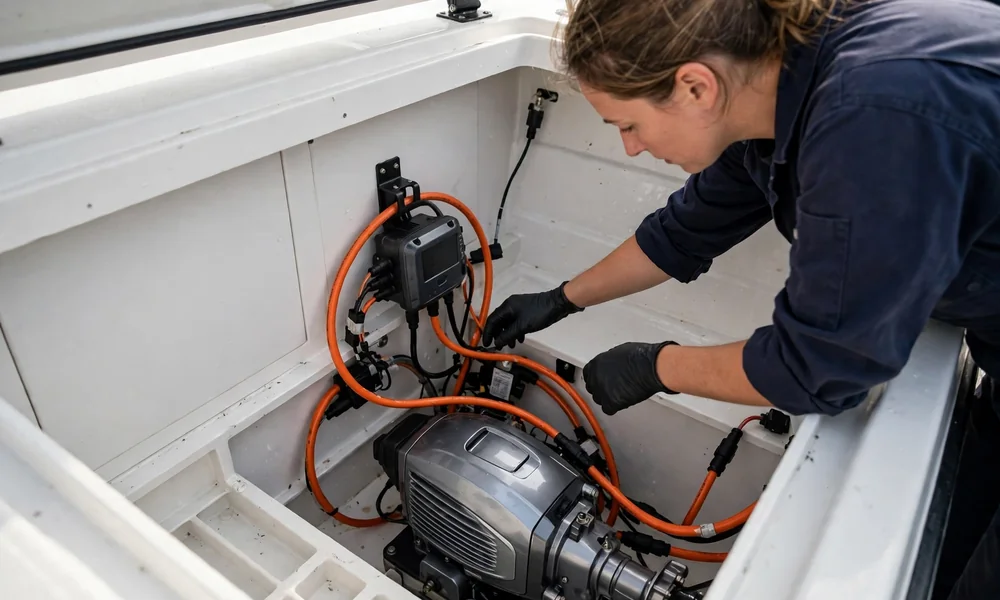
Step 3: The motor turns power into spin
The motor itself is usually a permanent-magnet unit, a cylinder of copper windings and rare-earth magnets that spins with almost no friction and no brushes to wear out. It sits in one of three places: inside the hull driving a shaft, in a pod hanging below the hull, or built into an outboard leg on the transom. A pod drive is the most efficient, because the motor sits directly in the water flow and drives the propeller without a shaft or a gearbox, losing almost no energy on the way. The range of systems a boat can carry, from small outboards to large pod drives, is compared in the best electric boat propulsion systems, where power, weight, and efficiency decide the right setup for each hull.
Step 4: The propeller turns spin into thrust
The propeller is where the motor meets the water. It is a set of blades, usually three, shaped to bite the water and push it backwards, which pushes the boat forwards. An electric motor is good at this job, because it makes full torque from a standstill, so the boat accelerates smoothly from the pontoon without the lag and the roar of a diesel. The propeller is sized to the motor and the hull, and a folding or feathering propeller can fold its blades flat when the boat sails, cutting drag.
Step 5: Cooling with the water around it
A motor and a controller make heat, and a boat has the perfect coolant all around it: the sea. Most electric boat motors are cooled by the water they sit in, either directly through a pod housing or through a closed loop that runs through a heat exchanger in the hull. The battery bank is cooled the same way, with a small pump circulating coolant through a plate under the cells. The cooling has to be watched, though, because a blocked intake or a failed pump is the one thing that can stop a motor that otherwise has almost nothing to go wrong.
Step 6: The helm, the range, and the return
From the helm, an electric boat is simpler than a diesel one. There is a single throttle, a display showing charge and range, and no gears, no choke, and no warming up. The skipper learns to read the range the way a sailor reads the wind, slowing down a knot to double the distance, because a boat’s power use rises steeply with speed. Some boats can even regenerate under sail, letting the water spin the propeller and feed power back into the battery on a long downwind run. The choice of motor for a particular boat is a story of its own, and the options are ranked in the best electric outboard motors ranked, where thrust, weight, and battery life decide the order. When the boat comes home, the skipper plugs it into the shore supply, and the battery fills overnight, ready for the next silent morning.
Electric Boat Motor Specifications
| Specification | Typical figure |
|---|---|
| Motor type | Permanent-magnet, brushless |
| Power | 3 to 100 kilowatts |
| Battery bank | 10 to 100 kilowatt-hours |
| Voltage | 48 or 96 volts |
| Cruising speed | 5 to 8 knots |
| Range | 20 to 80 nautical miles |
| Cooling | Water-cooled, closed loop or pod |
| Drive options | Shaft, pod, or outboard |
What Does an Electric Boat Motor Cost?
An electric boat motor is priced by its power. A small outboard of 3 to 6 kilowatts typically costs an estimated $3,000 to $8,000, while a larger inboard or pod system of 20 to 50 kilowatts typically costs an estimated $15,000 to $40,000, with the battery bank adding an estimated $5,000 to $30,000 on top. The electricity to run it is cheap: a full charge costs an estimated $5 to $20 at marina rates, against an estimated $50 to $150 of diesel for the same distance. Servicing is minimal, with no oil, no filters, and no exhaust to maintain, though the battery will need replacing after an estimated 8 to 15 years.
A Rare Fact About Electric Boat Motors
Here is the detail most people miss: an electric boat motor can hear the sea. Because there is no engine noise, the skipper can hear the water against the hull, the wind in the rigging, and even fish moving under the boat, sounds a diesel would drown out entirely. Some marine researchers use electric boats for exactly that reason, drifting through whale grounds and listening to the animals without disturbing them. The motor is not just a quiet way to move. It is a way to arrive without announcing yourself, and for a boat, that is a rare and lovely thing.

An electric boat motor is a simple machine in a hard place, and it works because every part of it was built for the water. The battery sits low and sealed, the controller shapes the power, the motor spins without a sound, and the propeller turns it all into a silent wake. The diesel age gave boats noise and smell. The electric age is giving them back the quiet, and the sea, it turns out, was waiting for it.


