An electric ferry runs a schedule a diesel ferry would find punishing. It crosses the water, docks, lets hundreds of passengers and dozens of cars off and on, and has ten minutes, sometimes less, before it must leave again. In that short window it must also recharge, because its batteries may only hold enough for one or two crossings. Docking, for an electric ferry, is therefore not just parking the boat. It is a refuelling stop, a passenger exchange and a precision manoeuvre, all at the same time, and every second counts.
That pressure has changed how docking works. Where a conventional ferry ties up with ropes and takes its time, a modern electric ferry often docks with automated mooring, a guided charging connection and a crew working to a timetable measured in minutes. The boat, the pier and the shore power system must act as one machine, because if the charging plug misses its socket or the boat drifts a metre off its mark, the whole crossing schedule slips.
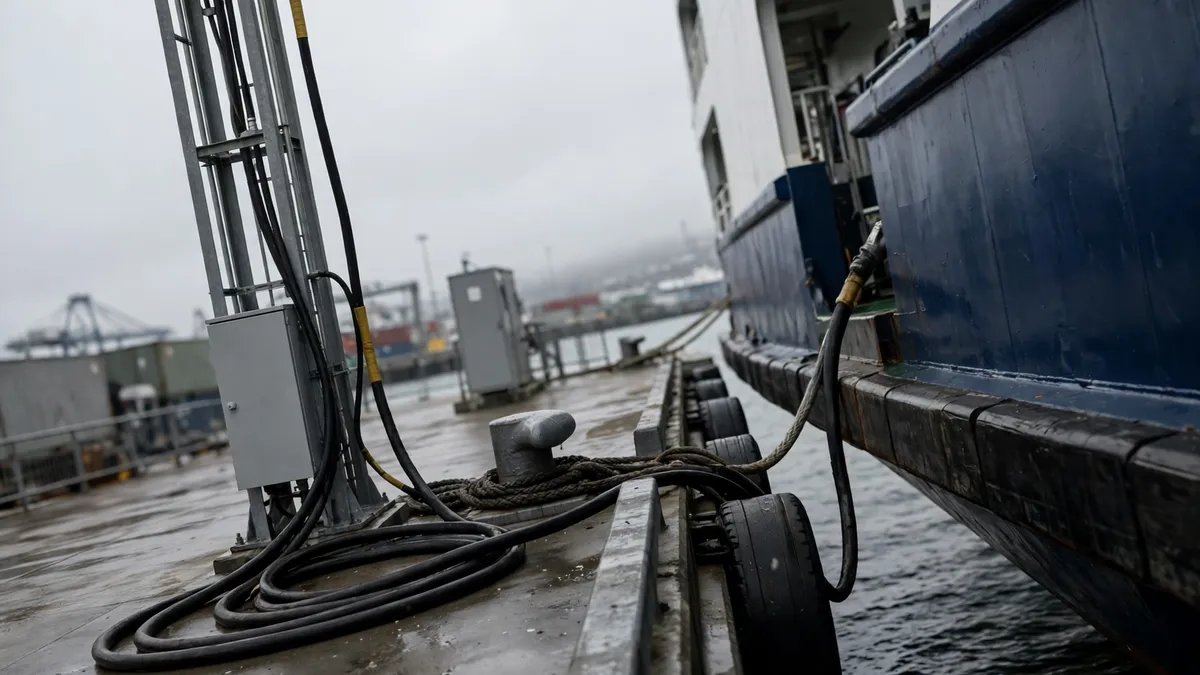
How Electric Ferry Docking Works
Step 1: The approach is planned before the boat arrives
Docking starts before the ferry reaches the pier. The captain, or the vessel’s control system, lines the boat up with the berth using GPS, radar and cameras, compensating for wind, current and tide. Electric ferries have an advantage: their motors respond almost instantly and can be reversed precisely, and many have azimuth thrusters or podded propellers that push in any direction. That fine control lets the boat creep sideways into the berth at a walking pace, which matters, because the charging connection on the pier only works if the boat stops in the right place. The same sensor-led approach is taken further in how autonomous yacht docking works, where software guides the whole manoeuvre.
Step 2: The boat is held still, fast
Once alongside, the ferry must be held still while passengers move and charging begins. Some berths still use mooring lines handled by the crew, but many electric ferry routes use automated mooring: vacuum pads mounted on the quay press against the flat side of the hull and grip it in seconds, holding the boat firmly without a single rope. The captain controls them from the bridge with a remote. A boat held by vacuum pads barely moves with the waves, which is exactly what a charging system needs, because a plug that has to chase a moving socket will never connect cleanly.
Step 3: The ramps and gangways open for a fast turnaround
With the boat secure, the bow or stern ramp lowers onto the pier and the gangways open. Cars and passengers flow off and on at the same time, usually through separate lanes so foot traffic never crosses the vehicle deck. On a short crossing the whole exchange is planned to take about ten minutes, and the crew works to a fixed sequence: unload first, then load, with the ramp position checked before every departure. On end-loading ferries the charging connection is often built into the ramp structure itself, so the same structure that carries the cars also carries the power.
Step 4: The charging connection finds its target
This is the step that makes electric ferry docking different from any other kind. A shore-side charging unit must connect to a socket on the boat and transfer a huge amount of power in minutes. The designs vary: some use a horizontal plug that slides into a hatch in the side of the hull, guided by laser sensors; some use a vertical tower that lowers a connector onto the roof of the vessel; some mount the charger on the vehicle ramp so it meets the bow as the boat docks. In automated systems, cameras or lasers watch the socket’s position, compensating for tide and the boat’s small movements, and the plug only engages when alignment is confirmed. The connection systems are covered in how electric ferry charging works, where the same high-power transfer must happen safely in rain, salt spray and constant motion.
Step 5: Megawatts flow during the turnaround
Once connected, charging begins at a rate that dwarfs anything a road vehicle sees. A large electric ferry may take on power at several megawatts, enough to top up its batteries for the next crossing in the same ten minutes the passengers need to board. The shore system includes transformers and frequency converters that match the grid’s power to the boat’s onboard system, and safety interlocks that cut power instantly if the connection is disturbed. The battery pack is built to absorb it quickly, and the cooling system works hard during those minutes, because pushing megawatts into a battery generates a great deal of heat in a very short time.
Step 6: The boat is released and departs on schedule
Departure is the reverse of arrival, compressed into seconds. The charging plug retracts or the tower lifts clear, the shore system confirms the connection is broken and safe, the vacuum pads release, and the ramp rises. The crew checks that every connection is stowed and every passenger is aboard, and the boat pulls away under electric power. On the best-run routes the whole cycle takes ten minutes or less, and the ferry repeats it dozens of times a day. The propulsion behind that quick, quiet departure is described in how ferry propulsion works, where electric drive brings the instant torque and precise control tight schedules demand.

Electric Ferry Docking Specifications
| Specification | Typical value |
|---|---|
| Turnaround time | About 10 minutes on short routes |
| Charging power at berth | Several megawatts for large ferries |
| Mooring method | Vacuum pads or mooring lines, released in seconds |
| Charging connection types | Side plug, vertical tower, or ramp-mounted bow charger |
| Alignment guidance | Laser sensors or cameras, compensating for tide and drift |
| Passenger capacity | 360 passengers and 120 cars on a large battery ferry |
| Shore equipment | Transformers, frequency converters and safety interlocks |
| Connection standard | Shore power systems built to IEC 80005-1 |
The numbers depend on the route: a small harbour ferry may charge at a fraction of a megawatt with a manual plug, while a large Norwegian battery ferry takes several megawatts through an automated connection.

How Much Does Electric Ferry Docking Cost?
There is no single price, because the berth and the boat are built as a pair. A single automated mooring and rapid-charging installation at a ferry terminal typically costs several million dollars, including the shore power equipment, the charging unit, the mooring system and the grid connection. The ferry itself costs tens of millions, with its battery pack a large share of that. Operators accept the cost because the alternative is worse: without fast docking and charging, a ferry would need a far bigger, heavier battery to survive a day of crossings.
A Rare Fact About Electric Ferry Docking
The world’s first large battery-electric car ferry, the Ampere, entered service in Norway in 2015 on a short fjord crossing, carrying 120 cars and 360 passengers. Its docking was designed around a simple observation: the ferry spends more time at the pier loading and unloading than it needs for charging, so the charging was fitted into time already being spent. The shore system used vacuum mooring pads to hold the boat still and a laser-guided connector to find a hatch in the side of the hull, and the batteries recharged during the ten minutes the passengers were boarding. That ten-minute turnaround, once a curiosity, is now the template for electric ferry routes around the world.


