Take the cover off an electric car motor and the first thing you see is copper. Great loops of it, bright orange-red, packed into a steel ring like thread on a loom. But those copper loops are the motor itself. Without them there is no magnetic field, no turning force, and no car moving at all. Everything else in the motor exists to serve the winding.
The winding is a set of coils, and its job is simple: carry electric current in a pattern that creates a spinning magnetic field. That field drags the rotor around, and the rotor turns the wheels. The difficulty is all in the detail. The copper must be packed tightly, cooled as it works, and insulated so that hundreds of volts never find a shortcut.
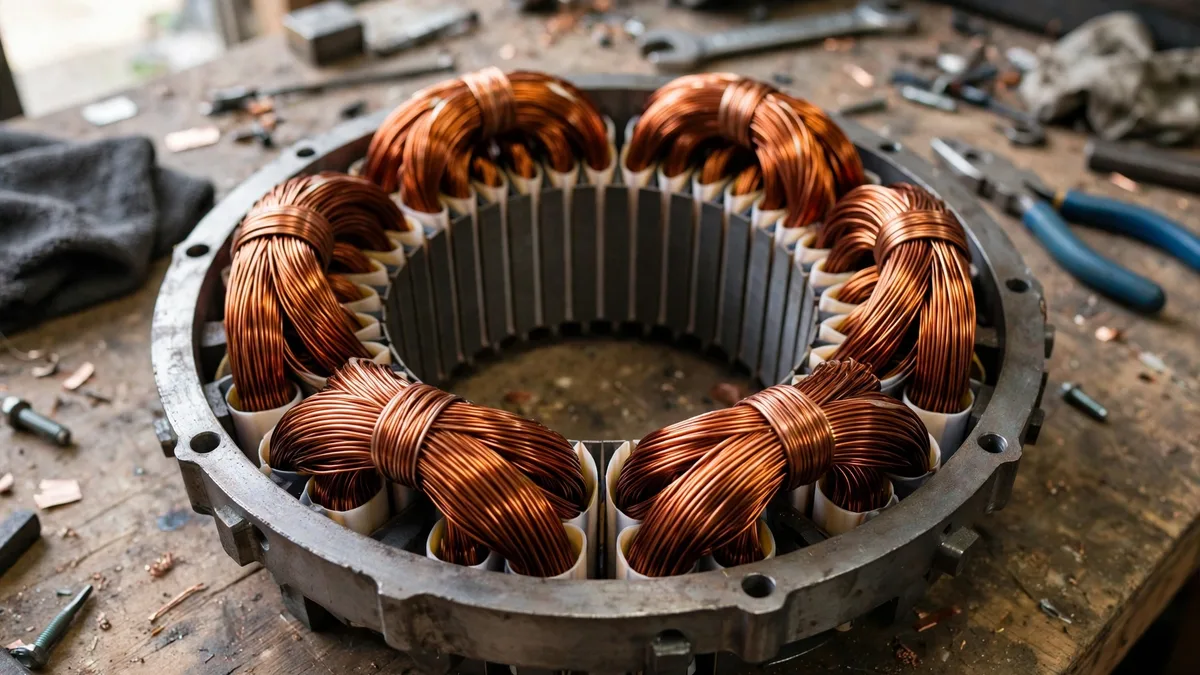
How an EV Motor Winding Works
A motor winding is a set of copper coils arranged around a ring of laminated steel called the stator. When current flows through the coils in a timed sequence, each coil becomes a small electromagnet, and together they make a magnetic field that rotates around the ring. The rotor in the middle chases that rotating field, and that chase is what turns the wheels. Control the timing and strength of the current, and you control the speed and the torque, smoothly and silently.
Step 1: Current creates the magnetic field
Every coil works on the same rule: current through a wire makes a magnetic field around it. Wind the wire into a coil and the field strengthens. In an EV motor, three separate sets of coils, one for each phase of the alternating current, are spaced around the stator. Feed them current in sequence and the field appears to rotate, sweeping around the ring dozens of times a second. The specifications of an EV motor winding start with that three-phase layout, which is what makes the field spin instead of merely pulsing.
Step 2: The stator slots hold the coils
The stator is a ring of thin steel sheets, laminated to stop wasteful currents swirling inside the metal, with slots cut around its inner edge. The copper coils sit in those slots, one side of each coil in one slot and the other side several slots away. The slots keep the copper exactly where the magnetic design needs it, and the steel around them carries the magnetic flux across the small air gap to the rotor. Too wide a gap and the field weakens; too narrow and the rotor cannot spin freely.
Step 3: The winding pattern sets the poles
How the coils are connected decides how many magnetic poles the motor has. A winding can be arranged as two poles, four, six or more, and the pole count sets the motor’s character: fewer poles mean higher speed, more poles mean more torque at low speed. Most EV motors use four to eight poles, a compromise that gives strong pull from a standstill and still spins fast enough for motorway cruising.
Step 4: Hairpin bars pack the copper tighter
Modern EV motors increasingly use hairpin windings: instead of round wire, the coils are made from thick rectangular copper bars, bent into hairpin shapes, pushed into the stator slots, and welded at the ends. The flat bars fill the slot far more completely than round wire, so more copper fits in the same space and the motor makes more power for its size. The welds are done by laser, hundreds of them, each one checked, because a single bad joint adds resistance and heat. The EV inverter feeds these windings the precisely timed alternating current they need, switching thousands of times a second.

Step 5: Insulation keeps the voltage in its lane
Copper coils sit millimetres apart carrying hundreds of volts, so insulation is everywhere: enamel on every wire, paper liners in every slot, and resin poured over the finished winding to lock it solid. The insulation must survive heat, vibration and voltage spikes for the life of the car. If it fails, current leaks between turns and the coil short-circuits, cooking itself in seconds. That is why windings are tested with high voltage before they ever meet a rotor.
Step 6: The rotating field drags the rotor
With current flowing, the stator’s field sweeps around the ring, and the rotor follows it. In a permanent-magnet motor, the rotor carries strong magnets that lock onto the field and turn in step with it, giving instant torque and high efficiency. In an induction motor, the field induces currents in the rotor’s own bars, and those currents make a second field that chases the first, always a step behind. Either way, the winding never touches the rotor.
Step 7: Cooling carries the heat away
A winding carrying hundreds of amps makes heat, and copper loses efficiency as it warms. So the stator is cooled, usually by oil sprayed directly onto the winding ends, or by water jackets in the housing around it. Temperature sensors buried in the winding tell the car’s computer to ease off the power if things get too hot, which is why an EV can sprint hard for a while and then quietly limit itself. The electric axle of an EV packages this cooled motor together with its gearbox, so the winding’s heat is managed as part of one compact unit.

| Specification | Typical value |
|---|---|
| Winding type | Three-phase, hairpin or round-wire coils |
| Copper per motor | About 10 to 20 kilograms |
| Operating voltage | 400 volts, or 800 volts on newer cars |
| Peak current | About 400 to 800 amps |
| Motor speed | Up to 15,000 to 20,000 revolutions per minute |
| Winding temperature | Up to about 180 degrees Celsius at the hottest spot |
| Motor efficiency | About 90 to 97 percent |
Price is best judged by the motor as a whole, since a winding is never sold on its own. Industry estimates put a complete EV traction motor at roughly 1,000 to 3,000 US dollars depending on size and power, with the copper winding itself accounting for a few hundred dollars of that, mostly the cost of the copper and the precision winding work. A rewind of a damaged motor by a specialist can cost 1,500 to 4,000 dollars (estimate), largely labour, because the stator must be stripped, rewound and retested by hand. Those are estimates (estimate), not list prices.
A rare fact: the copper in an EV motor winding is so pure that it is almost a different material from the copper in a household wire. Motor copper is refined to 99.99 percent purity, because even tiny traces of other metals raise its electrical resistance and steal efficiency. It is then drawn, enamelled and wound without ever being allowed to kink, because a kink thins the enamel and invites a short.
The EV motor winding works because copper, steel and timing agree to make a magnetic field that spins without moving. No brushes wear out, no fuel burns, and the only moving part is the rotor chasing a field it can never catch. When you press the accelerator and the car surges forward in silence, that is the winding doing its work.


