On a night train out of the city, a woman across the aisle opened her bag and took out something the size of a paperback novel. She unfolded it again, and it became a sheet of glass nearly as wide as the seat-back tray, glowing with a film she had paused halfway through. He was watching a tablet that refused to stay one shape, and wondering how anything that thin could fold twice without breaking.
A foldable tablet is not a phone that got bigger, and it is not a laptop that lost its keyboard. It is a whole new kind of machine, built around a single impossible demand: a screen the size of a magazine that folds down to the size of a book, thousands of times, without a crease, a crack, or a dead pixel.
The factory that makes a foldable tablet looks less like an electronics plant and more like a watchmaker’s workshop crossed with a glassworks. The build takes the tablet through six careful stages, from a sheet of flexible glass to a finished device that opens and closes like a book, and every stage exists to solve the same problem: how to fold a computer without breaking it.

How a Foldable Tablet Is Made
The build starts with a question that has no easy answer: how do you fold a screen that was never meant to bend? The display bends, the hinge guides it, the body protects it, and the battery and electronics split themselves across the fold so nothing is ever stretched too far.
Step 1: Designing the fold
Before any material is cut, engineers spend months deciding exactly how the tablet will fold. A tablet screen is wider than a phone screen, so the curve it makes when it closes is longer, and a sharp crease would destroy it in weeks. The designers map the smallest bend radius the display can survive, then shape the fold as a gentle teardrop loop, a curve that gives the glass room to breathe. Every decision here ripples through the rest of the build, because the fold is the one thing nothing else can work around.
Step 2: Making the flexible display
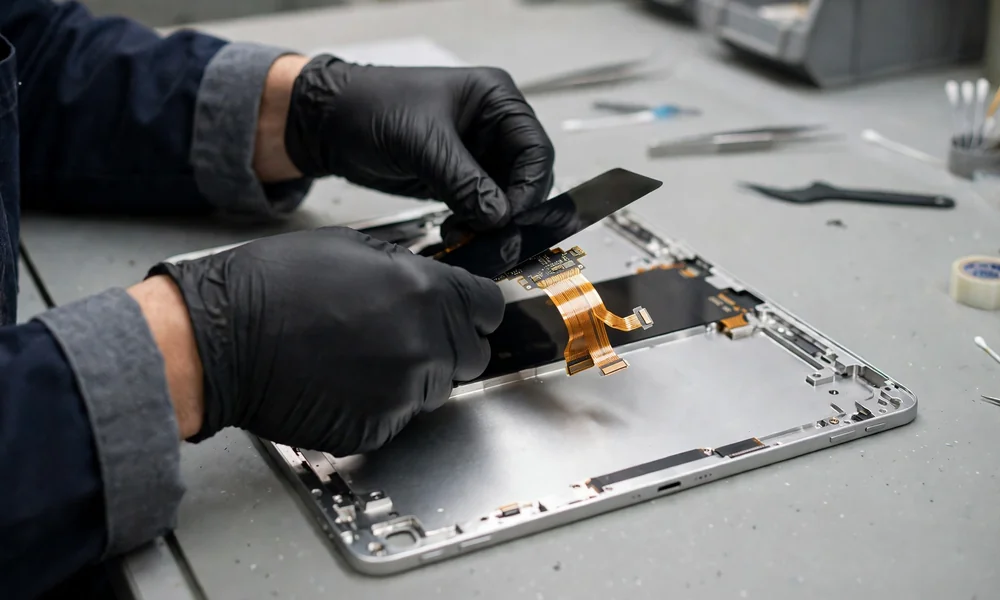
The heart of the tablet is its display, a flexible OLED panel built on a thin plastic base instead of rigid glass. Over the top goes a layer of ultra-thin glass, a sheet so fine it can bend like plastic, sealed with a clear encapsulation that keeps out moisture and oxygen, the two enemies that would kill the organic layers within days. The result is a screen that can fold flat and open again without a single dead pixel, and the craft of making it is described in detail in how a foldable display is made, where the layers and the sealing process are the whole story.
Step 3: Building the hinge into the body
The hinge is the part the user never sees and the tablet cannot live without. A long spine of stainless steel or titanium runs down the centre of the device, machined with internal ribs for stiffness, carrying the gears and cams that keep both halves moving in perfect sync. Its own build is a story in itself, and it is told in full in how a foldable phone hinge is made, which covers the gears, the synchronising, and the testing that keep the fold true.
Step 4: Machining the two body halves
With the hinge defined, the factory turns to the body. Each half starts as a block of aluminium alloy, milled on computer-controlled machines into a shell barely a few millimetres thick, with pockets carved out for the battery, the processor, the cameras, and the speakers. The two halves are not twins: one carries the main processor and the larger battery cell, the other carries the secondary battery and the antenna array, and each is machined to fit its own contents exactly. When the two shells close, they must meet flush, with a gap no wider than a hair.
Step 5: Fitting the split battery and electronics
A foldable tablet cannot use a single battery, because a battery cannot bend. Instead, the tablet carries two battery cells, one in each half, joined by a flexible circuit that crosses the hinge like a ribbon, bending a fraction of a millimetre every time the tablet folds. Every wire that crosses the fold is a flexible printed circuit, designed to survive 200,000 bends, and every connector is tested before the screen goes on, because once the display is bonded in place, there is no easy way back inside.
Step 6: Assembly, calibration, and the fold test
The flexible display is bonded to the two body halves over a floating steel plate that slides a fraction of a millimetre as the tablet folds, giving the screen room to move without stretching. Then the tablet goes to the test rigs, where robots open and close it thousands of times, checking for looseness, creaks, and screen damage, and where it is dropped, baked, and frozen. Only a tablet that survives the full programme earns its box, and the way its screen keeps working through all of it is the same bending trick explained in how a foldable display works, a panel that bends without ever breaking.
Foldable Tablet Specifications
| Specification | Typical figure |
|---|---|
| Display size open | 11 to 14 inches diagonal |
| Display type | Flexible OLED with ultra-thin glass |
| Folded thickness | 11 to 13 millimetres |
| Unfolded thickness | 5 to 6 millimetres |
| Rated fold life | 200,000 folds |
| Battery | Split dual-cell, 8,000 to 12,000 milliamp-hours total |
| Body material | Aluminium alloy, stainless steel or titanium hinge |
| Main processor | Flagship mobile chipset with vapour-chamber cooling |
What Does a Foldable Tablet Cost?
Current models typically sell for an estimated $1,800 to $2,500, a premium driven by the flexible display and the hinge, which together cost several times more than the screen and frame of a rigid tablet. If the screen is damaged outside warranty, a repair typically costs an estimated $600 to $1,000, because the display, hinge, and frame are usually replaced as one assembly. Those figures are estimates, and they vary by model and region, but they explain why the foldable tablet is still a luxury object: you are paying for a screen that bends, and for the factory that learned how to make it bend.
A Rare Fact About Foldable Tablets
Here is the detail most people miss: a foldable tablet does not actually fold its screen in half. When the tablet closes, the display curls into a tiny teardrop-shaped loop inside the hinge, a curve so gentle the glass never feels the bend at all. Every time you fold the tablet shut, the most expensive part of the device is quietly disappearing into a space designed just for it.

A foldable tablet is a strange object: a computer that pretends to be a book, a screen that pretends to be paper, and a machine that spends its whole life folding and unfolding without ever complaining. It is a machine built around a single moving part, and that part is the whole point. The next time you see one open on a train, watch the fold, not the screen. The screen is the show. The fold is the trick.


