Fold a phone in half and watch the screen. A decade ago that sentence would have sounded like a trick. Glass does not bend, and a display is a sandwich of glass, so a folding screen should be impossible. Yet the phone in your hand folds flat, opens again, and shows no crease, no crack, and no dead pixels. The trick is not one invention but a chain of them: a new kind of glass, a new kind of plastic, and a display built layer by layer like a sheet of paper that happens to glow.
A foldable display is the most delicate object in modern electronics, and it is made in some of the cleanest rooms on Earth. A single speck of dust can ruin a panel worth hundreds of dollars, and a fold that is a fraction of a millimetre too tight can crack the whole screen. The factories that build them are a cross between a printing press and a laboratory, and the process is so demanding that for years only a handful of companies in the world could do it at all. This is how a foldable display is made.

How It’s Made
Step 1: Making the flexible substrate
Every display starts with a base layer, and a foldable display cannot use rigid glass. Instead the base is a thin sheet of polyimide, a amber-coloured plastic that stays flexible at high temperatures and can survive the hundreds of degrees used later in the process. The polyimide is coated onto a rigid glass carrier plate so it can be handled like an ordinary sheet of glass through the factory, and it is baked until it is perfectly flat. This plastic sheet, thinner than a human hair, will carry every layer that follows. The idea of building electronics on a flexible base is the same principle behind the paper-thin screens described in our guide to e-ink display materials.
Step 2: Building the transistor backplane
On top of the polyimide, the factory builds the backplane: millions of thin-film transistors that switch each pixel on and off. The transistors are made by depositing layers of silicon and metal in a vacuum, then patterning them with photolithography, the same process used to make computer chips. For foldable displays the transistors are usually made from low-temperature polycrystalline silicon, which switches fast enough for a smooth, bright screen. The backplane is inspected after every layer, because a single faulty transistor means a dead pixel, and a dead pixel means a scrapped panel.
Step 3: Depositing the OLED layers
Now comes the part that actually makes light. In a vacuum chamber, organic materials are evaporated onto the backplane through a fine metal mask, building up the red, green, and blue subpixels one layer at a time. Each layer is only tens of nanometres thick, and the whole OLED stack is thinner than a soap bubble. The evaporation must be perfectly even, because a patch that is a few atoms too thick will glow brighter than its neighbours. This is the most expensive step in the whole process, and it is done in cleanrooms a thousand times cleaner than an operating theatre.
Step 4: Encapsulating against air and water
Organic light-emitting materials die quickly if they meet oxygen or moisture, so the finished OLED stack is sealed under a thin-film encapsulation: alternating layers of inorganic and organic material that block air and water while staying flexible. The encapsulation is built up one layer at a time, and it must be perfect, because a single pinhole can let in enough moisture to grow a black spot across the screen over months of use. When the encapsulation is done, the display is already a working screen, though it is still stuck to its glass carrier.
Step 5: Adding the ultra-thin glass and touch layer
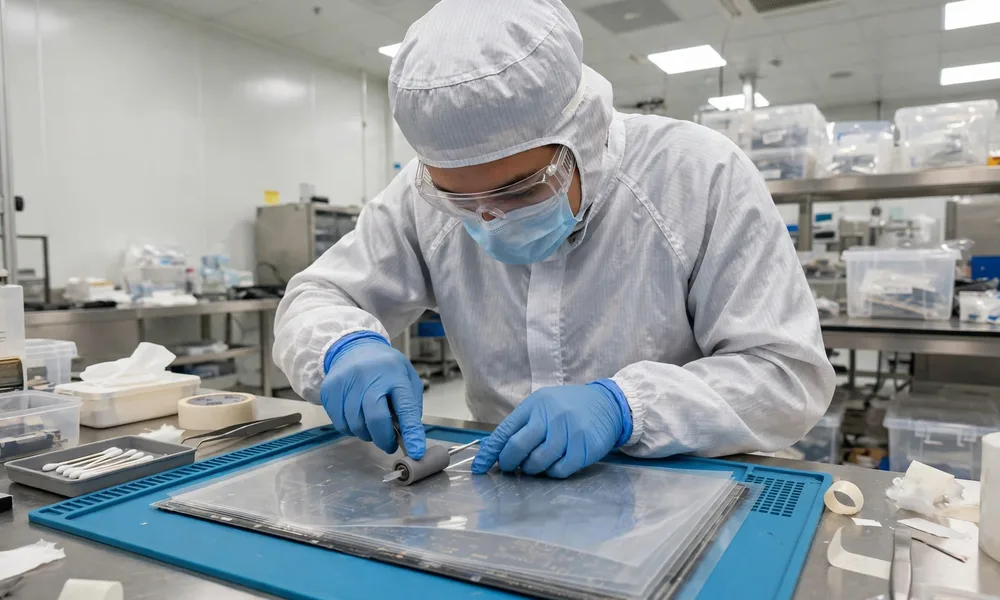
A foldable display needs a protective cover, and ordinary glass is too stiff. The answer is ultra-thin glass, a sheet of chemically strengthened glass only about 30 microns thick, thin enough to bend like paper. It is laminated onto the display with an optically clear adhesive, together with a flexible touch sensor layer and a polariser that cuts glare. The lamination is done under vacuum so no air bubbles are trapped between the layers, because a bubble over the folding area would become a crack the first time the phone is closed. Fitting delicate sensors into a bending stack is the same kind of challenge described in our look at fingerprint sensor materials.
Step 6: Cutting, folding, and testing
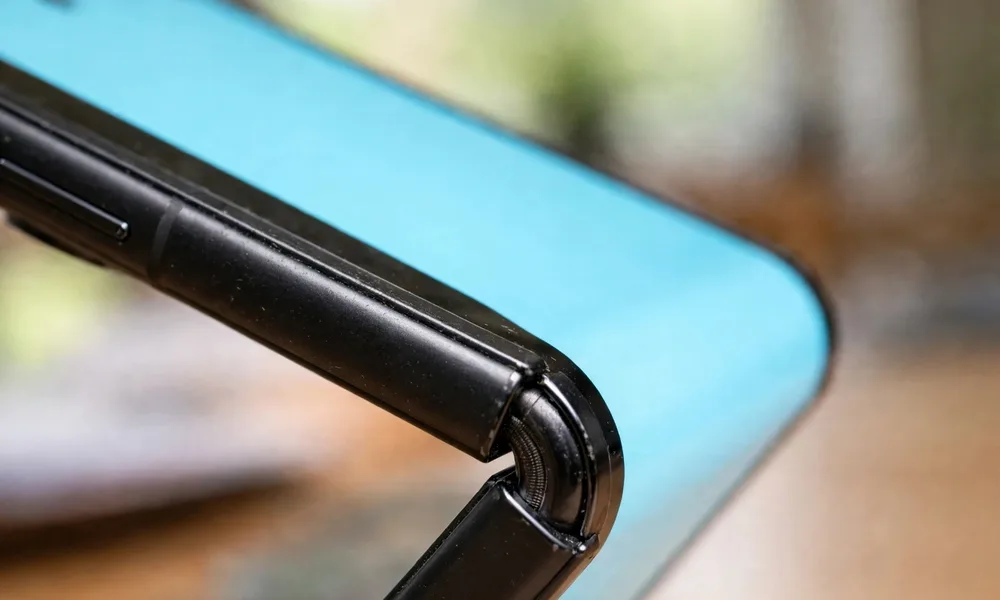
The finished display is laser-cut to size and peeled off its glass carrier, and then the real test begins. Each panel is folded and unfolded by machine, tens of thousands of times, while it is powered on, to prove the crease will not fail. Cameras and sensors check every pixel for brightness and colour, and panels that show even a faint line at the fold are rejected. Panels that pass are bonded to the phone’s hinge mechanism and shipped to the assembly plant. The folding itself is only possible because the display is designed to bend at a precise radius, and the engineers who tune that radius work with the same optical precision found in our guide to AR glasses waveguide materials.
Specs
| Specification | Detail |
|---|---|
| Display type | Flexible AMOLED with low-temperature polycrystalline silicon backplane |
| Substrate | Polyimide plastic film, thinner than a human hair |
| Cover material | Ultra-thin chemically strengthened glass, about 30 microns |
| OLED layer thickness | Tens of nanometres per layer |
| Fold durability | Typically rated for 200,000 folds or more |
| Typical panel size | 7 to 8 inches unfolded for a folding phone |
| Manufacturing environment | Cleanroom, thousands of times cleaner than an operating theatre |
| Encapsulation | Alternating inorganic and organic thin films |
Price
A foldable display is the single most expensive part of a folding phone. A replacement foldable panel typically costs $300 to $600 (estimate, based on typical repair pricing for folding phones), while the display module as supplied to the phone maker costs roughly $150 to $300 (estimate) depending on size and generation. The phone itself typically retails from around $1,500 to $1,800 (estimate) at launch, and the display accounts for a large share of that price. Costs fall as yields improve, but the cleanrooms, the vacuum evaporation equipment, and the low yield of early production runs keep foldable displays far more expensive than the rigid screens in ordinary phones.
Rare Fact
The ultra-thin glass that covers a foldable display is so thin that it can be rolled up like a sheet of paper, yet it is still real glass, made the same way as the glass in a window, only drawn far thinner and strengthened in a chemical bath. The first foldable phones did not use it at all; they used a plastic cover that scratched with a fingernail. The switch to ultra-thin glass was the breakthrough that made folding phones feel like real phones, and it happened because glassmakers learned to draw glass to a thickness of thirty microns, about a third the thickness of a human hair, without it shattering. A material we think of as the definition of rigid turned out to be flexible, as long as you make it thin enough.