The first time a foldable phone was unfolded in public, the room went quiet — not because of the screen, but because of the sound it did not make. There was no crack, no creak, no protest from the glass. A sheet of display folded in half simply opened flat, bright and unbroken, as if never bent at all. Behind that smooth motion sits one of the hardest problems in modern electronics: a display that is a screen and a hinge at once, folding two hundred thousand times without showing a line where it bent.
A foldable display is not a normal screen made bendy. Every layer of an ordinary phone screen — the glass, the light-emitting diodes, the touch sensor, the circuits that drive each pixel — is built on the assumption that it will stay flat forever. Fold it, and the outer layers stretch while the inner layers compress, and something has to give. Engineers spent a decade rethinking each layer, replacing rigid glass with a material that bends and building a hinge that controls exactly how the screen curves. The result is a phone that opens into a tablet, and a screen that has to survive a lifetime of being folded in a pocket.

How It Works
Step 1: The display starts with flexible OLED pixels
At the heart of a foldable display is an OLED panel, the same kind of screen used in high-end flat phones, built on thin plastic instead of rigid glass. Each pixel is a tiny organic light-emitting diode that makes its own light, so there is no backlight to crack. The panel is only a fraction of a millimetre thick, its layers all deposited on that flexible plastic base. Because the whole stack can flex, the panel can bend around a gentle curve without breaking.
Step 2: Ultra-thin glass adds protection without rigidity
A bare plastic display would scratch the first time it met a key, so the top layer is ultra-thin glass — real glass, only about 30 micrometres thick, a third the thickness of a human hair. At that thickness glass becomes flexible, able to bend without shattering, while still feeling like glass under a fingertip and resisting scratches far better than plastic. It is laminated to the OLED panel with a flexible adhesive, under a protective polymer film. The result bends like plastic and behaves like glass — one reason modern foldables feel so much more like ordinary phones.
Step 3: The neutral plane is where the fold hides
The cleverest idea in a foldable display is the neutral plane — the layer that neither stretches nor compresses when the screen bends. Engineers place the most fragile layer, the thin-film transistor circuits that control the pixels, exactly on that neutral plane, so folding barely stresses them at all. The layers above the plane stretch slightly and the layers below it compress slightly, and the adhesives between them are designed to let the layers slide a tiny amount against each other, like pages in a book. Getting this balance right is the difference between a screen that survives two hundred thousand folds and one that develops a bright line down the middle. The OLED panel at the centre of the display uses the same light-emitting principle as a flat phone screen, but every layer around it has been re-engineered for the fold.

Step 4: The hinge controls the curve
The display cannot fold itself safely, so the phone’s hinge does the job for it. A good hinge does not let the screen fold into a sharp V; instead it guides it around a gentle teardrop-shaped curve, spreading the bend across a few millimetres so no single point is stressed too much. Inside the hinge are tiny gears, cams, and springs that hold the phone open at several angles, and seals that sweep dust away every time it closes. The hinge is a mechanical watchmaker’s puzzle built to survive two hundred thousand cycles — and the foldable phone hinge that controls that curve is, in many ways, the harder engineering problem than the screen itself.
Step 5: The touch sensor and circuits flex too
A screen that cannot sense touch is useless, so the touch layer is built from a fine metal mesh or a flexible transparent conductor laminated into the stack, designed to stretch and relax with every fold. The circuits that drive the pixels are also redesigned: instead of rigid driver chips bonded to the edge of the glass, the connections are routed through flexible printed circuits that fold back behind the panel. The software plays a part too — it knows when the phone is half open, and can split the screen between two apps. Every fold is a quiet conversation between hardware and software.
Step 6: Testing that never stops
Before a foldable phone reaches a shop, its display has been folded by machines tens of thousands of times, in hot rooms and cold rooms, while cameras watch for the first sign of a crease or a dead pixel. Makers rate their phones for around two hundred thousand folds — about five years of daily use. The screens that pass are the ones whose layers slide rather than stick, whose neutral plane sits in exactly the right place, and whose hinge keeps the bend gentle every single time. It is a test regime no flat phone ever needed, and it is why a foldable costs so much more. The next generation of screens, including micro-LED displays with their tiny individual lights, promises even tougher panels — but for now, the flexible OLED remains the foldable’s beating heart.
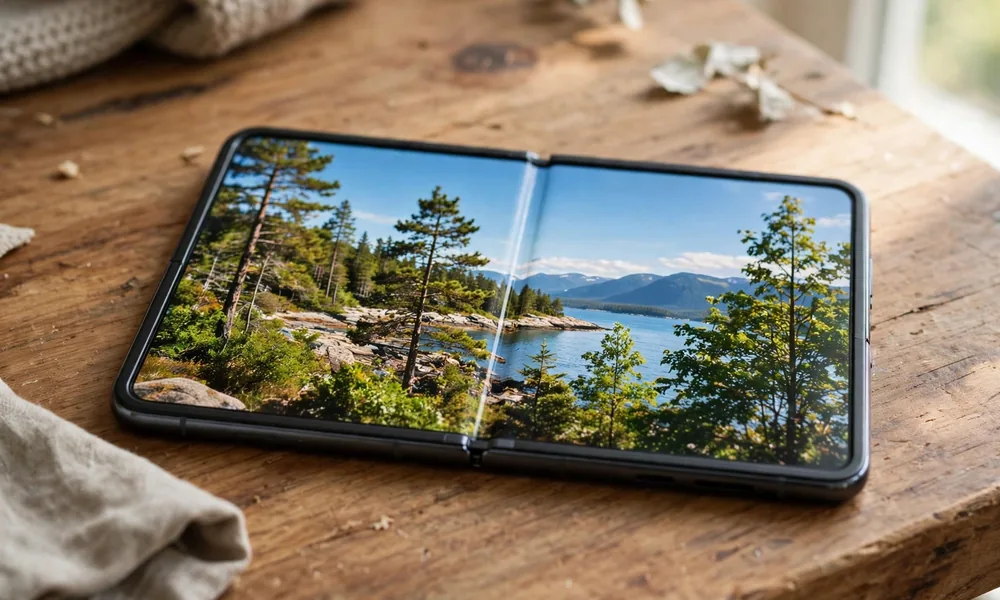
Specs
| Specification | Typical figure |
|---|---|
| Panel type | Flexible OLED on a plastic substrate |
| Cover material | Ultra-thin glass, around 30 micrometres thick |
| Fold rating | Around 200,000 folds |
| Inner screen size | Typically 7–8 inches when open |
| Outer screen size | Typically 6.2–6.4 inches when closed |
| Panel thickness | A fraction of a millimetre per layer |
| Bend radius | Around 1.5–3 mm at the fold |
| Touch layer | Flexible metal mesh or transparent conductor |
| Hinge mechanism | Geared multi-link hinge with dust seals |
| Refresh rate | Typically 120 Hz on the inner screen |
Price
A foldable display is one of the most expensive screens ever put in a phone. As an estimate, a replacement inner display for a flagship foldable costs roughly $500 to $900 including labour, while the phone itself typically sells for $1,500 to $2,000 — these are estimates, and the real figure depends on the brand, the screen size, and whether the hinge is damaged as well. The high cost comes from low yields: many panels fail testing, and the hinge is a precision mechanism in its own right. Prices are falling as factories improve, but a foldable screen remains a luxury component.
A Rare Fact
The first foldable phones did not use glass at all — their screens were protected only by a thin plastic film, and early reviewers famously peeled it off thinking it was a screen protector. The ultra-thin glass that replaced it is so thin that it can be bent around a pencil, yet it is made from the same kind of glass as a skyscraper window. The crease every foldable shows is a deliberate compromise: engineers could hide it, but only with a sharper fold — and a sharper fold would kill the screen far sooner.