At night, a hypercar announces itself before you see it, with a thin blade of white light that looks nothing like an ordinary headlight. That light is not a bulb in a tin box. It is a tiny computer-controlled projector, a lens ground to optical perfection, and a housing shaped by aerodynamics, all packed into a space smaller than a shoebox and sealed against rain, dust, and two hundred miles an hour of wind. It is one of the most complex parts on the whole car, and it is built almost entirely by hand.
A hypercar headlight must do three things that fight each other: throw light hundreds of metres down the road, fit into a body shape drawn by a stylist rather than an engineer, and survive heat, vibration, and stone strikes without ever fogging up. Meeting all three takes precision optics, exotic materials, and testing that would shame a camera factory. Here is how a hypercar headlight is made, step by step.

How a Hypercar Headlight Is Made
Step 1: Designing the optics on a computer
It starts in software, long before any metal is cut. Optical engineers model the beam pattern, deciding how the light should spread across the road, where the cutoff should fall so oncoming drivers are not blinded, and how the daytime running light should look as a signature shape. The housing is designed at the same time, because the headlight is part of the car’s aerodynamics, and its shape affects the air flowing over the front of the car. Prototypes are printed and tested in a dark room, where cameras measure the beam in fine detail, and the design is adjusted until the light is exactly right. Only then is the tooling ordered, and a single headlight mould can cost more than a family car.
Step 2: Moulding the lens
The clear front of the headlight is not glass but polycarbonate, a tough transparent plastic that is lighter and far harder to shatter. Pellets of polycarbonate are melted and injected into a polished steel mould under enormous pressure, forming a lens with curves accurate to a fraction of a millimetre. The mould itself is polished to a mirror finish, because any flaw in the steel becomes a flaw in the lens, scattering the beam. After moulding, the lens is coated with a hard lacquer that resists scratches and ultraviolet light, which would otherwise turn it yellow and cloudy within a few years. The finished lens is inspected under bright lights, and any with the smallest blemish are rejected.

Step 3: Building the LED modules
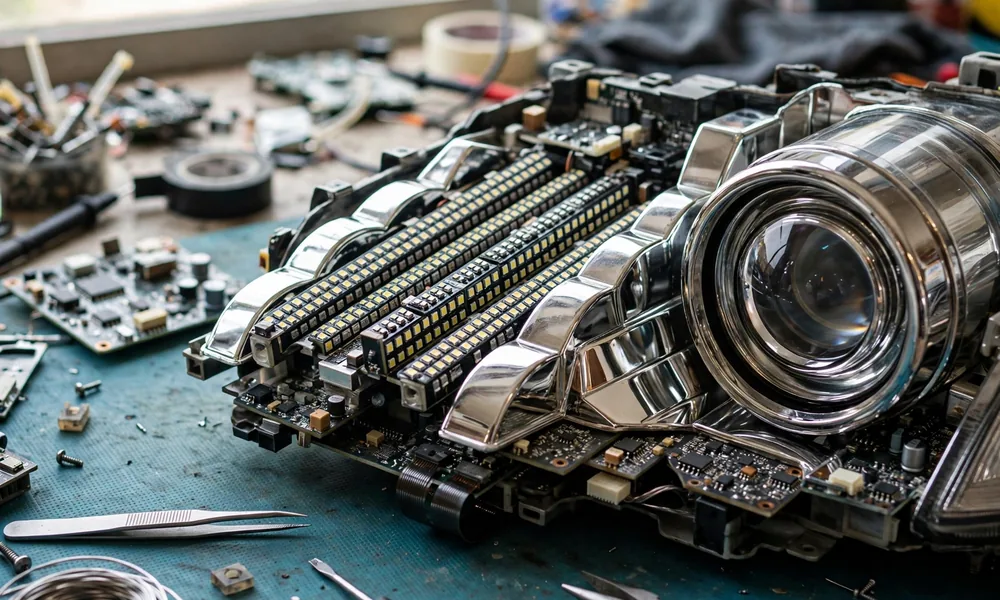
The light itself comes from light-emitting diodes, tiny chips mounted on circuit boards with their own heat sinks. Each module is assembled on a production line, with the LEDs soldered in place by machine, then wired to a driver that controls their brightness and, in the most advanced lights, switches individual LEDs on and off to shape the beam around other cars. The modules are tested as they are built, because a single dead LED in a matrix of hundreds would leave a dark spot in the beam. The LEDs, the lenses, and the housings that hold them are covered in the hypercar headlight materials engineering article.
Step 4: Coating the reflectors and housing
Behind the lens sits the reflector and the housing, and these are where the light is shaped. The reflector is moulded from plastic, then coated with a thin layer of aluminium in a vacuum chamber, giving it a mirror finish that bounces nearly all the light forward. The housing is moulded from a heat-resistant plastic, with ribs and vents that manage the heat from the LEDs, and metal inserts for the mounting bolts. Every part is handled with gloves, because a fingerprint on a reflector shows up as a flaw in the beam. This is also where the cost piles up, since the tooling and the coatings are expensive, as explained in the why hypercar headlight is so expensive article.
Step 5: Assembly and sealing
Assembly happens in a clean room, where workers fit the LED modules, the reflectors, the lens, and the wiring into the housing, working from a precise sequence that leaves no wire pinched and no seal twisted. The lens is bonded to the housing with adhesive, and the joint is cured under heat or ultraviolet light to form a seal that must keep water out for the life of the car. Some headlights have a small vent with a membrane that lets air pressure equalise without letting moisture in, which stops the lens fogging on a cold morning. Once assembled, the headlight is leak-tested, often by pressurising it and watching for any drop, because a single leak can fill the lens with condensation.
Step 6: Aiming and testing the beam
The finished headlight is powered up in a dark test room, where its beam is projected onto a wall and measured by cameras. Technicians check the brightness, the shape of the cutoff, and the alignment of every function, from dipped beam to indicators, and adjust the aim until it is perfect. The light is also tested for vibration, heat, and cold, and some units are run for hundreds of hours to prove the LEDs will last. Only then is the headlight packed and sent to the factory, where it is fitted to the car and aimed once more as part of the whole vehicle. The bodywork it sits in is shaped by the same obsession with air, covered in the how hypercar aerodynamic body is made article.
Hypercar Headlight Specs
| Specification | Typical figure |
|---|---|
| Light source | LED matrix, sometimes laser high beam |
| LED count | Dozens to over 1 million pixels in digital lights |
| Beam range | Around 300 to 600 metres on high beam |
| Lens material | Polycarbonate with hard coating |
| Reflector coating | Vacuum-deposited aluminium |
| Colour temperature | Around 5,500 to 6,500 kelvin |
| Operating voltage | 12 volts, driven by an electronic module |
| Sealing test | Pressurised leak test before shipping |
What a Hypercar Headlight Costs
A single hypercar headlight costs roughly 5,000 to 15,000 dollars (estimate), and a pair can cost more than a small car. The price comes from the tooling, which can run into millions of dollars for a production run of only a few hundred cars, plus the LED modules, the coated optics, and the hours of hand assembly and testing. A stone chip or a minor crash can therefore turn into a five-figure repair bill, and replacement lights are often made to order, with a wait of weeks. For the owner, the consolation is a light that is brighter, sharper, and more precisely aimed than anything fitted to an ordinary car.
A Rare Fact About the Hypercar Headlight
Here is a detail most people never hear: the most advanced hypercar headlights contain more than a million tiny mirrors or pixels, and they can project shapes onto the road. They can paint a warning symbol in front of the car, highlight a pedestrian at the roadside, or blank out just the part of the beam that would dazzle another driver, all while the rest of the road stays fully lit. The headlight has become a projector, and the road ahead is its screen, which is why it needs its own computer, its own cooling, and software updates like any other piece of electronics.