A hypercar headlight is not a lamp. It is a small, sealed machine that must throw a precise beam hundreds of metres down a dark road, survive stone chips at 200 miles per hour, shrug off heat, cold, rain and car washes, and still look like jewellery. Inside a housing barely bigger than a shoebox sit dozens of light sources, lenses, reflectors, cooling fins and electronics, each made from a different material chosen for what light and heat demand of it. The headlight is where optics, electronics and crash engineering meet.
This is the story of the materials inside that headlight, and of the trade-offs behind every lumen.

The Materials Behind the Hypercar Headlight
The headline materials are polycarbonate for the lens, aluminium for the heat sinks, and semiconductor chips for the light itself — LEDs, and in the most advanced cars, laser diodes. Around them sit reflectors coated in vapour-deposited aluminium, circuit boards, copper wiring, and a housing of glass-filled plastic sealed against water and dust. Even the glue matters: a headlight that fogs up is a headlight that has failed.
Step 1: The lens and its polycarbonate
The clear cover of a modern headlight is almost never glass. It is polycarbonate, a tough transparent plastic that is far lighter than glass and almost impossible to shatter — a stone that would crack glass merely scuffs polycarbonate. The lens is injection-moulded to a precise optical shape, then coated with a hard lacquer that resists scratches and yellowing from sunlight, because unprotected polycarbonate goes cloudy in the sun. The coating is only micrometres thick, but without it the lens would haze within a few years. Polycarbonate’s weakness is heat — it softens far below the temperatures a headlight can reach — so the lens is kept away from the hottest parts of the lamp, with air gaps and shields in between.
Step 2: LEDs and the light source
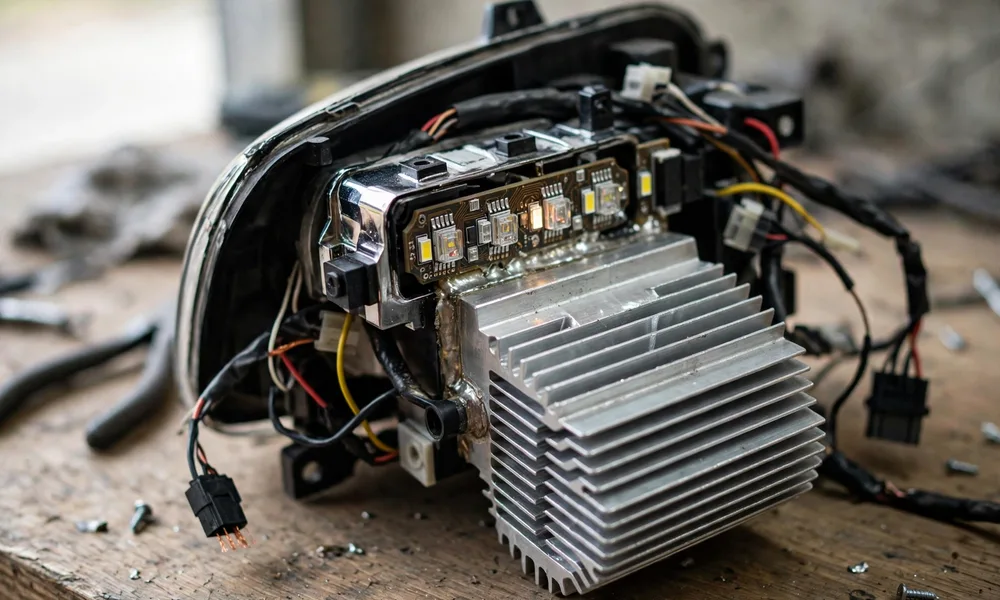
The light itself comes from light-emitting diodes, semiconductor chips usually made from gallium nitride on a sapphire or silicon carbide base. A single LED chip is smaller than a grain of rice, yet it can produce more light than an old halogen bulb while using a fraction of the energy. Hypercar headlights use arrays of them — dozens of individually controlled LEDs that can switch parts of the beam on and off, dimming around oncoming cars while keeping the rest of the road lit. The hypercar’s aerodynamic body shapes where the headlights can sit, and the lamps are often tucked into narrow slots that leave almost no room for cooling.
Step 3: Lasers and the long-range beam
Some top hypercars add laser diodes for the high beam. A laser diode produces an intense blue light that is shone onto a phosphor — a ceramic material that converts it into white light — creating a beam that can reach twice as far as an LED high beam. The phosphor is the clever part: it is a tiny ceramic plate, often based on cerium-doped garnet, that glows white when struck by blue laser light, and it must survive intense heat without degrading. Laser headlights are expensive and tightly regulated, because a raw laser beam would be dangerous, so the system is designed so the light can only leave the lamp as safe white light.
Step 4: Reflectors, lenses and the beam shape
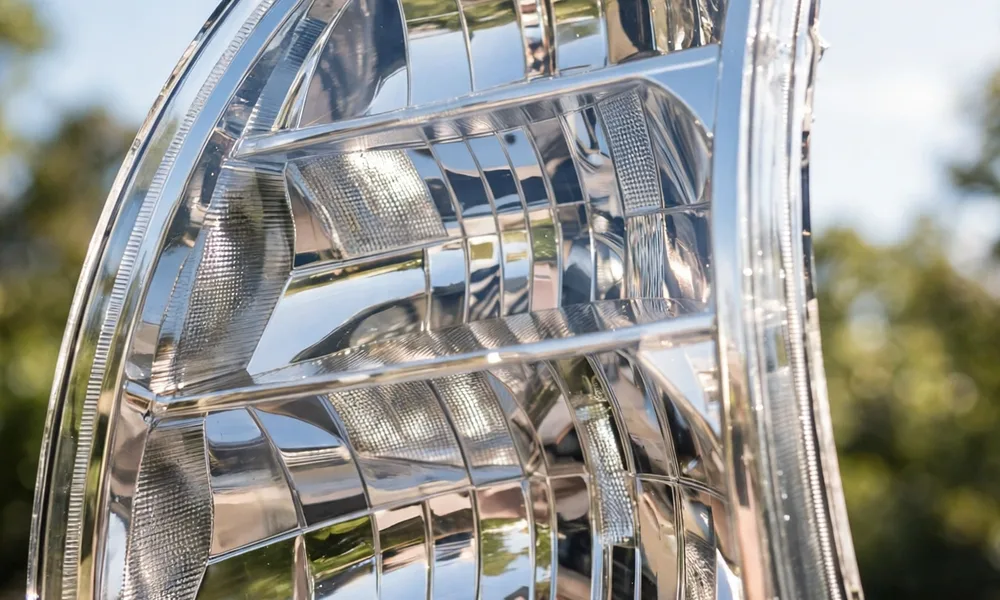
Making light is only half the job; shaping it is the other half. Inside the headlight, reflectors and projector lenses direct the light into a precise beam with a sharp cut-off, so the road is lit and oncoming drivers are not blinded. The reflectors are moulded plastic coated with a microscopically thin layer of aluminium, applied by vapour deposition in a vacuum chamber, which gives them a mirror finish that would be impossible to polish by hand. The Aston Martin Valkyrie’s materials show the same obsession with shaping: every surface, inside and out, is there for a reason.
Step 5: Heat sinks and the cooling problem
LEDs are efficient, but they still make heat, and heat is their enemy: a hot LED gets dimmer and dies sooner. So every headlight carries aluminium heat sinks — finned blocks of cast or extruded aluminium that pull heat away from the chips and dump it into the air inside the housing, where it escapes through vents or into the car’s bodywork. Aluminium is used because it conducts heat well, is light, and is easy to cast into complex fin shapes. The carbon fibre weave around the headlight complicates the problem, because carbon fibre conducts heat poorly, so the lamp must cool itself rather than leaning on the bodywork.
Step 6: The housing, the seal and the electronics
The headlight housing is usually a glass-filled thermoplastic — polypropylene or polycarbonate blended with glass fibres for stiffness — moulded into a rigid shell that holds the optics in exact alignment. The lens is bonded to the housing with a butyl or silicone sealant, and the whole lamp is tested for water and dust ingress, because a single drop of water inside will fog the lens and corrode the electronics. Inside the housing sits a control unit: a circuit board that drives the LEDs, talks to the car’s computer, and adjusts the beam for steering, speed and load.
Step 7: Testing, aiming and the law
Before a headlight is approved, it is tested against regulations that dictate exactly how bright the beam may be, where its cut-off must fall, and how it must behave when the car corners or brakes. The lamp is run for hundreds of hours, vibrated, frozen, baked and sprayed with water, and its beam pattern is measured on a wall with cameras. The result is a part that looks decorative and behaves like an instrument.
Hypercar Headlight at a Glance
| Specification | Detail |
|---|---|
| Lens | Polycarbonate, hard-coated against scratches and UV |
| Light source | LED arrays, laser diodes for long-range high beam |
| Phosphor | Cerium-doped garnet ceramic, converts blue laser to white |
| Reflectors | Moulded plastic, vapour-deposited aluminium coating |
| Cooling | Aluminium heat sinks, sometimes fans or heat pipes |
| Housing | Glass-filled thermoplastic, sealed against water and dust |
| Control | Electronic driver unit, adaptive beam control |
What Does It Cost?
A hypercar headlight typically costs $5,000 to $15,000 (estimate) per lamp, with laser and matrix LED units at the top of that range. A pair can add $10,000 to $30,000 (estimate) to a car’s price, and a replacement after a crash can cost more still, because the lamp is often sold only as a complete sealed unit. By comparison, a normal car headlight costs roughly $200 to $600 (estimate). The difference is the laser diodes, the precision optics, the aluminium cooling and the sealed, tested assembly.
A Rare Fact
The brightest hypercar headlights can throw a beam more than 600 metres down the road — further than six football pitches — yet the laser diodes that make it possible are so small that several of them would fit on a fingernail. The light they produce starts out blue and is turned white by a ceramic plate thinner than a coin, a trick borrowed from the phosphors inside ordinary white LEDs.


