A hypercar at full speed is held to the road not by its weight but by the air itself. The body is shaped so that the wind pushes it down, hard, with a force greater than the weight of the car, while the drag stays low enough for the engine to keep pushing it faster. Making a hypercar’s aerodynamic body is less like building a car and more like sculpting an aircraft that happens to have wheels.
The aerodynamic body of a hypercar is a carbon-fibre shell shaped to manage airflow: splitting it cleanly at the nose, channelling it through radiators and around the wheels, and accelerating it underneath the car to create downforce. The bodywork is not decoration. It is the part of the car that turns air from an enemy into an ally, and it is made in a process that mixes aerospace materials with coachbuilding craft. This is how a hypercar aerodynamic body is made.

How It’s Made
Step 1: Shaping the body in the wind tunnel
Long before any carbon fibre is cut, the body exists as a digital model and a scale model in a wind tunnel. Aerodynamicists test hundreds of shapes, watching smoke trails and measuring forces, looking for the shape that gives the most downforce with the least drag. The floor of the car matters as much as the top: the underbody is shaped like an upside-down wing, accelerating air beneath the car so the pressure drops and the car is sucked downwards.
Step 2: Making the moulds
Once the shape is settled, full-size moulds are made for every panel. A mould is a negative of the panel, machined from a solid block or built up from composite materials, then polished to a mirror finish, because every imperfection in the mould appears on the finished body. The moulds are also made to tolerances measured in fractions of a millimetre, because a panel that does not fit perfectly will disturb the airflow it was designed to manage.
Step 3: Laying up the carbon fibre
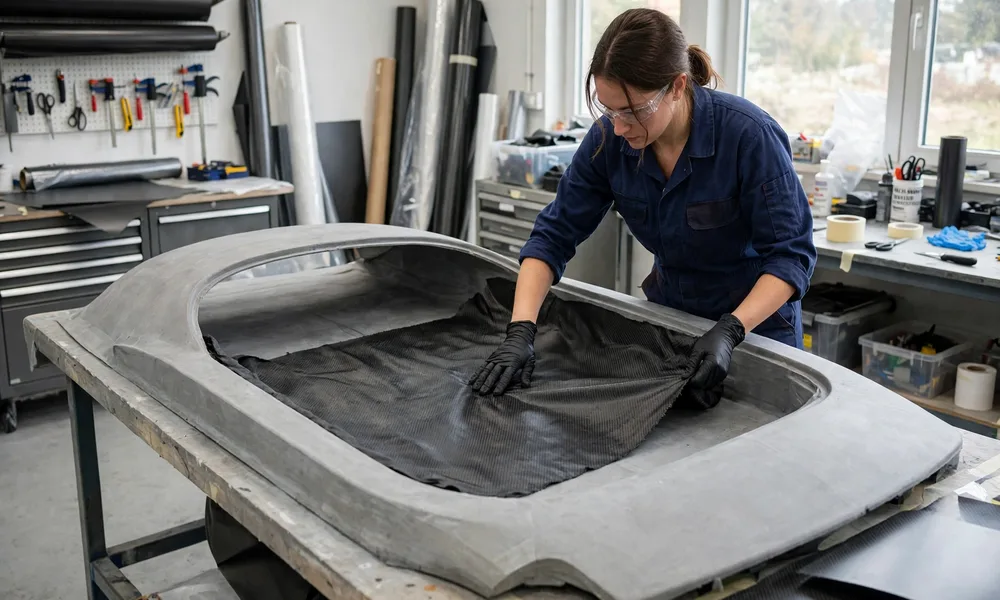
Carbon fibre arrives as a woven cloth, and the body panels are built by laying sheets of it into the mould by hand, one layer at a time. The direction of the weave matters: fibres carry loads along their length, so the layers are oriented to resist the forces each part of the panel will face, with some layers running lengthwise and others diagonally. Between the carbon layers, a lightweight honeycomb core is often added to stiffen the panel without adding weight. A single panel can take dozens of layers, and a skilled laminator will spend hours on one piece, pressing each layer into the mould’s curves and smoothing out any air bubbles. The materials behind these panels are explored in hypercar aerodynamic body materials engineering, which lists the fibres and resins that make the body possible.
Step 4: Curing the panels in the autoclave
With the layers in place, the mould is sealed in a vacuum bag and placed in an autoclave, a giant oven that applies heat and pressure at the same time. The heat cures the resin that binds the carbon fibres together, turning the soft cloth into a rigid panel, while the pressure squeezes out any remaining air. The curing cycle is carefully controlled: too hot and the resin degrades, too cool and it never fully hardens. The factory floor where this work happens is the same kind of place shown in inside hypercar aerodynamic body production, where each panel is built by hand.
Step 5: Fitting the active aerodynamics
Many hypercars do not have fixed bodywork. They have active aerodynamics: wings that tilt, flaps that open, and airbrakes that rise, all controlled by the car’s computers in real time. These moving parts are built into the body during assembly, with hydraulic or electric actuators hidden inside the carbon structure and wired to sensors that read speed, steering and braking. Fitting these systems means cutting openings in the bodywork, mounting the actuators, and testing each moving part through thousands of cycles before the car ever drives. A flap that sticks at speed can unbalance the car, so the mechanisms are tested to a standard no ordinary car part ever faces.
Step 6: Painting and finishing
A carbon-fibre panel fresh from the mould is rough and dull, and it must be finished to a standard closer to a piano than a car. The panels are sanded, primed, and painted in a dust-free booth, often with many coats that are sanded between layers. The finish is not just cosmetic: it protects the carbon from ultraviolet light and moisture, both of which degrade the resin over time. The gaps between panels are checked with feeler gauges, because a gap that is a millimetre too wide disturbs the airflow and can whistle at speed. The engine that the bodywork wraps around is its own masterpiece of engineering, as how a hypercar V12 engine is made describes, but the body is what lets that engine’s power reach the road.
Step 7: Testing the finished body at speed
The assembled car goes back to the wind tunnel as a full-size vehicle, and then to the test track. Engineers measure the downforce at different speeds, check that the cooling airflow reaches the radiators and brakes, and listen for wind noise that signals a panel out of place. The car is driven at high speed while sensors record the forces on the body, and the data is compared with the wind tunnel predictions.

Specs
| Specification | Typical figure |
|---|---|
| Material | Carbon fibre with honeycomb core, bonded with epoxy resin |
| Construction | Hand-laid laminate, autoclave-cured |
| Downforce | Often more than the car’s own weight at top speed |
| Drag coefficient | Roughly 0.30 to 0.40, varying with active aero settings |
| Active aerodynamics | Adjustable rear wing, flaps and airbrake |
| Underbody | Shaped floor with diffuser, generating ground effect |
| Panel inspection | Ultrasound or X-ray for hidden voids |
| Production volume | Tens to a few hundred cars per model |
| Finish | Multi-coat paint or exposed carbon weave |
Price
An aerodynamic body is part of a hypercar, not a product sold on its own, so there is no retail price for one. As an estimate, the carbon-fibre bodywork of a hypercar generally costs the manufacturer in the region of $100,000 to $300,000, including moulds, materials and hand labour, depending on the complexity of the active aerodynamics — these are estimates, and the true figures are commercial secrets. The cars themselves typically sell for roughly $2 million to $5 million, also an estimate.
A Rare Fact
The first car to use ground effect, the principle that sucks a hypercar to the road, was not a road car at all. It was the Lotus 79 Formula 1 car of 1978, designed by Colin Chapman, which shaped its underbody into venturi tunnels that accelerated air beneath the car. Road-going hypercars revived the idea legally, and every modern hypercar carries a piece of that 1978 racing car underneath it.
From wind tunnel smoke to hand-laid carbon fibre, the hypercar aerodynamic body is made by treating air as a building material.


