In a clean workshop in the corner of the factory, a machine the size of a small wardrobe is taking shape, and it does not look like much yet. There is a metal frame bolted to a bench, a set of shiny rails running down its sides, and a small brass nozzle hanging from a carriage like a pen waiting for paper. In a few days this skeleton will be a luxury 3D printer.
This is how a luxury 3D printer is made, from the machined frame and the calibrated rails to the heated print head, the tuned extruder and the first perfect print, where a test object is measured against the drawing it came from.
Step 1: The frame is machined and squared
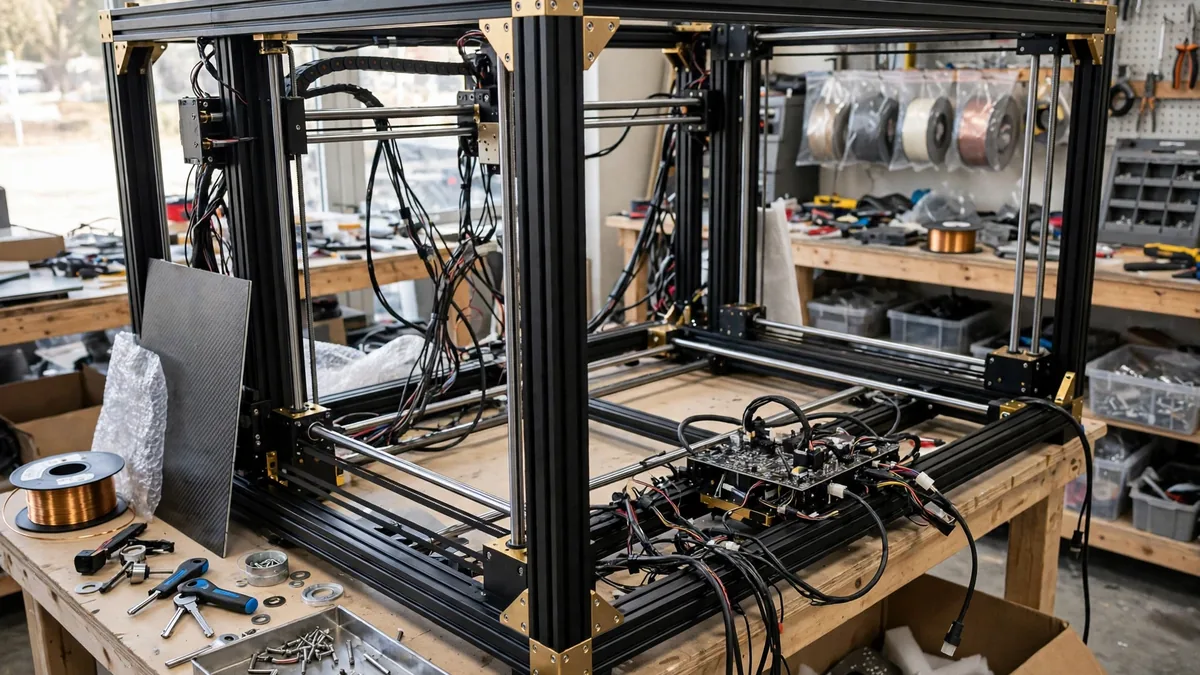
Every luxury 3D printer starts as a frame, and the frame decides everything that follows. It is usually cut from thick aluminium extrusion or a welded steel box section, then milled flat on a machine tool so that every face is true. The parts are bolted together on a surface plate, a slab of granite ground flat to within a hair, and each corner is checked with a square and a dial gauge. If the frame is out by even a fraction of a millimetre, every object the printer makes will carry that error, so the builders take their time here. The story of how metal 3D printing is made shows what happens when the material is powdered metal rather than plastic.
Step 2: The rails and motion system are fitted
With the frame square, the motion system goes in. Hardened steel rails are bolted to the frame, and small carriages ride along them on recirculating ball bearings, so smooth that a fingertip push will send one gliding. Belts or ball screws connect the carriages to stepper motors, and the motors are chosen for quiet, precise steps rather than raw speed. Each axis is then moved back and forth by hand and by motor, and a dial gauge checks that it runs straight over its full travel.
Step 3: The print head and extruder are built
The print head is the business end of the machine, and it is assembled like a small piece of jewellery. A heater block holds a brass or hardened steel nozzle with a hole less than half a millimetre wide, and a temperature sensor sits beside it, reading the heat many times a second. Above the heater sits a heat break and a cooling fan, keeping the plastic solid until exactly the right moment, and above that the extruder, a set of gears that grips the filament and pushes it down at a carefully controlled rate.

Step 4: The heated bed and chamber are fitted
Under the print head sits the bed, a flat plate that the object grows on. On a luxury machine the bed is a thick aluminium plate with a heater bonded underneath, covered by a spring steel sheet with a textured coating that the plastic grips while hot and releases when cool. The bed is mounted on three or four screws so it can be levelled, and it is levelled with a feeler gauge until the gap under the nozzle is the same at every corner. Around the frame go the enclosure panels, often with a glass door, and inside the chamber a second heater and a filter keep the air warm and clean. The story of how additive manufacturing is made shows the same care with sealed, controlled conditions at factory scale.
Step 5: The electronics and firmware are wired in
With the mechanics done, the printer gains its brain. A main board is mounted in a compartment away from the heat, and thick cables run from it to each motor, heater, sensor and fan, routed through clips so they never snag on a moving carriage. Then the firmware is loaded, the software that turns a digital model into thousands of tiny movements, and each motor is told how far it moves per step. A test pattern is then run on each axis, and the builders measure the travel with a gauge to confirm the motors move exactly as far as the software believes.
Step 6: Calibration, first print and final test
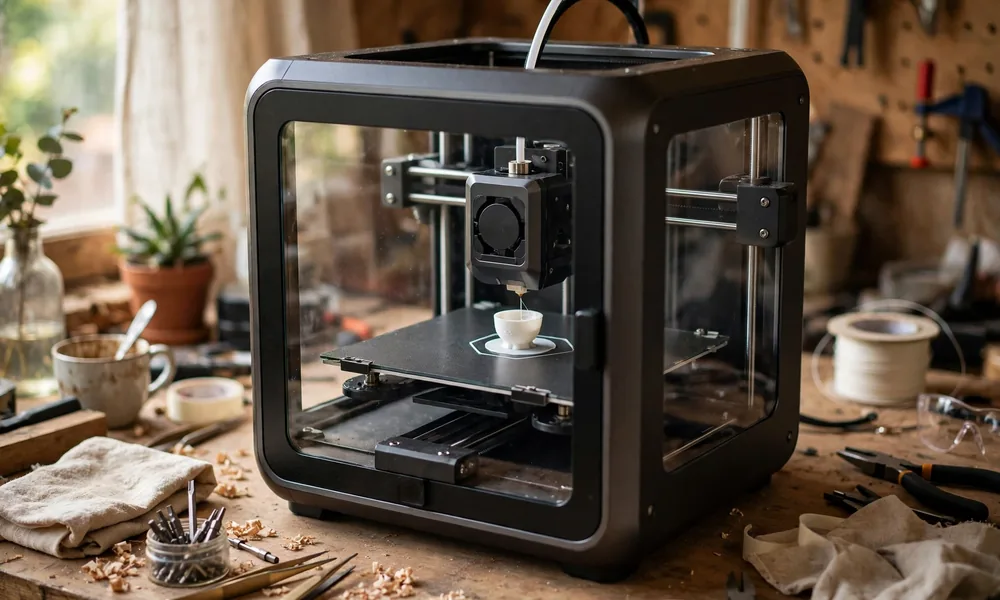
Before a luxury 3D printer leaves the factory, it has to prove itself. The bed is levelled once more, the nozzle height is set with a sheet of paper, and a test print is started, usually a small calibration object with fine details, overhangs and sharp corners. The builders watch the first layer go down, because a good first layer is flat, even and firmly stuck, and then they leave the machine to finish. When the print is done, it is measured with callipers against the drawing, weighed, and checked for stringing, gaps and warping. Only a printer that passes is cleaned, wiped down, and packed with a spool of filament, a spare nozzle and its tools. A look at inside additive manufacturing production shows the same discipline at factory scale.
The spec sheet at a glance
| Specification | Typical luxury figure | What it tells you |
|---|---|---|
| Build volume | 300 x 300 x 300 mm or larger | How big an object it can print |
| Frame | Machined aluminium or steel | How rigid and accurate the machine is |
| Motion | Linear rails on three axes | How smooth and repeatable the movement is |
| Nozzle | 0.4 mm brass or hardened steel | How fine the printed detail can be |
| Layer height | 0.05 to 0.3 mm | How smooth the finished surface looks |
| Print temperature | Up to 300 degrees Celsius | Which plastics and composites it can use |
| Bed | Heated, up to 120 degrees Celsius | How well large prints stay stuck and flat |
| Chamber | Enclosed, heated and filtered | How stable large prints stay as they cool |
| Print speed | Up to 300 mm per second | How fast a large object finishes |
What good build looks like
A well-made luxury 3D printer gives itself away in small details. The frame should feel dead solid when you push it, with no flex and no rattle, and the carriages should glide on their rails without a hint of grinding.
What it costs
A luxury 3D printer typically costs an estimated $5,000 to $25,000, depending on the build volume, the chamber, the materials it can print and whether it handles engineering plastics or composites. The estimate covers the printer alone, not filament, spare parts or software. The price is mostly in the frame, the rails and the motion system.
A rare fact
One detail few owners ever learn is that the brass nozzle on a luxury printer is a consumable, and it wears out from the inside. Abrasive filaments loaded with carbon fibre or glass slowly grind the tiny hole wider, so a nozzle that started at 0.4 millimetres can quietly grow to 0.5, and prints start coming out fatter and less detailed without any warning on the screen.
From a machined frame on a granite plate to a finished print measured with callipers, a luxury 3D printer is made in slow, squared stages, each one checked before the next begins. The result is a machine that turns drawings into objects while its owner sleeps.