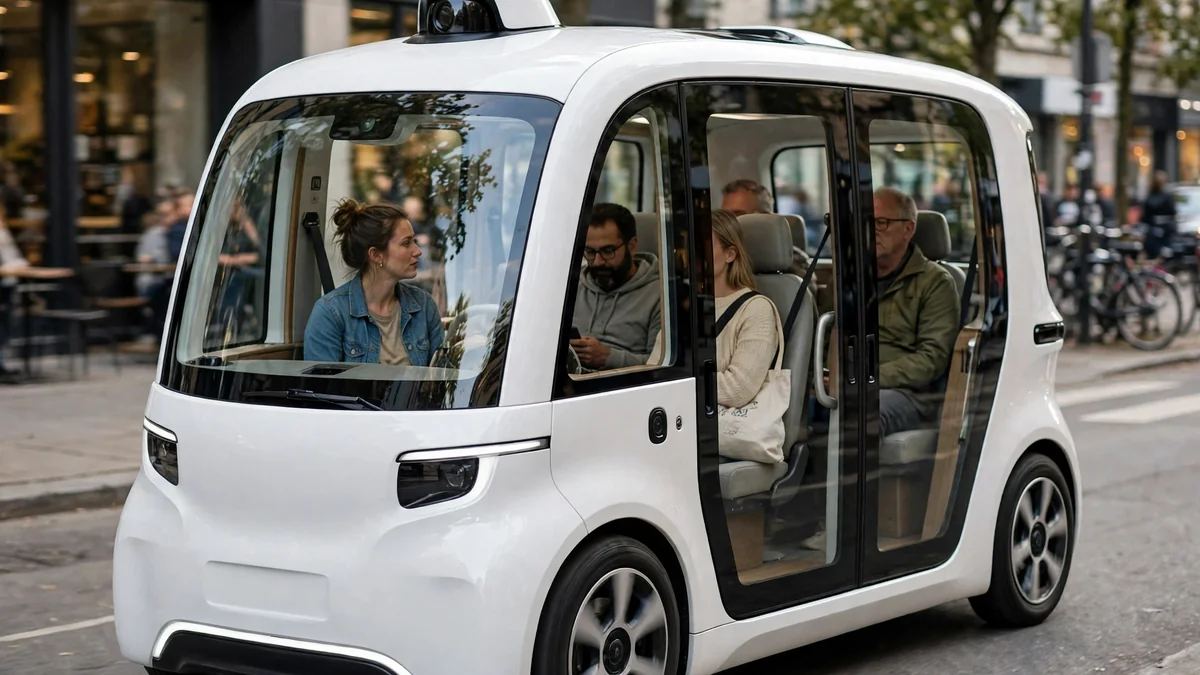
It pulls up to the kerb without a driver, its doors slide open, and the seats inside are arranged like a small lounge, facing each other across a low table. Nobody is sitting at the front, because there is no front in the usual sense: no steering wheel, no pedals, no dashboard. The luxury autonomous shuttle is the strangest vehicle on the road, and also one of the calmest, because it never hurries, never gets tired, and never looks at its phone.
These shuttles are appearing in city centres, airports, university campuses, and luxury resorts, carrying small groups of passengers on short, fixed routes. This guide explains how a luxury autonomous shuttle works, from the sensors on its roof to the safety systems that watch over every metre of its journey.
How It Works
Step 1: Seeing the world with lidar and cameras
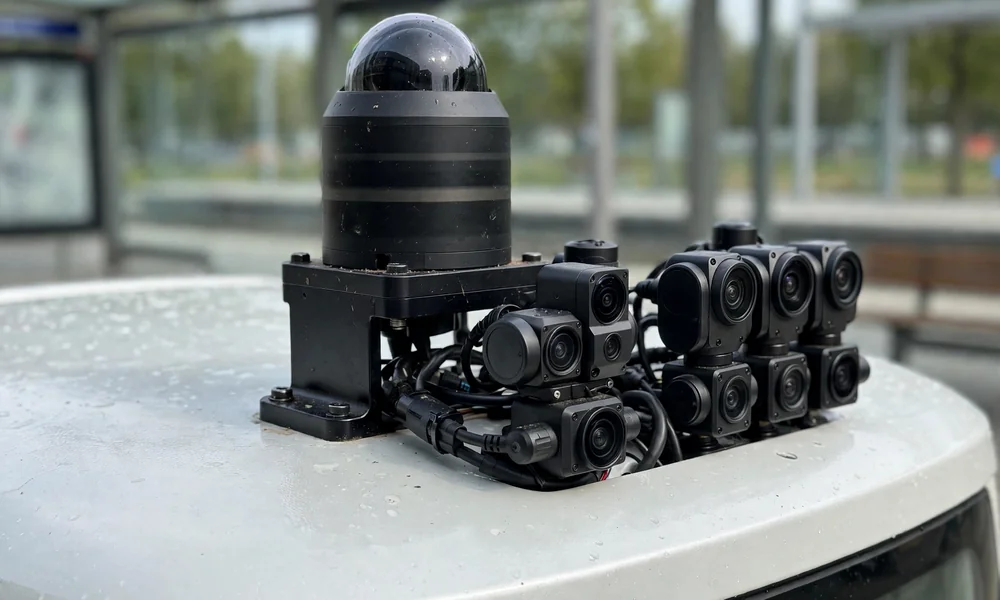
The shuttle’s eyes are a set of sensors mounted on its roof and around its body. Lidar units spin and send out pulses of laser light, building a three-dimensional map of everything around the vehicle, from kerbs and lampposts to pedestrians and cyclists, many times a second. Cameras read traffic lights, road markings, and signs, while radar watches through rain and fog when the cameras struggle. Together, the sensors give the shuttle a view of the road in every direction at once, with no blind spots and no moment of looking away.
Step 2: Knowing exactly where it is
Seeing is only half the job. The shuttle also has to know exactly where it is on the road, to within a few centimetres. It does this by combining satellite positioning with a detailed map of its route, stored on board, and by matching what its lidar sees against that map in real time. If the satellite signal drops between tall buildings, the map matching keeps it on course. Before a shuttle is allowed to carry passengers, its route is driven and mapped many times, so the vehicle knows every turn, every stop, and every crossing in advance. It does not explore. It follows a road it already knows by heart.
Step 3: Deciding what to do next
Once the shuttle knows where it is and what is around it, its computer decides what to do. This is the hardest part of the whole system, because the road is full of surprises: a pedestrian stepping off the kerb, a cyclist wobbling, a delivery van double-parked. The computer predicts what each moving object is likely to do next, and chooses the safest response, usually slowing down and waiting. The shuttle is programmed to be cautious, and that caution is its greatest strength. It will not squeeze through a gap, it will not rush a yellow light, and it will stop rather than guess.
Step 4: Moving with electric motors
The shuttle is driven by electric motors, one at each axle, fed by a battery pack under the floor. Because it travels slowly and stops often, the motors are small and efficient, and regenerative braking recovers energy every time the shuttle slows down. The ride is smooth by design: acceleration and braking are gentle, so standing passengers do not need to hold on tightly, and the cabin stays level over bumps.
Step 5: The cabin, built like a lounge
Inside, the shuttle is built for comfort rather than driving. The seats face each other, the windows are large, and the floor is flat and low, so boarding is easy for everyone, including passengers with wheelchairs or luggage. There is no driver’s seat to work around, so the space is used for legroom, for luggage racks, and for a screen that shows the route, the next stop, and the time to arrival. The cabin is air-conditioned, quiet, and lit with soft light, and a button connects passengers to a remote operator if they need help. It feels less like a bus and more like a small, moving room.
Step 6: The safety systems and the human backup
Safety is built into the shuttle in layers. If a sensor fails, another takes over. If the computer is unsure about what it sees, the shuttle stops. If the battery runs low, it returns to its depot to charge. And if anything goes seriously wrong, a remote operator in a control centre can see what the shuttle sees, talk to the passengers, and bring the vehicle to a safe stop. The shuttle also carries an emergency stop button inside, and its top speed is limited so that even a collision would be at walking pace. The goal is to drive more carefully than a human ever could.
Step 7: Charging, cleaning, and the next run
At the end of its route, or when its battery runs low, the shuttle returns to a small depot, where it charges, is cleaned, and is checked over by technicians. Software updates arrive overnight, like on a phone, improving the maps and the driving behaviour. In the morning, the shuttle runs a self-check: sensors, brakes, steering, doors, and battery, all tested before the first passenger boards. Only when every check passes does it roll out to its first stop.
Key Specifications
The figures below describe a typical current luxury autonomous shuttle; individual models vary.
| Specification | Typical figure |
|---|---|
| Battery capacity | 30 to 50 kWh |
| Passenger capacity | 8 to 12 passengers |
| Top speed | Around 25 to 40 km/h in service |
| Range | 120 to 200 kilometres per charge |
| Sensors | Lidar, cameras, radar, and ultrasonic sensors |
| Charging | Full charge in about 2 to 4 hours, or opportunity charging at stops |
| Drive | Electric motors, all-wheel steering, no steering wheel |
| Autonomy level | Driverless on fixed, mapped routes with remote supervision |
How Much Does It Cost?
A luxury autonomous shuttle typically costs from around $250,000 to $500,000 per vehicle, depending on the maker, the sensor package, and the interior specification. That is an estimate based on current low-volume production, and the price is expected to fall as more are built. Operators also pay for the depot, the charging, the mapping, and the remote supervision, so the vehicle is only part of the cost of running a service. For a larger autonomous cousin, how a luxury autonomous yacht works shows the same ideas on water. For the electric driving underneath, how a luxury electric SUV works explains the motors and battery. And for a smaller electric vehicle with a driver, how a luxury electric trike works shows how far a small battery can go.

A Rare Fact
Here is a detail that surprises passengers: the autonomous shuttle is often better at driving in the rain than in bright sunshine. Cameras struggle with glare and long shadows, but lidar and radar do not care about light at all, and the shuttle’s computer has learned to trust them more when the cameras are dazzled. Engineers test the shuttles in rain, fog, and snow far more than in sunshine, because bad weather is where the sensors earn their keep. The shuttle does not mind a grey day. In some ways, it prefers one, and that is why it keeps running when a human driver would be squinting into the sun.
The luxury autonomous shuttle proves that a vehicle does not need a driver to be luxurious. It needs to be calm, careful, and comfortable, and to arrive exactly where it promised, exactly when it promised. It is a small, moving room with a computer for a driver, and it is quietly changing what a journey through the city feels like.


