Turn on a luxury wireless speaker and the room seems to change shape. The sound does not come from a small box in the corner; it fills the space, warm and wide, as if the musicians were standing somewhere just out of sight. There is no harsh edge to it, no buzz at high volume, just a clean, easy sound that you can listen to for hours without tiring.
That ease is built, not bought off a shelf. A luxury speaker is made from real wood, copper and carefully shaped drivers, assembled by people who listen to every unit before it leaves the workshop. The cabinet is tuned like an instrument, the electronics are chosen for silence rather than speed, and the wireless parts are hidden away so they never get in the way of the sound.
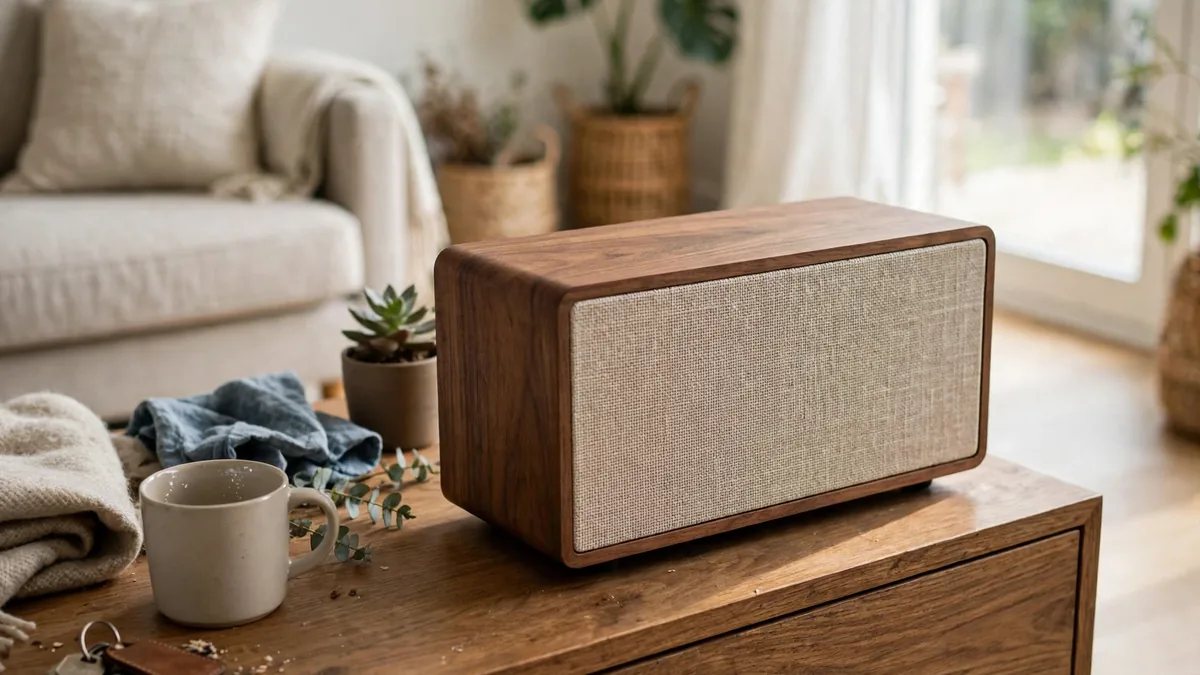
This is how a luxury wireless speaker comes together, from a sheet of timber to the finished box in your living room.
How It’s Made
Step 1: Building the wooden cabinet
Every luxury speaker starts with its cabinet, because the box is half the sound. Makers use dense hardwood, layered birch ply or high-density fibreboard, cut into panels and joined with glued mitres rather than screws, so there are no hard points that can buzz. The panels are thick, often more than an inch, because a thin wall flexes and colours the music.
Inside, the cabinet is braced with wooden ribs and lined with acoustic damping material, which soaks up the sound waves bouncing around behind the driver. A good cabinet, by contrast, simply disappears.
Step 2: Making the drivers
The drivers are the parts that actually move the air. A luxury speaker usually has a large woofer for the bass, a mid-range driver for voices and a tweeter for the fine detail at the top. The cones are made from paper, woven fibre or light metal, and each one is chosen for how it behaves at its own range of notes, not for how loud it can go.
The heart of each driver is its voice coil, a coil of copper wire wound around a small former and suspended in a powerful magnet. When music flows through the coil it moves, and the cone moves with it, pushing air into the room. The coil and magnet must be centred to a hair’s width, because a coil that rubs will buzz, and a buzzing driver ruins a speaker that cost thousands to build.
Step 3: Winding the crossover
Between the amplifier and the drivers sits the crossover, a small circuit that splits the music into low, middle and high parts and sends each part to the right driver. In a luxury speaker the crossover is built from large, carefully chosen components: air-core coils, film capacitors and resistors that can handle heat without changing value.
The crossover is tuned by ear as well as by measurement, which is one reason luxury speakers sound so different. The luxury smart speaker hides a simpler version of the same idea, though its small size forces compromises a full-size cabinet never has to make.

Step 4: Fitting the amplifier and wireless board
A wireless speaker carries its amplifier inside the cabinet, and that amplifier must be both powerful and silent. Class D amplifiers are common, because they run cool and efficient, but luxury makers choose the best versions and pair them with a clean power supply, so no hum or hiss reaches the drivers when the music stops.
The wireless board sits in its own shielded corner of the cabinet, away from the sensitive audio circuits. It handles the streaming, the connection to your phone and the timing that keeps two speakers playing in perfect step. The antenna is placed carefully, because a metal cabinet or a thick wooden wall can weaken the signal, and a speaker that drops out mid-song is a failed speaker, however good it sounds.
Step 5: Assembling and sealing the box
With the drivers, crossover and amplifier ready, the cabinet is assembled around them. The drivers are bolted in with an even torque, the seams are sealed with a flexible compound, and the grille cloth is stretched over a frame and fitted by hand. A sealed cabinet must be truly airtight, because even a small leak lets bass escape and makes the low notes sound thin.
Then the finish is applied. Real wood veneer is matched panel by panel so the grain flows around the corners, then lacquered in many thin coats and polished until it feels like glass. The luxury headphones in the same listening room are finished to the same standard, with leather and metal chosen to age gracefully rather than peel.
Step 6: Listening, measuring and pairing
No luxury speaker leaves the workshop unheard. Each unit is placed in a listening room, played through a set of test tracks, and measured with a microphone to check that its frequency response matches the design. A speaker that measures wrong is opened up and fixed, even if the fault is a single loose wire.
Pairs are matched too. Two speakers sold as a stereo pair are measured side by side, and only units whose response curves sit close together are boxed as a pair, so the left and right channels sound the same. That matching is invisible to the buyer, but it is what makes a stereo image feel solid and real, and it is why a luxury laptop streaming music to them is only the start of the chain, not the sound itself.
What it is made of
The table below sums up the parts that matter most in a luxury wireless speaker, from the cabinet to the wireless board.
| Part | Typical luxury choice |
|---|---|
| Cabinet | Braced hardwood or birch ply, real veneer |
| Woofer | Large paper or fibre cone, copper voice coil |
| Tweeter | Silk dome or beryllium, for fine detail |
| Crossover | Hand-tuned, film capacitors and air coils |
| Amplifier | Built-in Class D, 100 to 300 watts |
| Wireless | Shielded streaming board, stereo pairing |
| Weight | 8 to 25 kilograms per speaker |

How much does one cost?
A luxury wireless speaker is priced like a piece of furniture that happens to make music, and the cabinet and driver work are the main reasons why: a braced wooden box with matched drivers takes days to build and test, and the hand tuning cannot be rushed. As an estimate, a single high-end wireless speaker costs roughly 1,000 to 3,000 dollars, with a matched stereo pair running roughly double that.
At the very top, large floor-standing wireless speakers with exotic tweeter materials and custom veneers can be estimated at 10,000 dollars or more per pair. Owners accept the price because the speaker is a permanent part of the room: it will play every day for years, and its sound will not date the way a phone or a laptop does.
A rare fact
Here is something few people know: the most expensive part of some luxury speakers is not the driver or the amplifier, but the silence around them. Engineers spend months hunting down tiny vibrations, buzzes and resonances, and they often find them in the most unlikely places, like a loose screw in the grille frame or a wire touching the inside of the cabinet. One maker famously traced a faint rattle to a single staple in the damping material.
The result is a speaker that seems to make sound out of nothing. Building one takes days of patient woodwork and listening, but the payoff is a box that disappears, leaving only the music in the room.