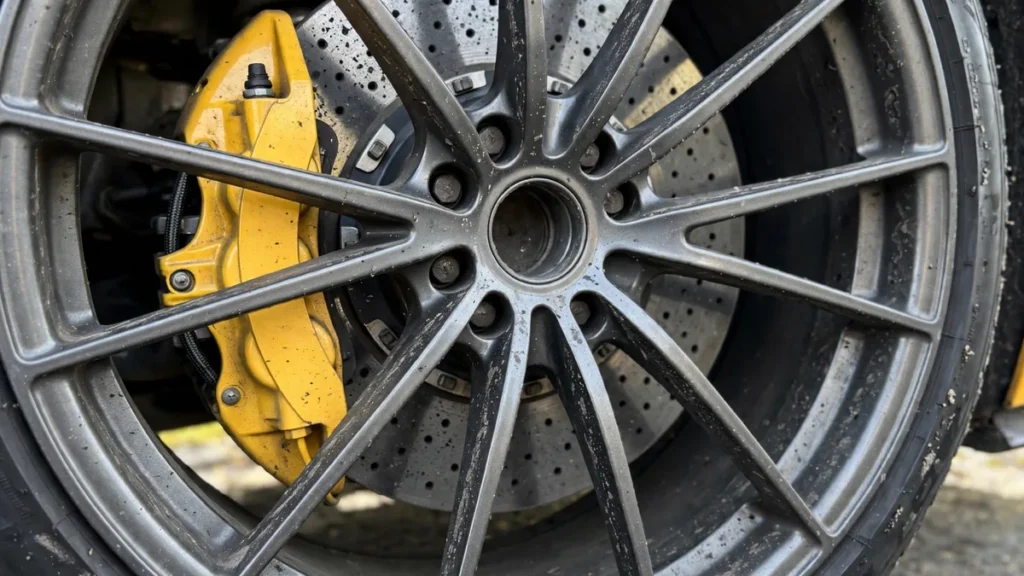
A hypercar can reach 200 miles per hour in seconds, but speed is the easy part. The hard part is stopping. At that speed, the brakes must turn a hurtling tonne and a half of metal into heat, and do it again and again, lap after lap, without fading. Ordinary steel brakes glow, warp and give up. The brakes on the finest hypercars are made from carbon ceramic, a material born in aerospace that can swallow enormous heat and keep on gripping.
A carbon ceramic brake disc looks almost ordinary: a dark grey ring with holes drilled through it. But inside that ring is a web of carbon fibres locked in a ceramic matrix, a material that is lighter than steel, harder than most metals, and almost unbothered by temperatures that would melt a lesser disc. Here is how it works, from the pedal to the pad.

How It Works
Step 1: The driver presses the pedal
It starts with the driver’s foot. The pedal pushes a piston in the master cylinder, forcing brake fluid down the lines to each wheel. The fluid cannot be compressed, so the force arrives instantly, and the harder the driver presses, the harder the brakes bite. In a hypercar, the pedal is tuned to feel firm and direct, with almost no wasted travel, because at racing speed a millimetre of pedal means metres of stopping distance.
Step 2: The caliper squeezes the disc
At each wheel sits a caliper, a strong metal clamp that straddles the disc. Inside the caliper are pistons, usually six at the front, which push the brake pads against both faces of the spinning disc. The clamping force is enormous, thousands of kilograms pressing on an area the size of a hand. The friction between pad and disc is what slows the wheel, and the caliper must stay rigid while it does it, or the pedal would feel soft and vague.
Step 3: Friction turns speed into heat
Friction is the whole trick. As the pads grip the disc, the car’s kinetic energy becomes heat, and the disc’s temperature can climb past 600 degrees Celsius in a single hard stop. A steel disc would warp or crack under that punishment, but a carbon ceramic disc simply absorbs it. The drilled holes in the disc help here too: they let hot gas escape from between pad and disc, and they give the disc room to expand as it heats. Engineers test the discs on a dynamometer that spins them up to speed and slams the brakes on, repeating the punishment until the disc proves it can take it.
Step 4: The ceramic matrix holds its shape
The secret of the disc is its structure. Carbon fibres are woven into a mat, soaked in resin and baked until the resin turns into silicon carbide ceramic. The result is a material that is both fibrous and stony: the fibres give it toughness, so it does not shatter, while the ceramic gives it hardness and heat resistance. It is lighter than a steel disc of the same size by about half, which also means less unsprung weight and sharper handling.
Step 5: Cooling air does the rest
Heat still has to go somewhere. Air ducts in the car’s bodywork funnel cool air onto the discs, and the discs themselves are ventilated, with internal vanes that act like a fan as they spin. Between corners, the airflow drags the heat away, so the brakes are ready for the next stop. Some hypercars add brake ducts that open only at speed, keeping the discs cool on track days without adding drag on the road. On a race track, the discs glow orange in the dark, a sight that tells the engineers the cooling is working exactly as designed.
Step 6: The anti-lock system keeps control
Raw braking force is useless if the wheels lock and the car slides. Sensors at each wheel watch the speed hundreds of times a second, and if a wheel is about to lock, the anti-lock system releases the pressure for a fraction of a second, then reapplies it. The driver feels a pulsing in the pedal, and the car keeps steering while it slows. In a hypercar, this system is tuned to let the driver brake later and harder than any road car of a generation ago.
Step 7: The pads wear, the disc endures
Over time, the pads wear down and are replaced, just like any brake. But the carbon ceramic disc itself lasts far longer than a steel one, often for the life of the car under road use. When it does need replacing, the cost is steep, because each disc is a precision-made piece of aerospace material. The owner pays for that longevity in advance, and in return gets brakes that stop the same on the hundredth lap as they did on the first.

Key Specifications
The figures below describe a typical luxury hypercar carbon ceramic brake system; individual builds vary.
| Specification | Typical figure |
|---|---|
| Front disc diameter | 390 to 420 millimetres |
| Rear disc diameter | 360 to 390 millimetres |
| Disc material | Carbon fibre in silicon carbide ceramic |
| Weight saving vs steel | Around 50 percent lighter |
| Peak disc temperature | Over 600 degrees Celsius |
| Front caliper pistons | Six |
| Stopping distance | Around 30 metres from 100 km/h |
| Disc service life | Often the life of the car on the road |
How Much Does It Cost?
A carbon ceramic brake system on a luxury hypercar typically adds from around $10,000 to $25,000 to the price of the car, depending on the size of the discs and the calipers. That is an estimate based on current flagship models, and a full replacement set of discs and pads can cost a similar amount again. Most of the cost sits in the discs themselves, which take days to bake and finish. To see how a hypercar recovers energy instead of wasting it as heat, read how hypercar regenerative braking works for the electric side of stopping. For the materials battle behind the brakes, aluminium versus titanium hypercar materials compared weighs the metals that surround them. And the Aston Martin Valkyrie specs explained shows a car where brakes like these are only the beginning.

A Rare Fact
Here is something few drivers ever learn: carbon ceramic brakes can feel worse than ordinary brakes when they are cold. On a frosty morning, the first few stops can feel wooden and unresponsive, because the material only reaches its full grip once it has warmed up. Racing drivers know this and weave gently on the warm-up lap to build heat into the discs. It is why some hypercars are fitted with brake pre-heating systems, and why an owner who only drives to the shops may never feel the brakes at their best.
A carbon ceramic brake is a piece of aerospace engineering hiding behind a wheel. It turns speed into heat, holds its shape at temperatures that would destroy steel, and does it lap after lap without complaint. From the driver’s foot to the glowing disc, every part of the system is built for one moment: the instant the car must stop. When a hypercar sheds 200 miles per hour in a few seconds and the driver feels nothing but a firm pedal, the carbon ceramic disc has done exactly what it was made to do.