The pit lane falls silent as the car rolls out, and then the V12 wakes up. It does not rumble like a normal engine — it screams, a high, hard-edged wail that climbs past ten thousand revs. This is not a car that happens to have a racing engine. It is a Formula One car that has been persuaded, just barely, to wear number plates.
The Aston Martin Valkyrie began as a question Adrian Newey, the most successful Formula One designer in history, had been asking for years: what would happen if you built a road car with no compromises at all? The answer is a machine so extreme that its numbers read like misprints. Over a thousand horsepower. A rev limit higher than a Formula One car of its era. Downforce greater than the weight of the car itself.
This guide explains the Valkyrie’s numbers in plain English — power, weight, downforce, acceleration and top speed. The way the Aston Martin Valkyrie works is a lesson in what happens when engineers are told to forget the rulebook.

How the Aston Martin Valkyrie Works
Step 1: The V12 heart
At the centre of the car sits a 6.5-litre naturally aspirated V12, built by Cosworth, that produces 1,000 horsepower on its own — the most powerful naturally aspirated production engine ever made. It has no turbochargers to muffle its voice, and it revs to 11,000 rpm. The engine weighs just 206 kilograms, and its internal parts are so light it can spin up faster than almost any road engine ever built.
Step 2: The electric boost
A small electric motor, developed with Rimac, adds a further 160 horsepower and fills in the gaps in the V12’s power delivery, bringing total output to 1,160 horsepower. The hybrid system also recovers energy under braking, like a Formula One car’s, and it weighs very little — the whole car was designed around the idea that every extra kilogram is a sin. The materials of the Aston Martin Valkyrie, from its carbon-fibre monocoque to its titanium exhaust, were chosen to keep the weight down to a level no other hypercar has matched.
Step 3: The invisible hand of downforce
The Valkyrie’s most important number is not its power but its downforce — the invisible aerodynamic force that pushes the car into the road. Tunnels beneath the car accelerate air so violently that it generates more than 1,100 kilograms of downforce at 150 mph, and up to 1,814 kilograms at top speed, more than the car itself weighs.
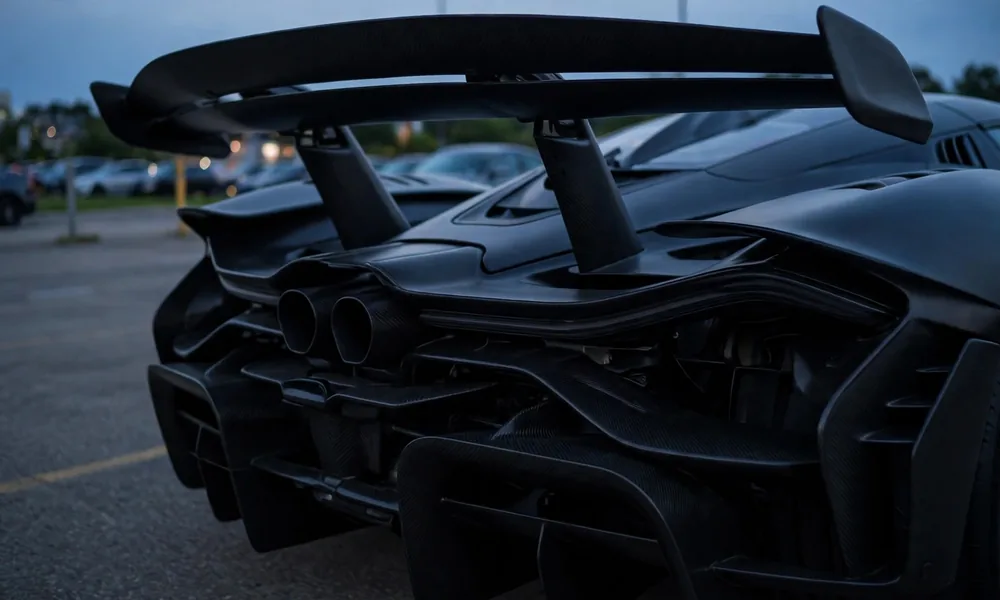
Aston Martin Valkyrie Specs
The Valkyrie’s spec sheet reads like a list of records, and each number answers a different question: how fast, how light, how hard it grips the road, and how loud it is while doing it.
| Spec | Typical number | What it means | How it compares |
|---|---|---|---|
| Total power | 1,160 hp | Combined output of the V12 and electric motor | A typical family car makes 150 hp; a Formula One car makes around 1,000 hp |
| Rev limit | 11,000 rpm | How fast the engine can spin | A normal car redlines near 6,500 rpm; a Formula One car near 12,000 rpm |
| 0 to 60 mph | 2.5 seconds | Time to reach motorway speed from a standstill | The fastest electric cars match it; most supercars take around 3 seconds |
| Top speed | 217 mph (350 km/h) | The fastest the car can go | Slower than a Bugatti Chiron’s 261 mph, because downforce trades top speed for grip |
| Dry weight | 1,270 kg | Weight without fuel, fluids or passengers | About 300 kg lighter than most hypercars, despite the hybrid system |
| Downforce | 1,814 kg at top speed | Aerodynamic force pressing the car into the road | Most supercars make 300 to 500 kg; a Formula One car makes over 1,500 kg |
Power-to-weight is the number that explains the Valkyrie better than any other. A car does not need a thousand horsepower to feel fast — it needs a thousand horsepower in a light body. At roughly one horsepower for every 1.1 kilograms, the Valkyrie accelerates like a racing car because, in weight terms, it almost is one. A Bugatti Chiron makes more power, around 1,500 horsepower, but it weighs nearly two tonnes, so each of its kilograms carries more weight than the Valkyrie’s. Removing weight improves acceleration, braking and cornering all at once, while adding power only helps in a straight line.
The rev limit is the number that explains the sound. Most road engines peak below 7,000 rpm, and turbocharged engines often peak lower still, because turbos do the work instead of revs. The Valkyrie’s V12 spins to 11,000 rpm, which means its pistons travel up and down more than 180 times every second, and the exhaust note climbs into a register closer to a racing car than a road car. At high revs, a naturally aspirated engine breathes most efficiently, and the power keeps building all the way to the limit instead of fading, as it does in most turbocharged cars.
Downforce is the hardest number to picture, because you cannot see it. Imagine the car driving at 150 mph: the air flowing under and over it presses down with a force of more than 1,100 kilograms, roughly the weight of a small car sitting on its roof. At top speed, that force grows to 1,814 kilograms, more than the car weighs. The tyres are therefore pressed into the road with more than twice the car’s own weight, which is why the Valkyrie can corner at forces above 3 g, where a normal supercar would slide off the road at around 1.2 g.
Acceleration tells a subtler story than the headline suggests. The Valkyrie reaches 60 mph in 2.5 seconds, which is astonishing — but the fastest electric hypercars now match or beat it, because electric motors deliver instant torque. Where the Valkyrie pulls away is beyond 100 mph, where its light weight and aerodynamic grip keep it accelerating hard while heavier cars run out of breath.
Weight is where the Valkyrie’s engineering is most extreme. At 1,270 kilograms dry, it weighs less than a small family hatchback, despite carrying a V12, a hybrid system and a full carbon-fibre safety structure. The seats are part of the monocoque itself, and the steering wheel is removable like a racing car’s.

What Does an Aston Martin Valkyrie Cost?
The Valkyrie cost around $3 million to $3.5 million (estimate) when new, and only 150 road cars were built, so used examples now change hands for considerably more — some have been listed at $4 million to $5 million (estimate). Running costs are in another world: a single set of tyres costs thousands, and servicing requires factory-trained technicians. For context, the hypercar chassis beneath cars like this is a carbon-fibre structure that costs more to build than most entire cars.
A Rare Fact
The Valkyrie was so extreme that Aston Martin had to invent a new way to build it. The car’s underbody tunnels are so large that the driver and passenger sit with their feet raised high, almost like in a Formula One car, and the seats are fixed to the monocoque — you adjust the pedals and steering wheel to fit, not the seat. Even stranger, the car was designed with no rear window at all: the engine and aerodynamics fill the space behind the driver, so the rear view comes from cameras instead.


