On a bright morning in southern Germany, a bare steel body shell rolls out of the paint shop wearing a colour that costs more than a family hatchback. It has no roof. That is the whole point. A luxury convertible is the most demanding car a factory can build, because everything a fixed roof normally does — keeping the body stiff, keeping the rain out, keeping the cabin quiet — has to be engineered into the floor, the windscreen frame and a folding roof that must vanish in seconds and reappear without a single drip. The car you see gliding along a coastal road with its top down is the end of a process that takes weeks, hundreds of skilled hands and a level of patience most car plants never need.
Convertibles have been with us since the earliest days of motoring, when almost every car was open to the sky. The modern luxury convertible is something else entirely: a grand tourer that must be as refined as a saloon with its roof up and as thrilling as a roadster with it down. That dual personality is what makes the build so involved, and it starts long before the first panel is pressed.

How a luxury convertible is made
Step 1: Designing strength into a roofless body
Engineers begin with the hardest problem. Remove the roof and a car body loses a huge share of its torsional stiffness, so it flexes over bumps and shudders on rough roads. The answer is to build that strength back in underneath: thicker sills, a reinforced transmission tunnel, extra bracing across the floor and behind the rear seats, and a windscreen frame strong enough to support the car if it ever rolls over. Computer models simulate thousands of twists and impacts before a single piece of metal is cut, and the body is designed so that the folding roof mechanism has a precise, rigid home to bolt into. The extra reinforcement typically adds around a hundred kilograms.
Step 2: Pressing, welding and bonding the shell
Steel and aluminium panels are pressed in huge dies, then welded and bonded by robots in the body shop. Because the shell has no roof to tie the sides together, the welding sequence is choreographed with unusual care: joints are made in an order that keeps the body true as heat moves through it, and structural adhesive is used alongside spot welds to spread loads across seams. Laser measurement checks the shell against its digital master to within fractions of a millimetre, because the folding roof will only seal properly if the windscreen frame, the rear deck and the side rails sit exactly where the drawings say.
Step 3: Painting a body that will be stared at
Luxury paint is a ritual. The shell is dipped, primed, baked and then sprayed in several coats, with hand sanding between layers on the most expensive finishes. Convertible buyers choose bold colours more often than saloon buyers, and the paint has to survive sun, salt and folding-roof friction without fading. Quality inspectors examine every panel under bright, raking light, and any imperfection means the shell goes back for rework rather than forward down the line.
Step 4: Building and fitting the folding roof
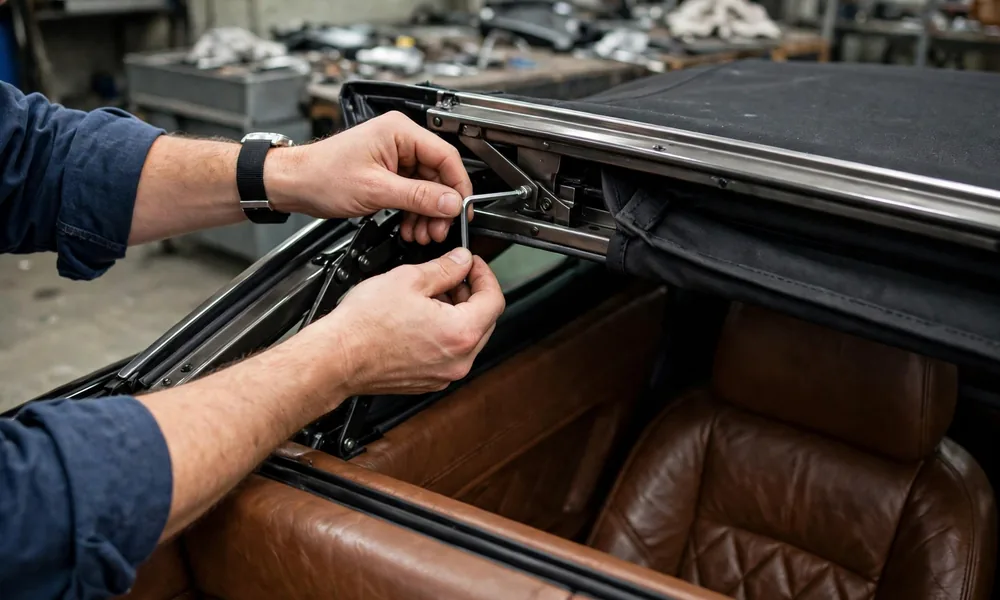
The roof is a machine in its own right. A fabric soft top is made from layers of canvas, acoustic insulation and a waterproof membrane, stitched and stretched over a frame of aluminium arms and hinges. A folding hard top is even more complex, with panels that stack into the boot in a sequence choreographed by electric motors and hydraulic cylinders. The roof module is built and tested on its own bench first, cycled dozens of times, then married to the car. Technicians adjust the latches, seals and tension by hand, and the roof is opened and closed repeatedly to check that it seals evenly all the way around. The target is a cabin as quiet as a coupe when the roof is up, and that standard is checked with microphones, not just ears.
Step 5: Trimming the cabin by hand
With the roof in place, the cabin is trimmed. Leather hides are cut, stitched and fitted by hand, with the best craftsmen working on steering wheels, seats and door panels. Wood and metal trim is matched for grain and finish across the car, and the dashboard, centre console and screens are installed and tested. Convertible cabins get special treatment: leather is chosen and treated to resist sun damage, and drainage channels are built into the body so that any water that finds its way past a seal has somewhere harmless to go. The seats, often heated and ventilated, are fitted last, because the trimmers need room to work around them.
Step 6: Testing with the roof up and down
Every luxury convertible goes through a water test that would make a submarine engineer nod: high-pressure jets and simulated rain check every seal while the car sits in a test booth. Then comes the road test, driven both with the roof up and with it down, listening for wind noise, rattles and the scuttle shake that convertibles are prone to. Engineers also test the roof at speed, in cold weather and after hundreds of open-close cycles, because a roof that works perfectly on day one must still work perfectly in year ten. Only then does it earn its badge.

| Specification | Typical figure |
|---|---|
| Body reinforcement vs coupe | About 80–120 kg extra |
| Roof operation time | About 15–25 seconds |
| Roof operation speed | Up to about 50 km/h |
| Soft-top layers | Three to five, including acoustic layer |
| Build time | Several weeks from shell to sign-off |
| Water test | High-pressure jets and simulated rain |
Price is where the extra engineering shows. A luxury convertible typically costs noticeably more than the equivalent coupe, and as an estimate, well-specified examples from the leading marques commonly fall in the region of $120,000 to $300,000, with limited editions and flagship V8 and V12 models reaching well beyond that. The folding roof mechanism alone, with its motors, hydraulics and hand fitting, accounts for a large share of the premium, and the reinforced body and hand-trimmed cabin account for much of the rest. Buyers pay for the engineering that makes the car feel like two cars in one.
Here is a rare fact worth remembering: some luxury convertibles are fitted with a hidden roll-over protection system that fires in a fraction of a second. If sensors detect an imminent roll, steel hoops shoot up from behind the rear headrests faster than the blink of an eye, working with the reinforced windscreen frame to protect the cabin. Most owners will never see it work, and that is exactly the point. The same spirit runs through the whole car: the best engineering in a luxury convertible is the engineering you never notice, from the drainage channels under the carpet to the extra steel hidden inside the sills. If you want to know where the money goes, the reasons a luxury convertible costs so much are worth a read, and the luxury roadster spec sheet shows how its open-top cousin balances power and weight. For a sense of how older open cars were built, how a luxury vintage car is made is a fine companion piece.


