In a small workshop behind a stone wall in the English countryside, a car from 1937 sits in pieces. Its wings are off, its engine is on a stand, and its wooden frame is bare, showing the hand-cut joints a coachbuilder made nearly ninety years ago. The owner who brought it here did not ask for a new car that looks old. He asked for his car back, exactly as it was the day it left the factory, only better in the places where time had been unkind.
Building a luxury vintage car is not manufacturing. It is restoration at the highest level, a craft where originality matters as much as condition and where a single wrong bolt can halve a car’s value. The workshops that do it take on only a handful of cars a year, and each one can take eighteen months or more. What follows is how a luxury vintage car is made, or rather remade, from a tired old machine into a concours winner.
How a Luxury Vintage Car Is Made
Step 1: Stripping the car to its bones
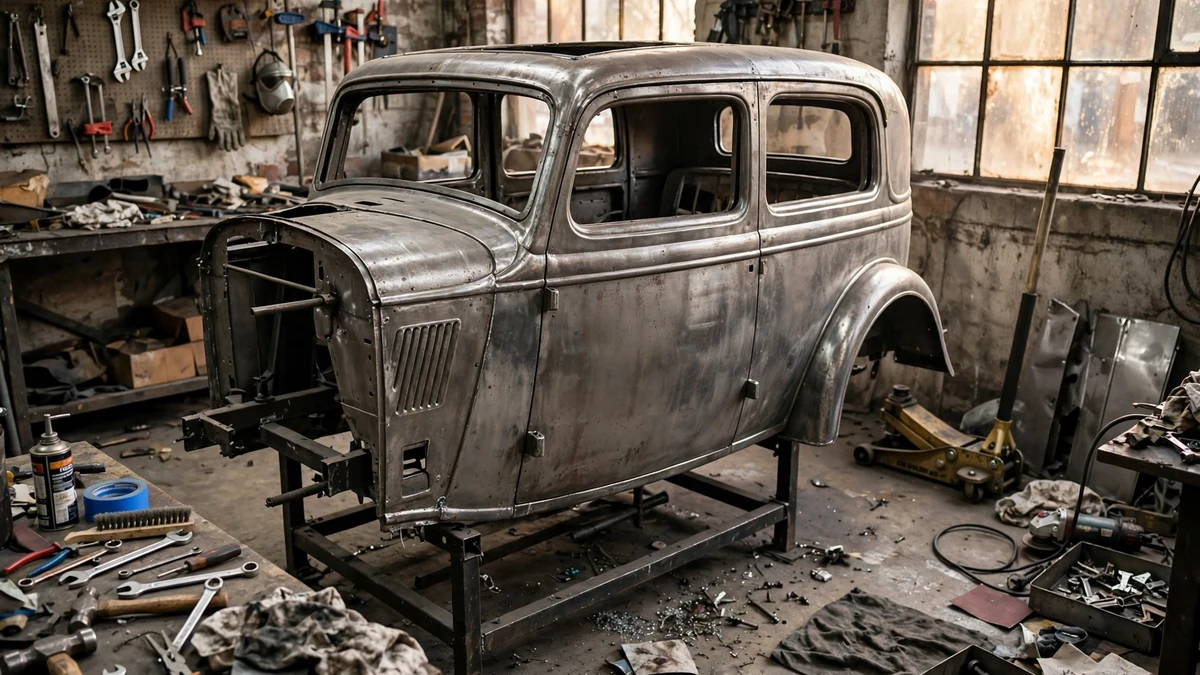
Everything starts with disassembly, and it is done slowly, by hand, with every part labelled and photographed. A vintage car can have thousands of pieces, and each one must be recorded so it can go back in exactly the right place. The body is lifted off the chassis, the engine and gearbox come out, and the interior is removed down to the bare metal and wood. Then the car is inspected piece by piece, and a report is written: what can be saved, what must be remade, and what is missing entirely. Missing parts are the hardest problem in the whole build, because a 1930s carburettor or a pre-war headlamp cannot be ordered from a catalogue, and the workshop must either find one, borrow one to copy, or make one from scratch.
Step 2: Rebuilding the chassis and wooden frame
The chassis is the skeleton, and on many vintage cars it is a steel ladder frame that has spent decades flexing on rough roads. It is cleaned to bare metal, checked for cracks with dye and a magnifying glass, and straightened on a jig if it has sagged. Then comes the wooden frame, the ash skeleton that carries the body panels on many pre-war cars. Ash is still the wood of choice, steamed and bent by hand over forms, because modern timber does not behave the same way. Each joint is glued and screwed exactly as the original coachbuilder did it, and the frame is sealed against moisture before a single panel goes back on.
Step 3: Remaking the body panels
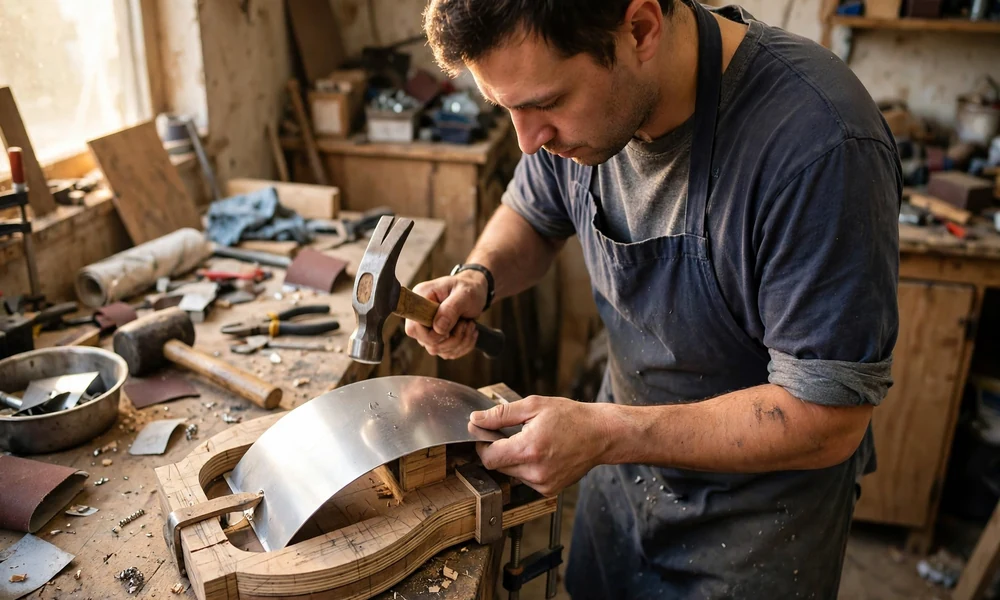
Vintage body panels were shaped by hand over wooden bucks, and remaking them is a skill that takes years to learn. A panel beater works a flat sheet of aluminium or steel with hammers and an English wheel, stretching and shrinking the metal a fraction of a millimetre at a time until it matches the curve of the original. The panel is checked against the buck again and again, and when it finally fits, it is welded to its neighbours and filed smooth. No filler is allowed on a concours car, so the metal must be right on its own. Once the body is complete, it is painted in the original colour, mixed from period formulas, in as many as a dozen coats, each one flatted back by hand.
Step 4: Rebuilding the engine and gearbox
The engine is stripped to its last nut, and every part is measured against the factory’s original tolerances. Cylinder bores are re-machined, crankshafts are ground and balanced, and bearings are made to order, because nobody stocks bearings for a 1937 straight-eight. Parts that cannot be found are cast from new patterns, using the old part as a model, and then machined on a lathe. The gearbox is rebuilt the same way, with new gears cut to the original tooth profile, and the whole drivetrain is assembled with the clearances the factory specified, not the looser ones a modern mechanic might accept. When the engine first runs again, it is run gently for hours, its oil changed again and again, until it settles into the smooth, unhurried rhythm it had when it was new.
Step 5: Trimming the interior in leather and wood
The interior is where the luxury lives, and it is made the way it was made in the 1930s. Hides are chosen one by one, matched for grain and colour, and cut by hand, because a machine cannot feel where a hide is thin. The seats are stuffed with horsehair over hand-tied springs, stitched with the same diamond pattern the original trimmer used, and the dashboard is veneered in walnut cut from a single log so the grain flows across it. The carpets are woven wool, the headlining is stretched and tacked, and even the smallest details are right: the window winders, the door handles, the tiny brass screws that hold the dashboard in place. A luxury vintage interior is not just comfortable, it is a faithful copy of a room that was built ninety years ago.
Step 6: Assembly, tuning, and the first drive
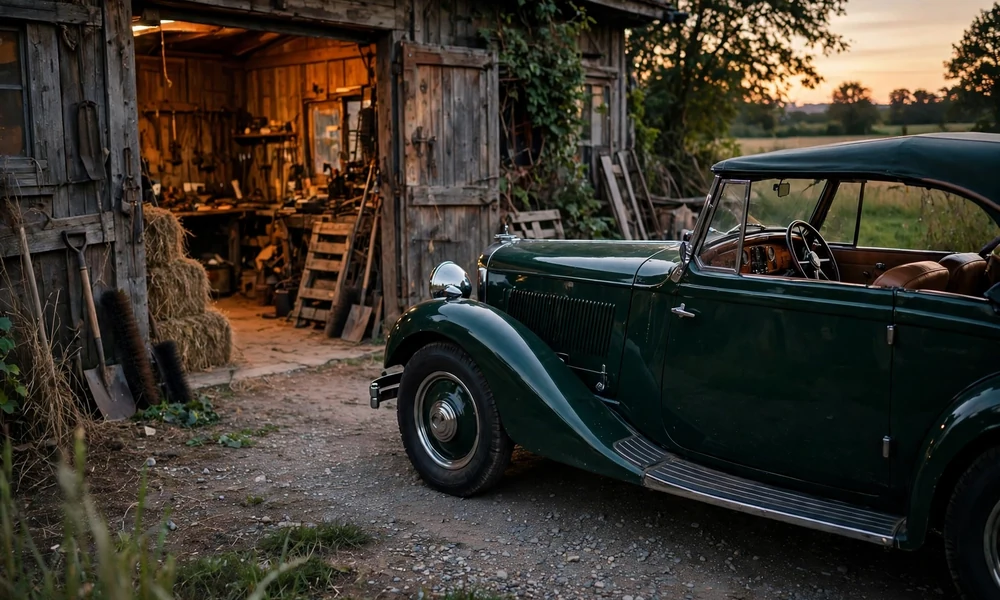
Finally the car goes back together, body onto chassis, engine into the frame, interior fitted last so nothing is scratched. The wiring is replaced with cloth-covered cable like the original, the brakes are rebuilt with new linings, and the suspension is set to the factory’s ride height. Then comes tuning: the carburettors are balanced by ear, the ignition timing is set with a strobe, and the car is driven, gently at first, then harder, over hundreds of miles. Every rattle is chased down, every leak is fixed, and only when the car runs as its makers intended is it washed, polished, and handed back to its owner, ready for the road and for the show field.
Specifications
| Feature | Typical luxury vintage car |
|---|---|
| Era | 1920s to 1940s, pre-war coachbuilt |
| Engine | Straight-six or straight-eight, 3 to 5 litres |
| Power | 80 to 150 hp |
| Body | Hand-formed aluminium over ash frame |
| Gearbox | Four-speed manual, often with overdrive |
| Top speed | 130 to 160 km per hour |
| Restoration time | 12 to 24 months |
How Much Does a Luxury Vintage Car Cost?
A full concours-level restoration of a luxury vintage car typically costs an estimated $250,000 to $600,000, depending on the rarity of the car, how complete it is when it arrives, and how much must be remade from scratch. The estimate covers the restoration work itself; buying the car in the first place can cost far more, and a rare pre-war luxury car in need of restoration can still sell for several hundred thousand dollars. The most valuable cars, restored to the highest standard, can be worth several million. The work is expensive because it is slow: a single craftsman may spend a month on one body panel, and a workshop may have only three or four cars in progress at a time.
A Rare Fact
Some vintage cars were built with bodies of wood and fabric rather than metal, and the best of them have survived for ninety years because their frames were made from ash, a wood that bends without breaking. The vintage car built this way is lighter than a steel-bodied one, and its body panels were hammered by hand over wooden bucks, a skill almost lost today. A luxury coupe from the same era shares the same coachbuilt heritage, while the luxury grand tourer that followed it inherited the idea of a hand-built car made for long, fast journeys in comfort.


