Press the button on the centre console and the world changes in nineteen seconds. The fabric roof folds itself away in a neat stack, the rear deck closes over it with a soft thunk, and the windscreen frame becomes the only thing between you and the sky. A luxury convertible does this at motorway speed in some cars, in the rain in none of them, and it does it hundreds of times over its life without ever leaking, rattling or jamming. That reliability is the real engineering story, and it is hidden in a mechanism most owners never see.
A convertible is a car that has lost its roof and gained a machine in its place. Everything a fixed roof does for free — holding the body stiff, keeping the rain out, keeping the cabin quiet — has to be done by other systems, and they all have to work together every time the roof moves. The folding roof is a robot, the body is a bridge without its top chord, and the cabin is a room with one wall missing. Here is how all of it works, from the first touch of the button to the last kilometre of a summer evening.

How a luxury convertible works
Step 1: The folding roof mechanism
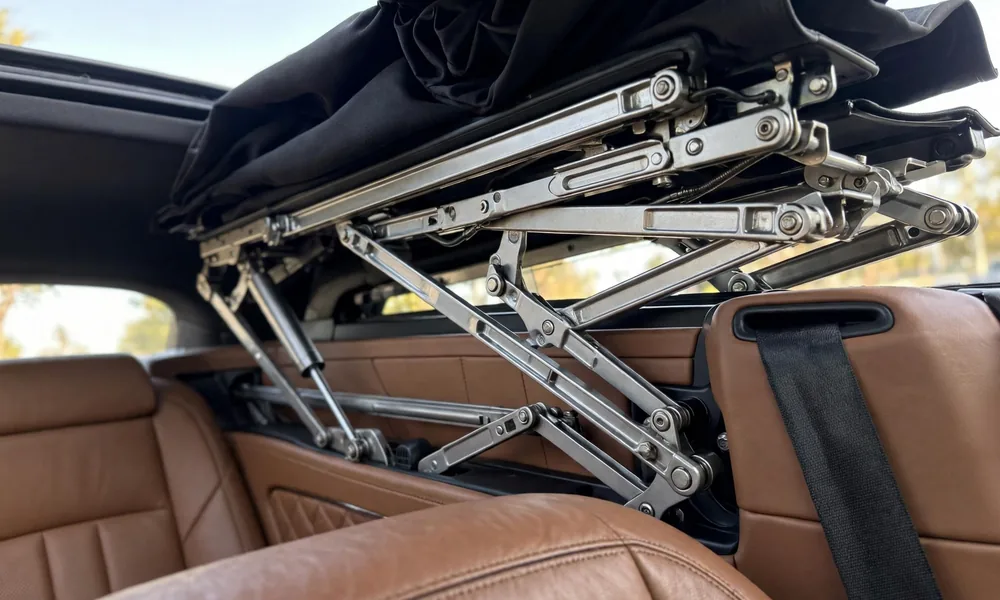
At the heart of the car sits the roof mechanism, a set of aluminium and steel arms driven by hydraulic cylinders or electric motors. When you press the button, a control unit checks that the car is slow enough, the boot is in its roof-stow position, and the windows are lowered, then it releases the header latch above the windscreen and drives the arms through a choreographed sequence. The fabric or metal panels fold into a stack no thicker than a suitcase, the rear deck lifts and closes, and sensors confirm every latch before the dashboard gives the all-clear. The whole sequence is timed to the tenth of a second, because one arm moving early would jam the rest.
Step 2: Keeping a roofless body stiff
Remove the roof and a car body loses much of its torsional stiffness, so it twists over bumps and shudders on rough roads. Engineers fight this with a stronger floor: thicker sills, a reinforced transmission tunnel, cross-bracing behind the rear seats, and a windscreen frame built to carry the car’s weight in a rollover. The body is also tuned with stiffer suspension bushes and carefully placed dampers, so the extra reinforcement does not make the ride harsh. The result is a car that feels solid with the roof down, even though the structure that makes it solid is entirely underneath you.
Step 3: Sealing out wind and rain
A convertible roof seals against the body with a maze of rubber gaskets, and the seal has to work while the car flexes, the roof vibrates, and the temperature swings from winter to summer. Engineers test the seals in rain chambers that spray the car from every angle, and in wind tunnels where smoke shows exactly where air leaks in at speed. Drainage channels run inside the body to carry away any water that does get past the first seal, so a single drop rarely reaches the cabin. The fabric itself is a multi-layer sandwich that blocks water, damps sound and holds its shape, and it is tensioned so it does not flap or drum at motorway speed.
Step 4: Quietening the cabin
With no roof to block the sky, a convertible cabin is naturally noisier than a saloon, so engineers attack noise from every direction. The fabric roof is lined with acoustic insulation, the windscreen is often made from acoustic laminated glass, and a small wind deflector pops up behind the seats to calm the air swirling into the cabin. Microphones in the cabin can even feed the stereo system, which adjusts its volume and tone to compensate for wind noise.
Step 5: Heating, cooling and the open-air climate
Heating a car with no roof is a losing battle against the sky, so convertibles cheat. Heated seats and a heated steering wheel warm the occupants directly, while neck-level air vents — sometimes called air scarves — blow warm air around the driver’s shoulders on cold mornings. The climate control watches the outside temperature and the roof position, and it adjusts fan speed and air direction automatically. In summer the same system works in reverse, with powerful air conditioning and ventilated seats keeping the cabin bearable even when the sun is beating straight down through the open roof.
Step 6: Safety when there is no roof above you
The most important convertible system is the one owners hope never to see: rollover protection. Hidden behind the rear seats sit steel hoops or deployable bars that spring up in a fraction of a second if sensors detect the car tipping, creating a survival space around the occupants’ heads. The windscreen frame is reinforced to carry the car’s weight, the side airbags are shaped to protect heads with no roof rail to anchor them, and the seatbelts are mounted to the reinforced body rather than the seats. Every one of these systems is tested in crash labs with the roof down, because that is the condition in which the car is most often driven.
Luxury convertible specifications
| Specification | Typical figure |
|---|---|
| Roof operation time | 15 to 25 seconds |
| Roof type | Fabric soft top or folding hard top |
| Roof operation speed | Up to 50 km/h |
| Body stiffness gain | Floor and sills reinforced |
| Seats | 2 or 4, heated and ventilated |
| Boot space, roof stowed | 200 to 350 litres |
What a luxury convertible costs
A new luxury convertible typically costs an estimated $90,000 to $220,000, depending on size, engine and equipment, with the most exclusive models passing $300,000. The roof mechanism alone can cost several thousand dollars to replace, and the reinforced body adds weight and manufacturing cost over the equivalent coupe. Running costs are close to a fixed-roof car, but owners should budget for roof fabric care and occasional seal replacement, since the roof is a moving part that works in all weathers. The build behind all of this is covered in how a luxury convertible is made, and the reasons for the price tag are set out in why a luxury convertible is so expensive.
A rare fact about luxury convertibles
One luxury convertible maker tests every roof by cycling it open and closed thousands of times in a climate chamber that swings from freezing cold to desert heat, and the test rig keeps going until something fails — because the engineers would rather find the weak link in the laboratory than have an owner find it on a rainy motorway.

A luxury convertible works because a dozen separate systems agree to pretend the roof was never missing. The mechanism folds, the body holds stiff, the seals hold the rain, and the safety systems wait silently for a day that may never come. It is the most theatrical car on the road, and the theatre depends entirely on engineering the audience never sees. The closest relative on the road is the roadster, whose simpler open body is explored in how a luxury roadster is made, but the convertible adds one thing the roadster never has: a roof that disappears on command.


