A superyacht anchored off a desert island can stay there for weeks, with guests showering twice a day, a galley washing dishes around the clock, and a hot tub steaming on the sun deck. None of it comes from a tap on shore, and none of it comes from tanks filled in port.
It comes from the sea itself. This is how a luxury yacht desalination system works, turning salty seawater into fresh drinking water, one litre at a time, while the yacht sits at anchor.
How It Works
Step 1: Seawater is drawn in and strained
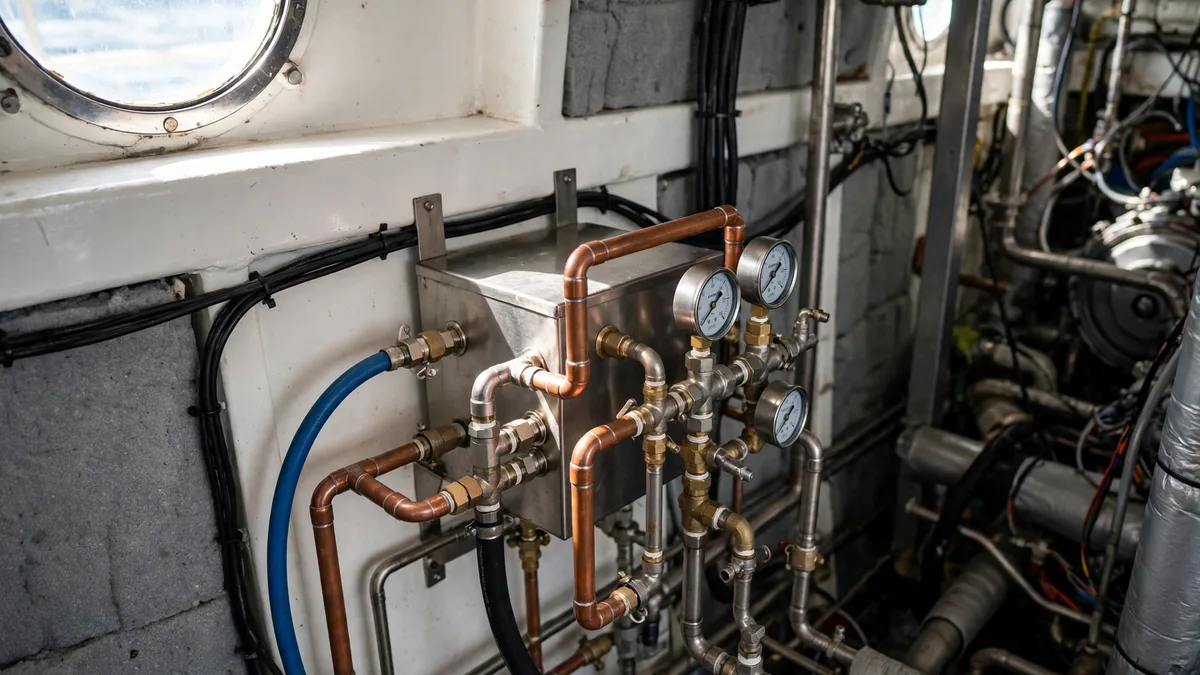
Everything starts with a through hull fitting below the waterline, a small opening that lets seawater into the yacht. A pump draws the water in, and it passes first through a strainer, a basket that catches seaweed, fish and grit before they can reach the delicate parts downstream. The crew clean the strainer every day, because a blocked intake starves the whole system.
The water then passes through fine filters that take out sand and silt. Seawater looks clean from the deck, but it carries tiny particles that would scratch the membranes at the heart of the system, so the filters step down finer and finer until the water is clear. A pressure gauge tells the crew when a filter is clogging and needs changing.
Step 2: The water is pressurised
Clean seawater is still salty, and salt will not come out on its own. The system uses a high pressure pump to squeeze the water to around sixty times normal air pressure, forcing it against a membrane that lets water through but blocks salt. The pump is the hardest working part of the system, and the loudest, so it is mounted on rubber feet inside a soundproof box.
The pump is driven by an electric motor, and it is built to run for hours at a time without overheating. A pressure relief valve guards the system, dumping water back overboard if the pressure climbs too high, and a sensor watches the pressure constantly. Too little pressure and no fresh water comes out; too much and the membrane can tear.
Step 3: Membranes strip out the salt
The heart of the system is a set of membrane cartridges, long tubes wound with layers of a special plastic film. Pressurised seawater flows along the film, and pure water passes through its microscopic pores while salt, minerals and bacteria are left behind. The fresh water, called permeate, is collected from the centre of the cartridge.
The salty water that does not pass through, called brine, flows out the other end and back into the sea. Only about a tenth of the seawater that enters becomes fresh water, so the system pumps far more water than it makes, and the brine it returns is saltier than the sea it came from. The membranes are flushed with fresh water after every run to keep them clean.
Step 4: The fresh water is tested and polished
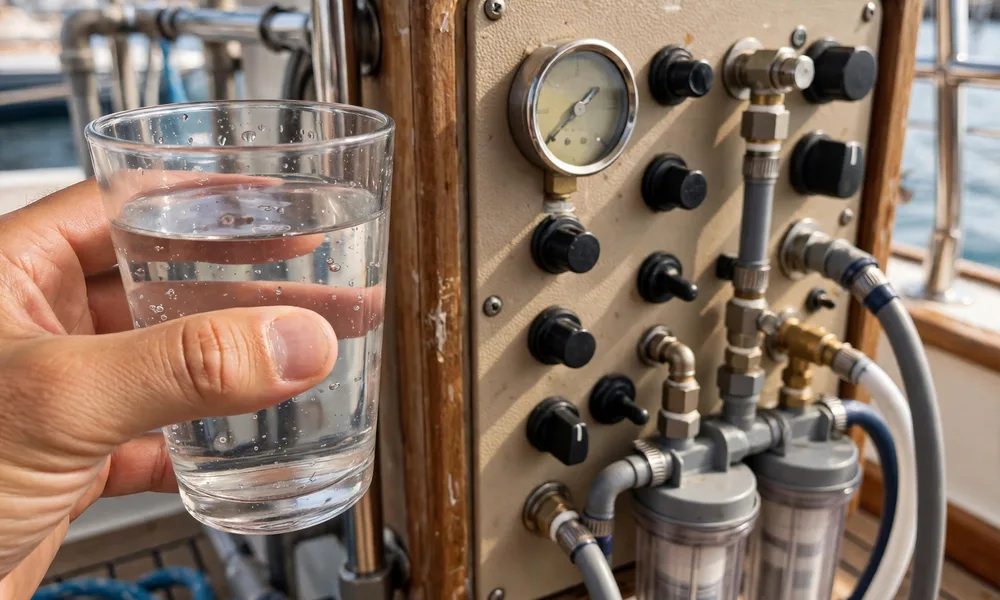
Water coming off the membranes is almost pure, but it is tested before anyone drinks it. A sensor measures its salinity in parts per million, and if the number is too high, the system dumps the water overboard and alerts the crew. Good product water reads below five hundred parts per million, and most yacht systems hold it far lower than that.
The water then passes through a carbon filter that takes out any taste or smell, and a mineral cartridge that adds back a pinch of calcium and magnesium, because water that is too pure tastes flat and can corrode pipes. Some yachts add an ultraviolet lamp as a final guard, killing any bacteria that slipped through. Only after all of that does the water reach the tanks.
Step 5: The water is stored in tanks
Fresh water is stored in stainless steel tanks, often holding thousands of litres, tucked low in the hull where their weight steadies the yacht. The tanks are baffled inside, with walls that stop the water sloshing from side to side when the yacht rolls, and they are vented so air can escape as they fill.
A level sensor in each tank tells the bridge how much water is left, and the system starts itself when the tanks drop and stops when they are full. The tanks are cleaned and disinfected once a season, because warm, still water grows things the crew would rather not drink. Clean tanks are the difference between fresh water and a stomach bug.
Step 6: The system is flushed and maintained
When the yacht moves to a marina with shore water, or sits unused for a while, the desalination system is flushed with fresh water and pickled, a process that fills the membranes with a preserving solution so they do not grow slime or dry out. A pickled system can sit for months and wake up ready to make water again.
Membranes last for years with care, but they are checked every season and replaced when the product water starts to creep saltier. The crew keep a log of pressures, flows and salinity, because a slow drift in the numbers is the first sign that a membrane is tiring. A well kept log means the system never fails on a guest’s first morning at anchor.
| Spec | Detail |
|---|---|
| Intake | Through hull fitting with a strainer and fine filters against grit |
| Pump | High pressure pump squeezing seawater to about sixty times air pressure |
| Membranes | Wound plastic film cartridges letting water through and blocking salt |
| Polishing | Salinity sensor, carbon filter, mineral cartridge and ultraviolet lamp |
| Storage | Baffled stainless steel tanks holding thousands of litres low in the hull |
| Care | Fresh water flush and pickling when idle, membranes checked each season |
The hardest part of a yacht desalination system is the power. Pushing seawater through a membrane at sixty times air pressure takes a lot of electricity, so the system runs best when the generators are already running for air conditioning and cooking. A yacht that tries to make water on batteries alone will drain them before the tanks are half full.
What One Costs
A luxury yacht desalination system typically costs an estimated $20,000 to $120,000 installed, set mostly by how much water it makes per hour and how quiet it runs. A compact unit for a modest yacht sits near the bottom of the range, while a large high output system for a superyacht costs far more. For the cargo ship systems that work the same way at scale, how a luxury cargo ship works shows the bigger picture, and the explorer yacht specifications list the tanks it fills.
A Rare Fact
A yacht desalination system throws away about nine litres of seawater for every litre of fresh water it makes. The brine it returns to the sea is saltier than the water it took in, and in a still anchorage the crew run the system while the tide is moving, so the salty plume drifts away instead of settling under the hull.
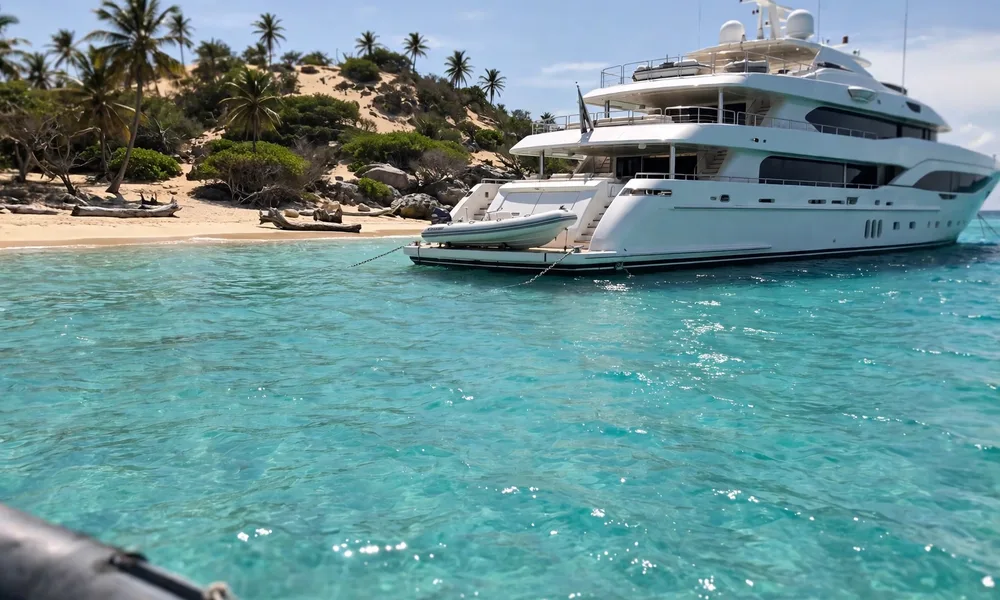
A luxury desalination system is a pump, a membrane and a set of filters that together turn the sea into drinking water. It draws seawater in, squeezes it through film finer than any sieve, tests what comes out, and fills the tanks while the yacht sits at anchor in the middle of nowhere. For the expedition yacht that carries it furthest, how a luxury expedition yacht is made follows the vessel built to stay out at sea the longest.


