Far from any harbour, in water cold enough to sting, a long steel yacht pushes through a field of broken ice. There is no port for a thousand miles, no rescue boat nearby, and no one on board seems worried. This is not a holiday cruise. It is an expedition, and the yacht was built for exactly this.
A luxury expedition yacht is a vessel that carries its owners to the ends of the earth and brings them home again in comfort, and it is made very differently from a yacht built for calm Mediterranean summers. The guide to how a luxury expedition yacht works explains what its systems do once it is at sea, and this article follows the build itself, in six steps: the ice-strengthened hull, the engines and fuel, the long-range systems, the tenders and toys, the warm interior, and the cold-water trials that prove the yacht is ready for anywhere. It is a ship that happens to be a home.

Step 1: Building a hull strong enough for ice
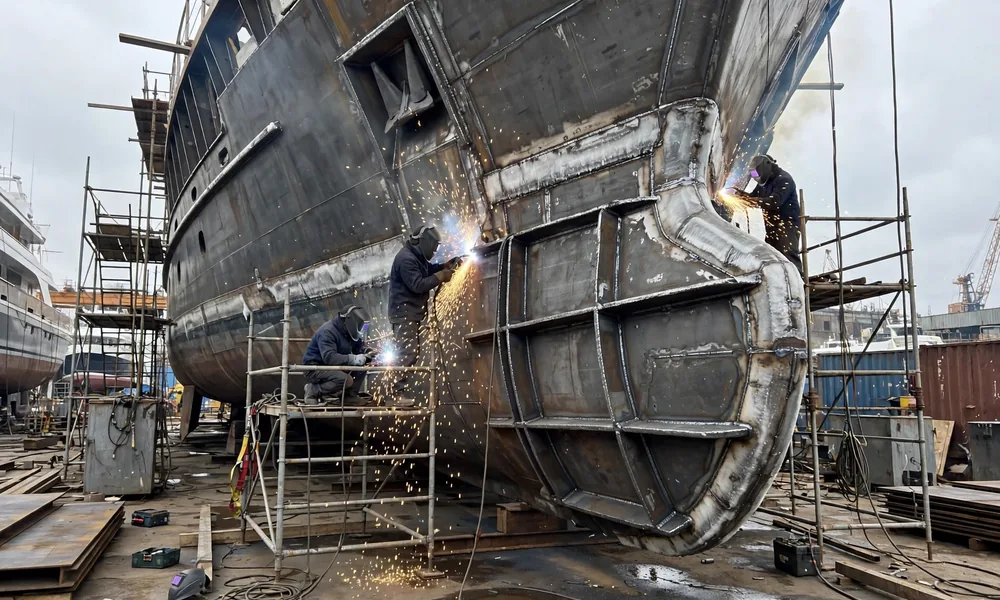
An expedition yacht begins with a steel hull, not the fibreglass or aluminium of a fair-weather yacht, because steel can take a knock from ice and keep going. The plates are thicker than usual, especially around the bow and the waterline, and the frames inside are set closer together, so the hull behaves like a single solid shell rather than a thin skin. Watertight doors divide the hull into sealed sections, so even a serious leak in one part leaves the yacht afloat and able to reach shelter.
Step 2: Adding engines and fuel for months at sea
An expedition yacht must travel far beyond the reach of fuel docks, so its engines and tanks are built for range first and speed second. Twin diesel engines are the usual choice, because two engines mean the yacht can keep going on one if the other fails, and the fuel tanks are large enough to carry the yacht thousands of miles without refuelling. Generators run day and night to power heating, cooking and navigation, and the engine room is built so that engineers can reach every pump and filter easily, even in rough weather, because a breakdown at sea must be fixed at sea. The guide to luxury expedition yacht specs explained breaks down the numbers behind that range, from fuel capacity to cruising speed, and shows why range matters more than top speed on a yacht like this.
Step 3: Fitting systems that make the yacht self-sufficient
Once the engines are in, the yacht is fitted with the systems that let it live alone for weeks at a time. A desalination plant turns seawater into fresh drinking water, freezers and cold stores hold food for a month or more, and a small workshop with a lathe and welding kit lets the crew repair almost anything on board. The waste system is built to the strictest rules, because an expedition yacht visits fragile places, and nothing may be thrown overboard that could harm them. Every system has a backup, and every backup is tested, because in the places this yacht goes, there is no one to call for help.
Step 4: Adding tenders, toys and a helicopter deck
An expedition yacht is also a base camp, so it carries the boats and machines that let guests explore once it anchors. A large tender with a strong engine is stored in a garage at the stern, launched by a crane that can work in a swell, and smaller kayaks and paddleboards are tucked into lockers along the deck. Every toy is chosen to be tough and simple, because a machine that cannot be fixed on board is a machine that will be left behind.
Step 5: Building a warm interior for cold places
The interior of an expedition yacht is built to feel like a mountain lodge that happens to float. Cabins are lined with warm wood and thick fabrics, the saloon has a fireplace that is safe at sea, and the windows are small and double-glazed, because large sheets of glass lose heat fast in polar cold and can ice over in a storm. Underfloor heating runs through the cabins and the wheelhouse, and the galley is fitted to cook for a full crew and a full party of guests for weeks without resupply.
Step 6: Trials in cold water, before the real cold
Before it is handed over, the yacht is tested in cold, rough water, not the calm seas of a summer trial. The crew takes it out in heavy weather to check that it rides steadily, that the heating keeps every cabin warm, and that the ice-strengthened bow behaves as designed. Only when the yacht has proved it can look after itself, far from help, is it washed, polished and handed over, ready for the first voyage to somewhere no ordinary yacht would dare to go. The guide to why a luxury expedition yacht is so expensive explains why a yacht built like this costs so much, where the steel, the range and the self-sufficiency each add their own share to the price.
The luxury expedition yacht at a glance
| Part | Typical luxury figure | What it tells you |
|---|---|---|
| Hull | Thick steel, ice-strengthened bow | How far into the ice the yacht can safely go |
| Engines | Twin diesels, guarded propellers | How reliably it keeps moving far from help |
| Range | Around 8,000 to 10,000 nautical miles | How far it can travel without refuelling |
| Guests | Around 12 guests, plus a crew of 12 to 16 | How many people it carries on long voyages |
| Endurance | Weeks at sea, food and water for a month | How long it can stay away from any port |
| Tenders | Large tender, kayaks, often a helicopter deck | How guests explore once the yacht anchors |
| Build time | Around 30 to 36 months in the yard | How much hand work goes into each yacht |
What it costs
A luxury expedition yacht typically costs an estimated $20 million to $80 million, depending on its length, its ice class and the size of its tender and helicopter facilities, and the estimate covers the yacht alone, not the crew, the fuel or the running costs, which are far higher than for an ordinary yacht because the yacht carries more crew and sails much further.
A rare fact
One detail few guests ever learn is that the best expedition yachts carry a full set of spare parts for almost everything on board, from pumps and filters to a spare propeller blade, stored in a dedicated spares room below deck.
Follow the six steps in order, hull first, then engines, self-sufficiency, tenders, interior and trials, and a luxury expedition yacht stops looking like a big yacht with a steel hull and starts looking like what it is: a floating home built to go where nothing else can go, carrying its people in warmth and comfort through ice, storms and empty oceans, and bringing them back with stories no ordinary holiday could ever give them.