The valet brought the car around at midnight, and the first thing the owner noticed was what was missing. There was no rumble, no vibration through the steering wheel, no smell of fuel in the cold air. The doors closed with a soft thunk, the cabin lit up like a lounge, and when she pressed the accelerator the car simply left, quickly and without any drama at all, the city sliding past the windows in silence. It is the absence of everything a car used to be.
A luxury electric car works on the same basic idea as any electric car: a battery feeds a motor, and the motor turns the wheels. What makes it luxury is how far the engineers take that idea. The battery is bigger and flatter, the motors are stronger and quieter, the body is stiffer, and the software manages everything, from the torque at each wheel to the temperature of the seats.
Under the floor and behind the panels, the car is a chain of systems talking to each other a thousand times a second. Here is how that chain works, from the charge in the floor to the silence in the cabin.
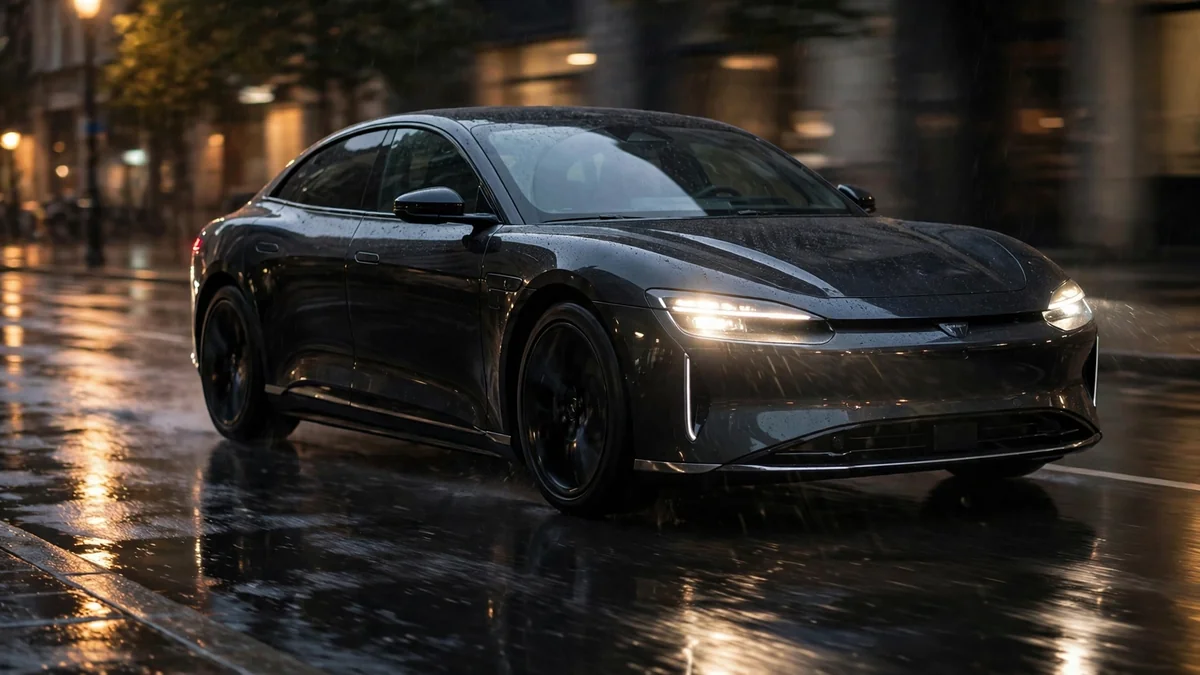
How a Luxury Electric Car Works
The car works in four stages: the battery stores the energy, the inverter shapes it, the motors turn it into motion, and the software manages it all.
Step 1: The battery in the floor
Everything starts with the battery, a flat pack of lithium cells bolted into the floor of the car, between the axles and under the cabin. It is the heaviest part of the car, often weighing half a tonne, and that weight sits low, which is why a luxury electric car corners so flat and feels so planted. A typical luxury pack holds 90 to 120 kilowatt-hours, enough for 300 to 400 miles, and it is the reason the car can be so quiet: there is no engine to mount, no exhaust to route, and nothing to vibrate.
Step 2: The inverter shapes the power
The battery stores direct current, but the motors run on alternating current, so the power passes through an inverter, a box of power electronics that switches the current thousands of times a second to build the smooth wave the motor needs. The craft of building that box, and the silicon carbide switches inside it that waste almost no energy as heat, is the subject of EV inverter specs explained, where the switching speed and the cooling decide how much of the battery actually reaches the road.

Step 3: The motors turn power into motion
Most luxury electric cars carry two motors, one on each axle, and some carry three or four. Each motor is a compact cylinder of copper and magnets that spins up instantly, with no gears to shift and no waiting for revs to build. The front and rear motors work together, and the car can send more torque to the axle with the most grip, or to the outside wheel in a corner, a trick called torque vectoring that makes a heavy car feel light.
Step 4: The power electronics and the brain
Between the battery and the motors sits a network of power electronics, the inverters, the converters, and the controllers that move energy around the car. They feed the motors, run the air conditioning, charge the small 12-volt battery that powers the lights and the computers, and manage the flow when the car charges. The whole network is described in EV power electronics specs explained, where the wiring, the cooling, and the safety systems decide how reliably the car can deliver its power. Above it all sits the car’s central computer, a machine that reads the sensors, talks to the motors, and updates itself over the air, so the car you own in a year can be a better car than the one you bought.
Step 5: Regenerative braking and one-pedal driving
When the driver lifts off the accelerator, the motors reverse and become generators, turning the car’s motion back into electricity and feeding it into the battery. This is regenerative braking, and on a luxury car it is tuned so smoothly that most city driving needs only one pedal: press to go, lift to slow, and the friction brakes only wake up for a hard stop. The system also saves the brake pads, which can last the life of the car, and it adds miles of range on a hilly road, where every downhill becomes a small recharge.
Step 6: The luxury layer, silence and air
The last stage is the one the driver feels most. With no engine noise to mask it, the engineers had to silence everything else, so the car gets acoustic glass, active noise cancelling through the speakers, and air suspension that reads the road ahead and softens each bump before the wheel reaches it. The cabin is a sealed, quiet room, and the car updates its own software while it sleeps, so the range, the charging speed, and even the sound of the door chime can improve overnight. The ranking of the cars that do all of this best is a separate story, told in the best luxury electric cars of 2027 ranked, where the quietest cabins and the longest ranges decide the order.
Luxury Electric Car Specifications
| Specification | Typical figure |
|---|---|
| Battery capacity | 90 to 120 kilowatt-hours |
| Range | 300 to 400 miles |
| Motors | Dual motor, all-wheel drive |
| Power | 400 to 750 horsepower |
| 0 to 60 miles per hour | 3.0 to 4.5 seconds |
| Charging, DC fast | 10 to 80 percent in 20 to 30 minutes |
| Cabin noise at speed | Under 60 decibels |
| Suspension | Adaptive air suspension |
What Does a Luxury Electric Car Cost?
A luxury electric car is priced like the flagship it is. Current models typically sell for an estimated $80,000 to $150,000, with the most exclusive versions reaching an estimated $200,000 or more. The battery pack is the single most expensive part, an estimated $15,000 to $25,000 of the price, followed by the motors, the power electronics, and the cabin. Running costs are lower than a petrol flagship: electricity for a year of driving costs an estimated $600 to $1,000, and servicing is minimal, with no oil, no exhaust, and brakes that barely wear. Those figures are estimates, and they vary by model and region, but the shape of the deal is the same everywhere: a high price to buy, and a quiet, cheap life afterwards.
A Rare Fact About Luxury Electric Cars
Here is the detail most people miss: a luxury electric car is quieter inside than a recording studio. At motorway speed, the cabin of the best models measures under 60 decibels, quieter than a normal conversation, and the engineers achieve it by fighting noise the petrol age never had to think about. They tune the tyres, seal the glass, cancel the wind noise with the speakers, and even shape the body so the air slides past without a whistle. The silence is not an accident. It is the product, and it is the hardest thing in the car to build.

A luxury electric car is a strange kind of flagship: it has no engine to show off, no exhaust note to brag about, and no gears to shift. What it has is silence, instant torque, and a cabin that feels like a good hotel room. The car does not shout about what it is. It simply moves, quickly and quietly, and lets the silence do the talking.


