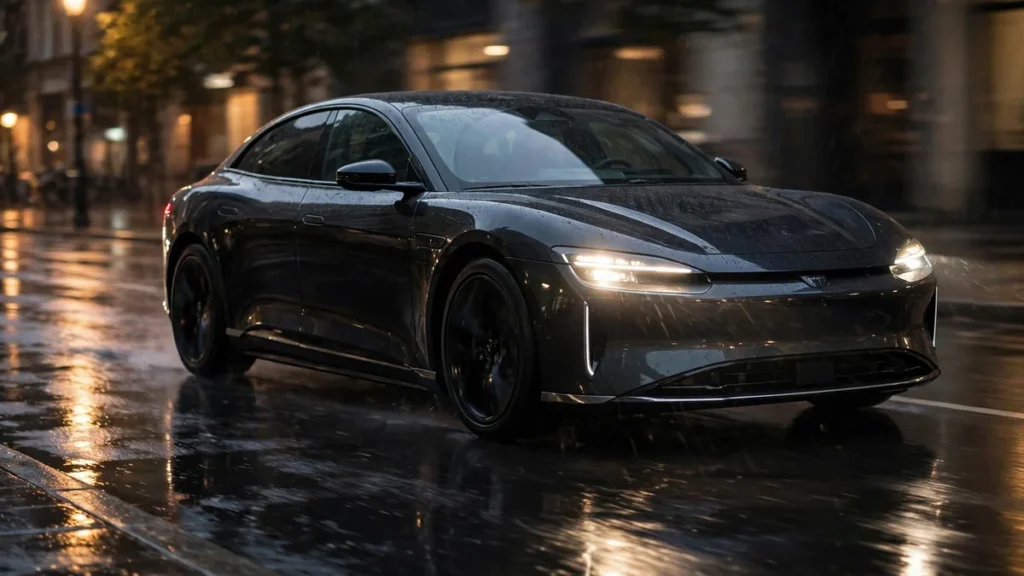
Open the bonnet of a modern electric car and you will not find an engine. You will find a collection of boxes, cables, and cooling pipes, and the boxes are the power electronics — the inverters, converters, and chargers that move electricity between the battery, the motor, and the charging plug.
Power electronics is the umbrella term for everything that converts and controls electrical power in an EV: the inverter that drives the motor, the DC-DC converter that runs the 12-volt systems, and the on-board charger that turns mains electricity into battery charge.
This guide explains the key numbers on an EV power electronics spec sheet in plain English: what power rating really means across different units, why voltage architecture matters, how efficiency turns into range, and which figures are worth comparing between cars.

Decoding EV Power Electronics Specs
1. Power rating: the ceiling on everything the car can do
Power rating is measured in kilowatts, and it is the maximum power a unit can handle — for the traction inverter, typically 150 to 400 kW in a modern electric car, and more than 500 kW in the fastest ones. The inverter’s rating is the ceiling on acceleration, because the motor cannot produce more power than the inverter can feed it. The on-board charger’s rating is a different number, usually 7 to 22 kW on AC, and it is the ceiling on home charging speed. The inverter itself is covered in detail in EV inverter specs explained.
2. Voltage architecture: 400 volts, 800 volts, and what changes
Voltage architecture is the nominal voltage of the car’s high-voltage system, usually around 400 volts or around 800 volts. For the same power, doubling the voltage halves the current, which means thinner cables, less heat, and faster charging. An 800-volt car can add hundreds of kilometres of range in under twenty minutes at a suitable charger, while a 400-volt car on the same charger charges more slowly.
3. Efficiency: the percentage that becomes range
Efficiency is the share of energy that survives each conversion, and it is the number that turns directly into range. A modern EV inverter is 97 to 99 percent efficient, a DC-DC converter is typically 95 to 97 percent, and an on-board charger is usually 92 to 96 percent. The semiconductor material that makes the best efficiency possible is covered in EV silicon carbide inverter specs explained.
4. Switching frequency: the hum you cannot hear
Switching frequency is measured in kilohertz, and it is how many times per second a unit’s transistors turn on and off to shape the electricity. A typical silicon inverter switches at 10 to 20 kHz, while a silicon carbide unit can switch at 50 kHz or more. Silicon carbide switches faster still, which is why it is replacing silicon in the newest designs. Higher frequency means smoother power, a quieter motor, and smaller, lighter filters — but it also means more heat in the transistors, so frequency is a trade-off against cooling.
5. DC-DC converter: the quiet unit that runs the whole car
The DC-DC converter steps the battery’s 400 or 800 volts down to 12 volts to run the lights, wipers, infotainment, and safety systems. Its rating is usually 2 to 5 kW, far smaller than the inverter’s. The spec sheet quotes its output power, its efficiency, and its operating temperature range, and modern converters are increasingly bidirectional, able to feed power back to the high-voltage system.
6. On-board charger: the bottleneck at home
The on-board charger converts AC mains electricity into DC for the battery, and its rating — usually 7 kW single-phase or 11 to 22 kW three-phase — is the bottleneck for home and workplace charging. The spec sheet also quotes the charger’s efficiency and whether it supports vehicle-to-load or vehicle-to-grid, where the car can power a house or feed electricity back to the grid. The battery the charger feeds is covered in EV battery cell specs explained.
7. Cooling and power density: the heat that has to go somewhere
Cooling is the real limit on power electronics, because even at 98 percent efficiency a 300 kW inverter wastes 6 kW as heat — enough to warm a small house. The spec sheet quotes the cooling method, usually a liquid loop shared with the battery and motor, and the maximum coolant temperature the unit can tolerate. Power density — kilowatts per kilogram or per litre — is the figure engineers compare, and it has roughly doubled in a decade as silicon carbide and better cooling have taken hold.

EV Power Electronics Specs
| Specification | Typical range |
|---|---|
| Traction inverter power | 150 to 400 kW, 500+ kW in performance cars |
| Voltage architecture | 400 V or 800 V nominal |
| Inverter efficiency | 97 to 99 percent |
| Switching frequency | 10 to 20 kHz silicon, 50+ kHz silicon carbide |
| DC-DC converter power | 2 to 5 kW, 12 V output |
| On-board charger power | 7 kW single-phase, 11 to 22 kW three-phase |
| On-board charger efficiency | 92 to 96 percent |
| Cooling | Liquid cooling loop, shared with battery and motor |
What Does EV Power Electronics Cost?
EV power electronics are estimated at roughly $1,000 to $3,000 for the full set in a mainstream electric car — inverter, DC-DC converter, and on-board charger combined — and $3,000 to $7,000 or more in a high-performance 800-volt car. The traction inverter is the most expensive single unit, estimated at $500 to $2,000, and the silicon carbide power modules inside it are the reason the price has stayed high even as the rest of the car has got cheaper. All prices are estimates only and vary widely by power rating, semiconductor type, and production volume. Power electronics are a small share of the car’s price, but they are the parts that most directly decide how it drives and how fast it charges.
A Rare Fact
The first electric cars of the 1890s had no power electronics at all, because their motors ran on direct current straight from the battery — and they were slow, inefficient, and hard to control. The alternating-current motor, which needs an inverter, was invented by Nikola Tesla in the 1880s, but it took a century of power electronics before an inverter small and efficient enough for a car existed. The modern power electronics package, shrunk from a cabinet the size of a wardrobe into boxes that fit under the bonnet, is what finally made the electric car fast, efficient, and practical.

The spec sheet is the honest version of the brochure’s range and acceleration figures. Power rating tells you the ceiling, voltage tells you how fast it charges, efficiency tells you how much of the battery becomes motion, and the charger rating tells you how long a full charge really takes at home. The boxes under the bonnet are the parts nobody sees and everybody relies on, and their numbers are the ones that decide how an electric car actually lives day to day.