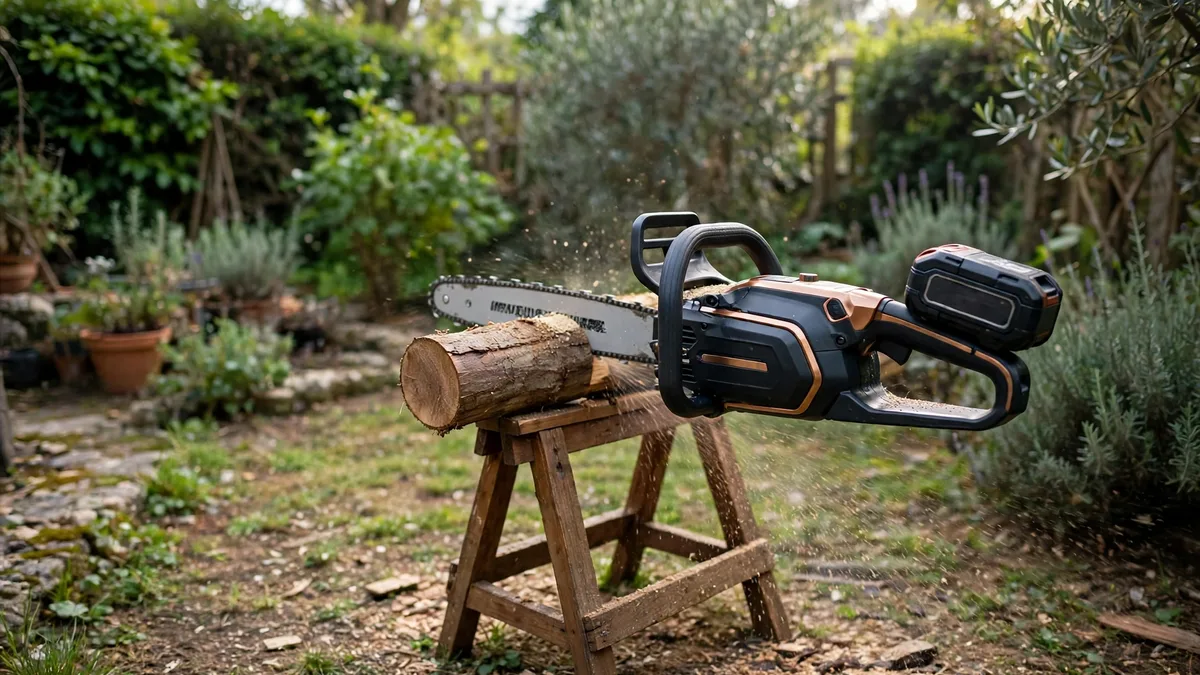
In a quiet garden on a still morning, a log lies across a sawhorse, waiting to become firewood. A person in gloves picks up a saw, presses a button, and a loop of steel teeth begins to race around a long bar, biting into the wood and throwing a neat spray of sawdust onto the grass. The cut takes seconds, the log falls in two clean halves, and the only sound is a smooth rising whine, not a petrol snarl. It looks like a simple tool, yet building one takes a factory full of forges, grinders and careful hands.
A luxury electric chainsaw is a cutting tool powered by a battery and an electric motor, built to drive a loop of sharp chain around a steel guide bar at high speed. It is made for owners who cut firewood, prune trees and clear branches, without the noise, fumes and pull cord of a petrol saw. Building it means forging a bar that stays straight under load, sharpening dozens of tiny cutters, winding a motor with instant torque, and fitting brakes and oilers that keep the cut safe. This is how it is made, from a strip of steel to the first clean cut on the test bench.
How It’s Made
Step 1: Forging and grinding the guide bar
The guide bar is the long steel spine the chain runs around, and it starts as a flat strip of hard alloy steel. The strip is cut to length, heated until it glows, and pressed in a forge that shapes its rounded nose and the slot where the chain’s drive links ride. After forging, the bar is ground flat to a mirror finish, since any roughness would drag on the chain. Workers check the bar with a straight edge, rejecting any that bend, and the nose is fitted with a small sprocket that lets the chain turn smoothly at the tip. A luxury bar is laminated steel with a hardened edge, so it stays straight through years of hard cutting.
Step 2: Stamping and sharpening the chain
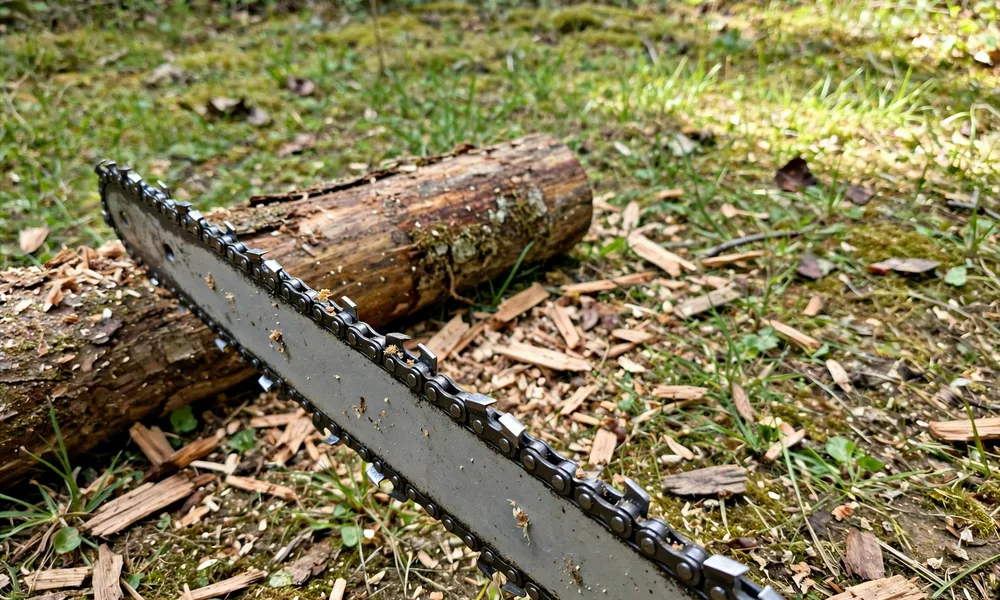
The chain is a loop of more than fifty steel links, each stamped from sheet steel on a press that cuts a cutter, a drive link and a tie strap in a single blow. Each cutter is ground to a precise angle, its edge honed until it can shave wood like a chisel. The links are then riveted into a loop, each rivet pressed and checked so the chain can flex around the bar without coming apart. A luxury chain is chrome-plated steel that stays sharp longer, and every loop is pulled through a test groove to check it runs freely before it is oiled and coiled.
Step 3: Winding the motor and fitting the drive sprocket
The motor must deliver huge turning force the instant the trigger is squeezed, so it is wound with thick copper wire around a steel core, with strong magnets on the rotor. Each coil is laid by machine with exact tension, and the finished motor is tested for power and heat before fitting. A small steel sprocket is pressed onto the motor shaft, its teeth shaped to grip the chain’s drive links and pull it around the bar at speed. The motor is sealed into the body on rubber dampers that soak up vibration, so the handles stay steady even when the chain is biting into oak.

Step 4: Building the body, handles and safety brake
The body is moulded from tough glass-fibre plastic, in two halves that fit around the motor, the battery bay and the oil tank, much likehow a luxury robot lawn mower is made. The handles are shaped for gloved hands, with a soft rubber grip at the rear and a wide hand guard that doubles as the brake lever. The brake is a steel band around a drum on the drive sprocket, held back by a spring and ready to snap shut if the guard is pushed forward. Workers fit the trigger, safety lock and chain tensioner by hand, testing each with a click, because a saw that cannot be stopped instantly is not safe to sell.
Step 5: Fitting the oiler and the battery bay
A chain that runs dry will overheat, stretch and snap, so every luxury chainsaw has an automatic oiler that drips oil onto the bar and chain while cutting. The oil tank sits beside the motor, with a clear window for the level, and the pump is driven by the motor, so oil flows only when the chain is moving. The battery bay is fitted next, with spring contacts, a firm latch and a circuit board that watches temperature and charge, ashow a luxury electric leaf blower works shows, cutting power if the saw is pushed too hard. The bar and chain are then mounted, the tension set with a small dial, and the chain cover bolted on with a single large nut that can be undone by a gloved hand.
Step 6: Testing the cut and the final check
Before it leaves the factory, a technician slots in a charged battery and makes a series of cuts through seasoned logs in a test bay. Engineers watch the chain speed, listen for rattling, and check that the brake stops the chain instantly when the guard is touched. The oiler is checked by the fine line of oil it throws onto paper, and the battery is run down and recharged to confirm its true working time. Only when the saw has cut straight, stopped instantly and stayed cool is it wiped clean, packed with a charger, chain oil and a spare chain, and sent out to gardens and woodpiles. The way the finished saw behaves in the cut is what a luxury electric chainsaw does at work shows, with the same instant torque and the same clean, quiet cut.
| Specification | Typical machine |
|---|---|
| Power source | Slide-in lithium battery pack, charged from a household socket |
| Motor | Brushless electric motor with instant torque and sealed housing |
| Guide bar | Forged laminated steel bar with hardened edge and nose sprocket |
| Chain | Chrome-plated steel loop, ground cutters riveted into a flexible loop |
| Safety brake | Steel band brake that stops the chain in a fraction of a second |
| Oiler | Automatic pump dripping oil onto bar and chain while cutting |
| Battery bay | Latched bay with temperature and charge protection circuit |
| Working time | Dozens of cuts per charge, with a spare pack for long sessions |
A luxury electric chainsaw costs an estimate of $500 to $1,500, depending on the length of its bar, the size of its battery and whether it comes with spare chains and a fast charger. The price covers the saw, battery and charger, forged bar and sharpened chain, and the safety brake and oiler that set it apart from cheaper saws. Owners who cut firewood all winter often buy a second battery and a spare chain, so the work never has to stop while a pack charges or a chain is sharpened.
Here is a rare fact worth knowing. The first chainsaws were made for surgery, invented in the late 1700s to help doctors cut bone, and the first tree-felling saws were so heavy that two men carried one. It took a century of shrinking motors and lighter steel before a chainsaw could be held by one person, and another leap to battery power before one could be used in a quiet garden. A modern luxury electric chainsaw weighs only a few kilograms, starts with a button, and can fell a small tree before neighbours notice.