In a quiet garden on a still morning, a log lies across a sawhorse, waiting to become firewood. A person in gloves picks up a saw, presses a button, and the chain begins to move, a blur of steel teeth that bites into the wood and throws a neat spray of sawdust onto the grass. The cut takes seconds, the log falls in two clean halves, and the only sound is a smooth rising whine, not the snarl of a petrol engine. The work is done before the neighbours have even noticed it started.
A luxury electric chainsaw is a cutting tool powered by a battery and an electric motor, built to drive a loop of sharp chain around a steel guide bar at high speed. There is no petrol, no exhaust, no pull cord and no idling engine, just a motor, a chain and a bar, with a brake and an oiler to keep the cut safe and smooth. It looks like a smaller, quieter version of the petrol saws that have felled trees for a century, but inside it works in a very different way, trading brute engine noise for instant torque and fine control.

How It Works
The battery: instant power with no pull cord
Everything starts with the battery pack, a heavy block that slides into the back of the saw and locks with a click. Inside are lithium cells wired to deliver a high voltage to the motor, and a small circuit that watches their temperature, balances their charge and cuts the power if the saw is pushed too hard. A luxury chainsaw uses a large pack, because cutting wood takes a great deal of energy, and a small pack would be empty after a few logs. The pack is the heaviest part of the tool, so it sits low and close to the rear handle, balancing the weight of the bar at the front.
The motor: torque the instant the trigger is squeezed
The heart of the saw is a brushless electric motor, a compact cylinder that turns the chain through a small sprocket at the base of the bar. Unlike a petrol engine, which must rev up to reach its power, an electric motor gives its full turning force the instant the trigger is squeezed, so the chain bites into the wood immediately, with no lag and no stalling. The motor has no brushes to wear out and no spark plug to foul, just magnets and coils switched by an electronic controller that reads the rotor position many times a second. The same instant-torque idea drives bigger electric machines, and the way a luxury electric excavator works shows how electric motors give full power from the first second.
The chain and bar: a loop of teeth at high speed
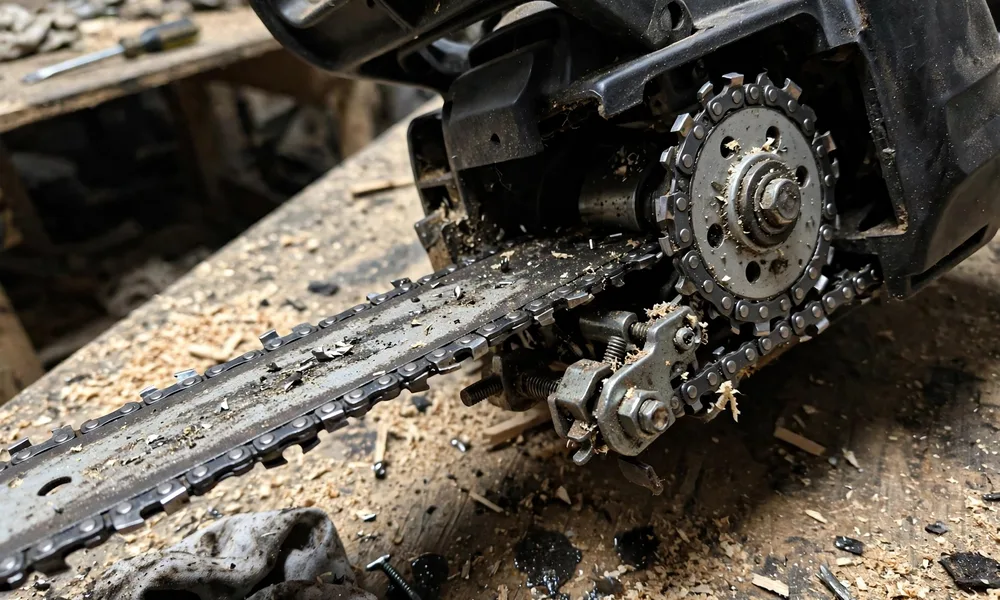
The cutting is done by the chain, a loop of steel links that runs around the guide bar, each link carrying a sharp tooth shaped like a tiny chisel. The teeth are arranged in a pattern, with cutting teeth that slice the wood fibres and depth gauges that limit how deep each tooth bites, so the chain takes a thin shaving on every pass rather than grabbing and kicking. The chain runs at high speed, often twenty metres a second or more, and each tooth takes its small bite hundreds of times a second, which is why the cut is so fast and so clean.
The oiler: keeping the chain cool and smooth
A chain running at high speed around a steel bar would destroy itself in minutes without oil, so every chainsaw has an automatic oiler, a small pump that drips chain oil onto the bar as the chain runs. The oil is stored in a tank beside the battery, and the pump is driven by the motor, so it only oils while the chain is moving, and it oils more at full speed than at idle.
The brake and safety: stopping the chain in a blink
A chainsaw is the most dangerous garden tool most people will ever hold, so a luxury saw is built around its safety systems. The most important is the chain brake, a band that clamps around the drive sprocket and stops the chain in a fraction of a second. It is triggered by the hand guard in front of the top handle: if the saw kicks back, the user’s hand pushes the guard forward and the brake fires instantly, and the same brake can be set by hand before the saw is carried. The trigger also has a lockout, a small button that must be pressed before the trigger will move, so the saw cannot start by accident. The crane that lifts steel on a building site is guarded by the same idea, and the way a luxury electric crane works shows how brakes and limits keep a strong machine under control.
Why it cuts so cleanly, and how to keep it sharp
A chainsaw cuts cleanly because each tooth takes a tiny, controlled bite, hundreds of times a second, slicing the wood fibres rather than tearing them. The cut stays clean as long as the teeth stay sharp, and a sharp chain throws long, neat shavings, while a dull chain throws fine dust and needs to be pushed hard, which is when accidents happen. Sharpening is done with a small round file, a few strokes on each tooth at the angle stamped on the bar, and a luxury saw comes with a guide that holds the file at exactly the right angle, so even a beginner can keep the chain keen. The same care with a sharp, well-kept cutting edge shows up in heavy work too, and the way a luxury electric dump truck works shows how electric power and careful upkeep keep a hard-working machine going without the noise and fumes of diesel.
| Specification | Typical saw |
|---|---|
| Power source | Slide-in lithium battery pack, fast-charged in about an hour |
| Motor | Brushless electric motor, full torque from the first second |
| Chain speed | Roughly twenty metres a second around the guide bar |
| Guide bar | Hardened steel bar with grooved edge and tip sprocket |
| Oiler | Automatic pump, adjustable flow, biodegradable chain oil |
| Safety | Chain brake, hand guard, trigger lockout, low-kickback chain |
| Tensioning | Tool-free dial or screw, checked before every session |
| Upkeep | File the teeth, check tension and oil, charge the battery |

A luxury electric chainsaw is an estimate of $400 to $1,200, depending on the size of the battery, the length of the bar and the quality of the motor and safety systems. The price covers the saw, the battery pack and the fast charger, with spare chains, bars and batteries sold separately, and a good saw will cut firewood for years with almost no running costs beyond the electricity to charge it and the oil for the chain.
Here is a rare fact worth knowing. The first chainsaw was not built for cutting wood at all. It was a hand-cranked surgical tool invented in the late 1700s to cut bone, and the first petrol chainsaws for trees, built in the 1920s, were so heavy that two men were needed to carry one, and they were used by felling crews who worked in pairs. The modern battery saw weighs less than a bag of shopping, starts with a button, and can cut a log in seconds, yet it still uses the same idea as that first surgical tool, a loop of teeth moving fast enough to slice through whatever it touches.


