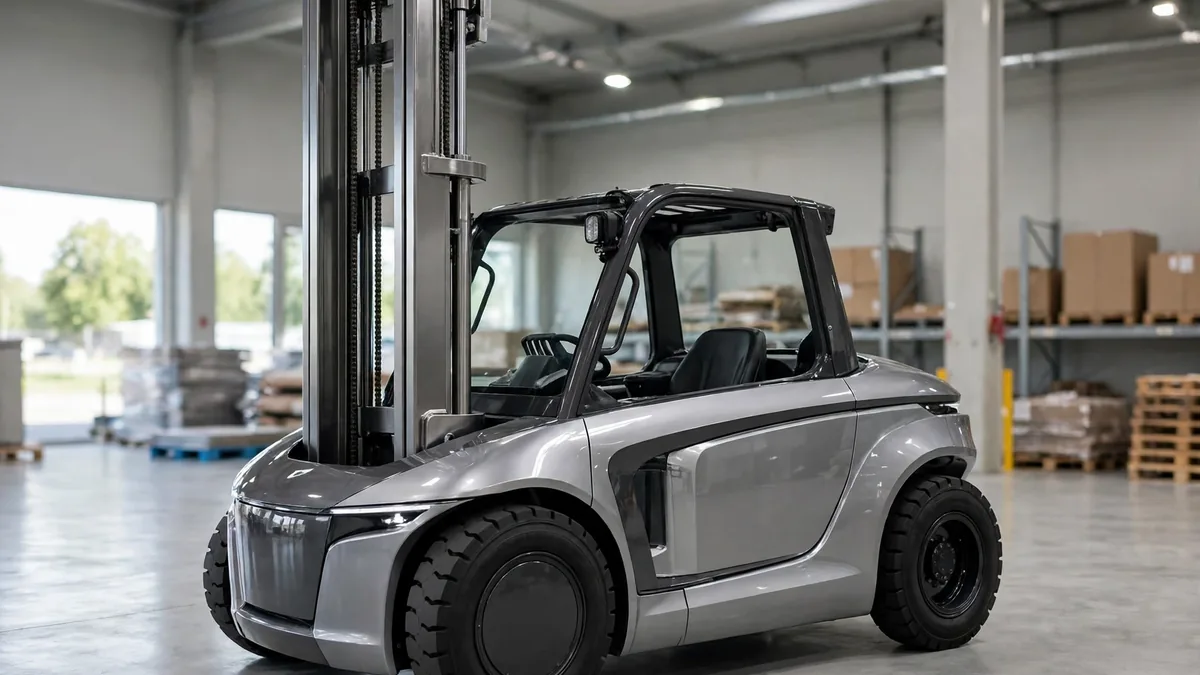
A luxury electric forklift does not look like a machine when it stands in a warehouse. It looks like a compact block of polished steel and glass, quiet and clean, with a tall mast at the front and a seat that feels more like a car than a work truck. Nobody nearby hears an engine or smells diesel, and that silence is the whole point.
The price of the finest electric forklifts runs into six figures, and most of that money is not in the paint or the tyres. It is in the mast, the motors, the battery and the slow, careful assembly that keeps a machine lifting tonnes smoothly, safely and silently for years. A cheap forklift is bolted together and sent out to rattle. A luxury electric forklift is built in stages, tested at every step, and finished like a premium vehicle. This is how it is made.
How It’s Made
Step 1: The chassis is cut, welded and balanced
Every forklift starts as a drawing, long before any steel is cut. Engineers plan the machine around its counterweight, the heavy block at the back that stops the forklift tipping forward when it lifts a full load, and that balance fixes the shape of everything else. Sheets and castings of high-strength steel are cut, bent and welded into a compact chassis, and every weld is inspected, because a forklift chassis must stay straight and true through years of lifting, turning and braking on hard concrete.
Step 2: The mast is built and fitted
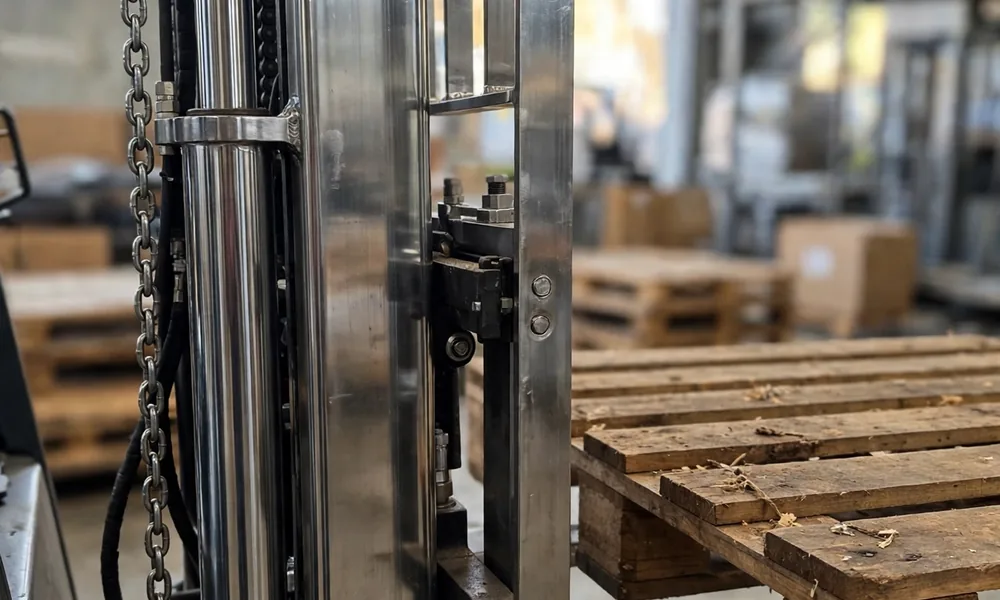
With the chassis complete, the mast goes on, and it is the most carefully built part of the whole machine. Steel channels are machined so that they slide inside each other with almost no play, then assembled into two or three lifting stages that rise smoothly to several metres. Hydraulic cylinders are fitted between the stages, and the chains that carry the forks are tensioned so that both sides lift exactly together, with no tilt and no shudder.
Step 3: Motors, battery and power systems are installed
The next stage is the fitting of the forklift’s heart. Electric drive motors are mounted to the wheels, a separate lift motor powers the hydraulics, and a steering motor turns the rear axle, so that every movement is electric and every movement is quiet. A large lithium battery pack is slung low in the chassis, where its weight helps the balance, and the wiring that links it to the motors is run through protected channels. The whole system is tested under load, so that the forklift can accelerate smoothly, lift a full pallet without a jerk, and brake gently without dropping anything.

Step 4: The cab is built like a car interior
Only when the machine works is the cab built, and on a luxury forklift this is done to the standard of a good car. A suspension seat is fitted, with armrests and a backrest shaped for an eight-hour shift, and the controls are placed so that the driver’s hands never have to stretch. The steering wheel, the lift levers and the pedals are all adjusted by hand, and a clear display shows the load weight, the lift height and the battery charge at a glance. The overhead guard is fitted above, a steel frame that protects the driver from falling goods, and the cab is lined with materials that swallow noise, so the only sound is the soft whirr of the motors.
Step 5: Electronics, safety systems and software are loaded
A modern forklift is as much a computer as a machine, and the next stage is the fitting of its brain. Sensors watch the load weight, the lift height and the tilt of the mast, and a central computer links the drive, the lift and the steering into one system. The software is loaded and calibrated so that the forklift slows itself on corners, refuses to lift a load that is too heavy, and warns the driver before the mast reaches its limit.
Step 6: The forklift is tested in the yard before delivery
The last stage of the build happens away from the factory floor, in a test yard. During trials the forklift is driven empty, then loaded with pallets to its full rated capacity, through tight turns, up ramps and onto high racking, in heat and in cold. Engineers watch with notebooks, logging every hesitation, every vibration and every lift that is not perfectly smooth, and the factory fixes each one before the machine is handed over. Only when it has lifted thousands of pallets without a fault, and the drivers are happy with every lever and every sightline, does the forklift enter service, ready to work quietly for the next decade.
| Spec | Detail |
|---|---|
| Chassis | Welded high-strength steel frame with a cast counterweight at the rear |
| Mast | Two or three steel lifting stages with hydraulic cylinders and chains |
| Motors | Separate electric motors for driving, lifting and steering |
| Battery | Large lithium pack mounted low in the chassis for balance |
| Lift capacity | Around 2 to 3 tonnes, lifted to roughly 6 metres |
| Testing | Thousands of loaded lifts in the test yard before delivery |
The most expensive part of a luxury forklift is not the steel or the battery, but the smoothness. Every stage is a chance for a small jerk to become a ten-year problem, a mast that shudders, a lift that drops a centimetre, a steering axle that wanders, and the factory’s job is to catch each one before the machine ever lifts a pallet. That is why the line moves slowly and the testing takes weeks, and why the finished forklift feels so calm when it lifts, because it was built by people who knew it would be judged every single shift.
What One Costs
A luxury electric forklift typically costs an estimated $60,000 to $150,000, and the price is set mostly by the mast, the battery and the safety electronics rather than the size of the machine. A high-lift model with a large lithium battery, a premium cab and full sensor systems sits at the top of the range, while a simpler forklift with a smaller battery and a standard mast costs far less. The price is in the engineering, not the badge, and how a luxury electric forklift works explains what all those motors and sensors actually do, while how a luxury electric tractor is made shows how a similar electric drivetrain is built for the farm.
A Rare Fact
Some luxury electric forklifts can recover energy every time they lower a load, because the lift motor turns into a generator as the forks come down and feeds power back into the battery. The heavier the load and the higher the lift, the more energy comes back, which is why the factory spends so long on the hydraulics and the motor controls, turning gravity into free charge on every single lift.
A luxury electric forklift is a steel chassis, a smooth mast, a set of quiet motors and a car-like cab, built slowly and tested for thousands of lifts so it can work silently for a decade. For the price of the warehouse it works in, how a luxury electric truck is made explains what a larger electric work vehicle built to the same standard really adds up to.


