On a bright summer morning, a garden hedge has grown shaggy over the winter, its top uneven and its sides bristling with new shoots. A gardener lifts a long, flat tool with both hands, presses the triggers, and the blade begins to hum, sliding back and forth too fast to follow with the eye. The tool sweeps along the top of the hedge in one smooth pass, and a neat flat surface appears behind it, with a shower of small green clippings falling to the lawn. There is no petrol smell, no pull cord and no roar, only a soft buzz and the smell of fresh-cut leaves.
A luxury electric hedge trimmer is a garden tool that cuts hedges, shrubs and bushes with two rows of steel teeth sliding past each other, powered by a battery and an electric motor. It is made for owners who want crisp, straight hedges and tidy shrubs without the noise and fumes of a petrol trimmer, and for gardeners who shape hedges all day and need a tool that is light, balanced and kind to tired arms. Inside the long blade bar is a clever piece of engineering, turning the spin of a motor into a rapid back-and-forth slicing motion, thousands of times a minute. This is how it works, from the battery in the handle to the teeth at the tip.

How It Works
The battery: quiet power in a slide-in pack
Everything starts with the battery pack, a slim block that slides into the back of the trimmer and clicks home with a latch. Inside are rows of lithium cells, wired together to deliver a high voltage to the motor, with a small circuit that watches their temperature, balances their charge and cuts the power if the tool is pushed too hard. A luxury trimmer uses a large pack, because driving two blades back and forth thousands of times a minute takes a great deal of energy, and a small pack would be empty before the hedge is half done. The pack sits low and close to the rear handle, balancing the weight of the long blade bar at the front, so the tool feels level in the hands instead of nose-heavy.
The motor: a brushless spin with instant torque
The heart of the trimmer is a brushless electric motor, a compact cylinder tucked into the handle that spins far faster than any petrol engine and delivers its full turning force the instant the trigger is squeezed. It has no brushes to wear out and no spark plugs to foul, just magnets and copper coils, sealed against dust and damp. The motor does not drive the blades directly, because a spinning shaft cannot make a blade slide back and forth, so its power passes through a small gearbox that slows the spin down and multiplies the force. The gearbox is filled with grease and sealed for life, and its gears are cut from hardened steel so they can survive years of chattering against thick branches.
The reciprocating blades: teeth that slice past each other
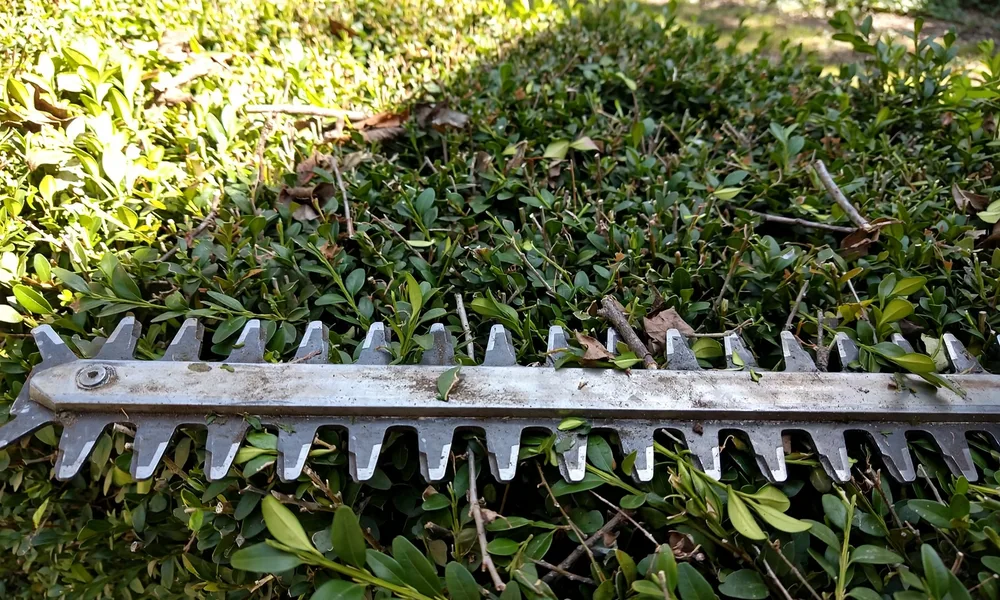
The blade bar is the working end of the trimmer, a long flat bar with two rows of sharp steel teeth, one row fixed and one row that slides. A crank pin on the gearbox catches the sliding blade and pushes it back and forth, so the two rows of teeth scissor past each other several thousand times a minute, slicing any twig that pokes between them. Each tooth is ground to a fine edge and spaced to catch stems up to the thickness of a finger, while a small gap between the blades lets sap and crushed leaves fall away instead of jamming the cut. The tip of the bar carries a small guard, a blunt nose that stops the teeth from catching on a fence post or a wall while the gardener shapes the far side of the hedge.
The triggers and safety switches
A hedge trimmer has a blade that can cut a finger in a blink, so it is built so that it only runs when both hands are in the right place. The rear handle has a trigger and the front handle has a second switch, and the motor only starts when both are squeezed together, which means the gardener cannot hold the blade with one hand and reach into the hedge with the other. A lock on the rear handle stops the trigger from being squeezed by accident, and the motor stops the blades within a fraction of a second when either hand lets go. Some luxury trimmers add a rotating rear handle, which twists to a comfortable angle when the gardener turns the tool on its side to shape the top of a tall hedge, saving wrists and shoulders over a long day.
Cutting in use: sweeping, shaping and clearing
In use, the gardener sweeps the blade along the hedge in slow, even passes, letting the teeth do the work instead of forcing the tool into thick wood. The best cuts come from moving the bar in a shallow arc, so the teeth meet each shoot at a slight angle and slice cleanly, leaving a smooth surface that heals quickly and grows back evenly. When the blades meet a branch too thick to cut, the motor simply stalls against it rather than kicking back, and the gardener steps back to use loppers instead. The clippings fall to a sheet laid under the hedge, and the same quiet battery that powers the trimmer also powers its garden companions, like the blower that sweeps the clippings away, as a luxury electric leaf blower does at work shows, and the saw that tackles the branches too thick for teeth, as a luxury electric chainsaw does at work shows, and the self-driving mower, ashow a luxury robot lawn mower works shows.
| Specification | Typical machine |
|---|---|
| Power source | Slide-in lithium battery pack, charged from a household socket |
| Motor | Brushless electric motor with instant torque and sealed housing |
| Gearbox | Sealed steel gears turning motor spin into blade motion |
| Blades | Two rows of ground steel teeth, one fixed and one sliding |
| Cutting action | Reciprocating scissor motion, thousands of strokes per minute |
| Safety | Two-hand triggers, trigger lock and instant blade stop |
| Handle | Rotating rear handle for comfortable top and side cutting |
| Working time | A whole hedge shaped on one charge, with a spare pack for big gardens |

A luxury electric hedge trimmer costs an estimate of $350 to $1,000, depending on the length of its blade bar, the size of its battery and whether it comes with spare packs and a fast charger. The price covers the tool, the battery and charger, the ground steel blades and the sealed gearbox, and the two-hand safety system that sets it apart from cheaper trimmers. Owners with long hedges often buy a second battery, so the shaping never has to stop while a pack charges.
Here is a rare fact worth knowing. The first hedge trimmers were not machines at all but pairs of giant shears, and gardeners once shaped the great hedges of country estates by hand, a job that could take a whole team of men several days. The first powered trimmers were petrol machines so heavy and loud that they were used only by professionals, and they shook so much that a full day of trimming left arms numb. A modern luxury electric trimmer weighs only a few kilograms, hums instead of roars, and can shape a hedge in an afternoon while the gardener still has feeling in both hands at the end of it.


