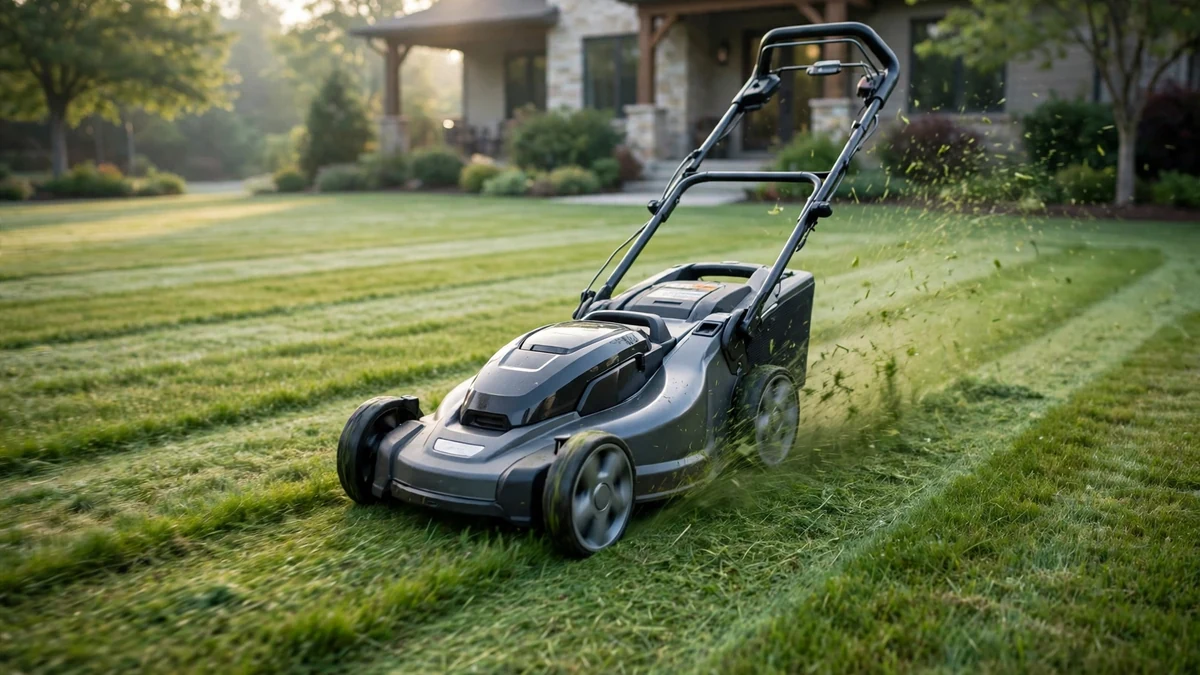
Early on a summer morning, a mower glides across a large lawn in long straight lines, leaving stripes of light and dark green behind it. There is no engine roar to wake the house, no smell of petrol drifting through the open windows, just a soft whir and the clean smell of cut grass. The garden looks as if it has been combed, and the machine that did it is already back in its shed, charging quietly.
A luxury electric lawn mower is a high-end battery-powered mower built to cut a large lawn to a precise, even finish, using an electric motor instead of a petrol engine. It is made around a strong cutting deck, a sharp steel blade or a set of reel blades, and a large removable battery, with a drive system that pulls the mower forward so the owner only has to steer. The mower has to cut cleanly without tearing the grass, run long enough to finish a big garden on one charge, and stay quiet enough to use at breakfast time.
How It Works
Step 1: The battery powers the motor
Everything starts with the battery, a large lithium pack that slides into the mower and locks with a click. When the owner presses the start button, the battery sends power through a controller to a brushless electric motor, which spins up smoothly and quietly, with no pull cord and no choke. The controller watches the load on the motor and gives it more power when the grass is thick or damp, then eases off on light grass to save the charge.
Step 2: The blade cuts the grass cleanly
Under the deck spins the blade, a hardened steel bar sharpened to a fine edge, turning fast enough to slice each blade of grass rather than tearing it. A clean cut matters, because torn grass turns brown at the tips and lets disease in, while sliced grass heals quickly and stays green. On the finest luxury models a cylinder of spiral reel blades cuts against a fixed bottom blade like a pair of scissors, giving the striped finish seen on sports pitches. The blade is balanced with care, because an unbalanced blade shakes the mower and leaves an uneven cut, and it is easy to remove for sharpening.
Step 3: The deck shapes the airflow
The cutting deck is the steel or aluminium shell that covers the blade, and its shape decides where the cut grass goes. Air spun by the blade lifts the grass upright before it is cut, then carries the clippings into a collection bag, out of a side chute, or back down onto the lawn as fine mulch. A deep deck moves more air and fills the bag more completely, while a mulching plug closes the outlet so the clippings are chopped again and fall back to feed the soil. The deck is coated to resist rust and to stop wet grass sticking, and its front edge is low enough to cut cleanly right up to a flower bed.

Step 4: The self-drive pulls the mower forward
A luxury mower does not need to be pushed. A second, smaller motor or a belt drive turns the rear wheels, pulling the mower forward at a steady walking pace that the owner can adjust with a lever on the handle. The drive disengages when the owner pulls the mower backwards, so it can be manoeuvred around trees and beds without a fight, and it keeps a constant speed on slopes, where a pushed mower would run away downhill.
Step 5: The height and the handle adjust to the lawn
Cutting height is set with a single lever that raises or lowers the whole deck, usually in steps of a few millimetres, so the same mower can cut a short formal lawn in summer and leave the grass longer in a dry spell. The handle folds for storage, telescopes to fit a tall or short owner, and carries the controls: the start button, the drive lever and the battery gauge, all within reach of the thumbs. A wash port on the deck lets a hose flush out stuck grass, and the collection bag lifts off with one hand to be emptied on the compost heap. Every adjustment is made to be done without tools, because a mower that needs a spanner to change its height is a mower that never gets adjusted.

Step 6: Sensors protect the motor and the blade
While the mower works, its controller keeps watch. If the blade hits a stone or a thick root, the motor stops in a fraction of a second, before the blade can be badly damaged or the mower can kick. If the grass is too wet and thick, the controller slows the drive and warns the owner rather than letting the motor overheat, and a thermal cut-out shuts everything down if the battery gets too hot. When the job is done, the battery slides out and goes on its charger, the deck is brushed clean, and the mower is ready for the next cut, its blade still sharp and its charge full.
The cleverest part of an electric mower is not the motor, but the way it manages its power. A petrol mower runs at full speed whether the grass is thick or thin, while an electric mower speeds up only where the grass demands it, which is why its battery can last a whole large lawn. The electric lawn tractor works on the same idea at a larger scale, while the robot lawn mower takes it further still, cutting a little every day on its own.
| Specification | Typical figure |
|---|---|
| Motor | Brushless electric motor, removable lithium battery |
| Cutting width | Around 46 to 56 centimetres |
| Cutting height | Around 20 to 80 millimetres, single-lever adjustment |
| Run time | An estimated 45 to 90 minutes per charge |
| Drive | Self-propelled rear-wheel drive, variable speed |
| Noise | Far quieter than a petrol mower at the same distance |
How Much Does a Luxury Electric Lawn Mower Cost?
Prices are estimates and vary with cutting width, battery size and brand. A luxury electric lawn mower typically costs an estimated $800 to $2,500, and the price is set mostly by the motor, the battery and the self-drive system. A smaller model with one battery sits at the low end, while a wide-cut model with two large batteries, a reel blade and a full set of adjustments can cost far more. The electric hedge trimmer shows how the same battery system powers the rest of the garden tools.
A Rare Fact About Electric Lawn Mowers
Here is a detail most owners never notice: the stripes on a mown lawn have nothing to do with cutting the grass to different lengths, and everything to do with bending it. As the mower passes, a roller or the back of the deck bends the grass blades in the direction of travel, and blades bent towards you look dark while blades bent away catch the light and look pale. That is why the stripes always run in straight lines and flip with every pass, and why the effect is strongest in the low light of morning and evening. Some luxury mowers fit a separate rear roller just to make the stripes sharper, turning an ordinary lawn into a pattern that looks like it was laid out by a groundskeeper.


