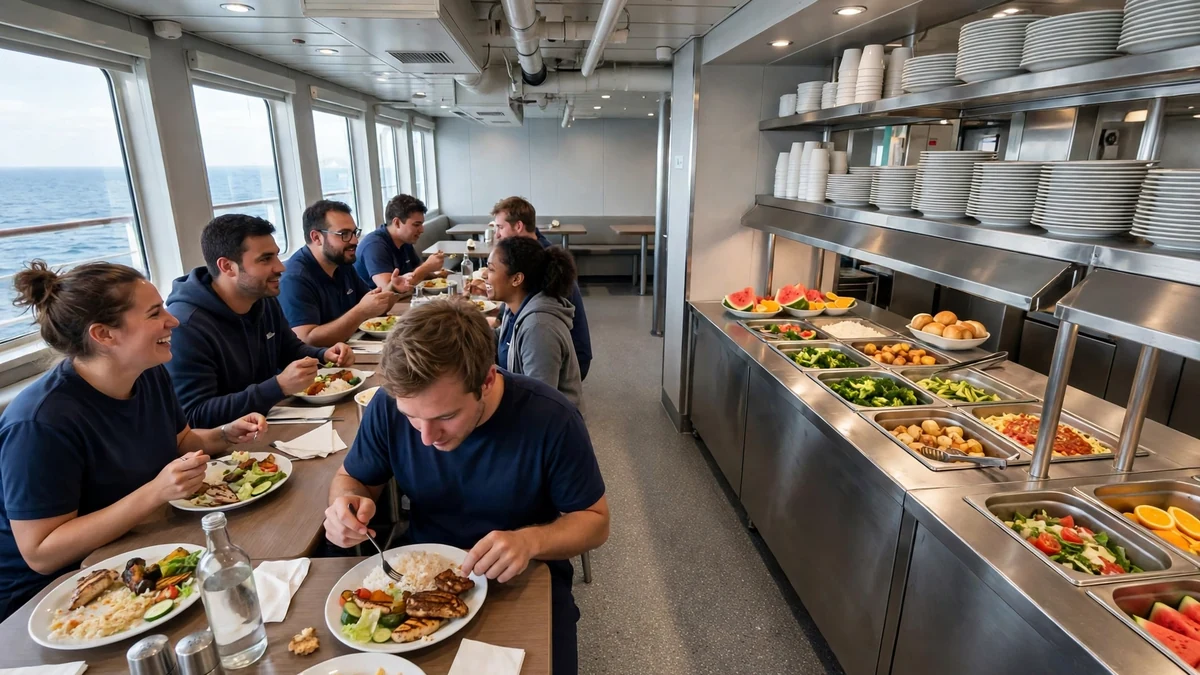
Deep inside a cruise ship, below the restaurants where the guests dine, there is a room that smells of fresh bread and coffee, where off-duty crew in uniform sit with their feet up and talk in a dozen languages. There are no white tablecloths and no waiters, just long tables, a self-service counter and a noticeboard full of shift rotas. This is the crew mess, and for the hundreds of people who keep the ship running, it is the most important room on board.
A luxury ship crew mess is the dining and rest room for the ship’s crew, usually seating a hundred or more people at a time, built below decks near the galley. It is made up of a serving line, long tables and benches, a drinks station and a quiet corner for resting, all fitted to survive the roll of the sea. The mess has to feed a whole crew in shifts around the clock, stay clean and safe in rough weather, and give people who work long hours a place that feels like a break rather than another workstation.
How It Works
Step 1: The galley cooks in bulk, around the clock
Everything starts in the galley next door, where a team of cooks prepares food for a crew that never all eats at once. The ship runs on watches, so breakfast, lunch and dinner are cooked in waves, with hot dishes held in heated serving counters and cold food kept chilled until it is needed. Menus are planned to suit a crew drawn from many countries, with rice, noodles, curries and breads alongside familiar Western dishes, and the food is cooked in large batches in tilting kettles and combi ovens that can feed hundreds.
Step 2: The serving line moves people through fast
When a watch ends, hungry crew file into the mess and along the serving line, a long stainless steel counter with heated trays, salad bowls and a drinks station. The line is laid out so a person can collect a full meal in under a minute: a tray, a hot dish, a side, a salad and a drink, with cutlery and napkins at the end. The counter is heated from below so food stays hot without drying out, and the sneeze guards above it keep the food clean. A separate station serves tea and coffee all day, because on a ship that never sleeps, someone is always coming off watch and needing a hot drink.
Step 3: The tables and seats are built for the sea
The dining area is filled with long tables and fixed benches, bolted to the deck so they cannot slide when the ship rolls. The tables are topped with a tough, easy-clean surface, and the benches are upholstered in a wipe-clean vinyl that survives spilled soup and coffee. Everything is rounded at the corners, because a sharp edge in a rolling ship is a bruise waiting to happen, and the floor is a non-slip vinyl that stays grippy even when wet. The room is lit brightly and painted in warm colours, a deliberate choice, since a dark, grey mess makes tired people feel more tired, while a bright one lifts them.

Step 4: Washing up runs like a small factory
As soon as a crew member finishes eating, the tray goes to a scullery at the end of the room, where the washing up runs like a small factory. Trays and cutlery are stacked on a conveyor that carries them through a high-temperature dishwasher, coming out clean and dry in under two minutes, while pots from the galley are washed by hand in deep sinks. The water is hot enough to sanitise, the chemicals are dosed automatically, and the whole system is checked daily, because a stomach bug spreading through a crew at sea can put a ship’s whole operation at risk. Nothing is left to pile up: a mess that feeds hundreds in shifts cannot afford a backlog.
Step 5: The mess doubles as a rest and meeting room
Between meals the mess changes its job. The tables become a place for crew to rest, read, play cards or call home on the ship’s internet, and a quiet corner with soft chairs is kept for people who need to sit down away from the noise. Noticeboards carry the shift rotas, safety drills and news from home, and the room is used for crew meetings, training sessions and the occasional birthday party.

Step 6: It is cleaned, restocked and ready for the next watch
After every sitting, a team of stewards wipes the tables, sweeps the floor and restocks the drinks station, so the room is ready before the next watch arrives. Deep cleaning happens every night, when the floors are scrubbed, the serving line is emptied and the dishwasher is descaled, and a health officer inspects the room regularly, checking temperatures, dates and cleanliness. The food stores below are topped up from the ship’s provisions, the menus for the next day are posted, and the mess settles into the rhythm it keeps for the whole voyage: cook, serve, clean, rest, and start again.
The hardest part of running a crew mess is not the cooking, but the timing. The ship’s departments finish their watches at different hours, so the mess has to be ready for a rush of engineers at midnight and a rush of housekeepers at dawn, with hot food waiting for both. The ship galley next door is where that food is cooked, while the crew quarters upstairs are where the same people sleep between their shifts.
| Specification | Typical figure |
|---|---|
| Seating | Around 100 to 200 people at a sitting |
| Location | Below decks, beside the galley and crew quarters |
| Serving | Heated self-service line, salad and drinks station |
| Meals | Three main meals plus night meals, around the clock |
| Furniture | Fixed tables and benches, bolted to the deck |
| Cleaning | Conveyor dishwasher, deep clean every night |
How Much Does a Luxury Ship Crew Mess Cost?
Prices are estimates and vary with ship size, seating and finish. A luxury ship crew mess typically costs an estimated $500,000 to $2,000,000 to fit out, and the price is set mostly by the serving line, the galley equipment behind it and the furniture. A small mess on a yacht sits at the low end, while a large mess on a cruise ship, with several serving lines and a full scullery, can cost far more. The building of a crew mess shows how the room itself is put together, from steel deck to final fitting.
A Rare Fact About Ship Crew Messes
Here is a detail most passengers never learn: on many ships the crew mess has its own traditions that no guest ever sees, including a wall where the crew mark the days until they go home. Some messes keep a book where each departing crew member writes a message for the next person to take their bunk, and on some ships the mess hosts a weekly crew talent night, with singing and dancing that would put the guest theatre to shame. The food, too, has its legends: a curry cooked by a particular chef can become famous across a whole fleet, with crew swapping ships just to taste it. A crew mess is not just a canteen, it is the place where a ship’s crew becomes a community, and where the long months at sea feel a little shorter.


