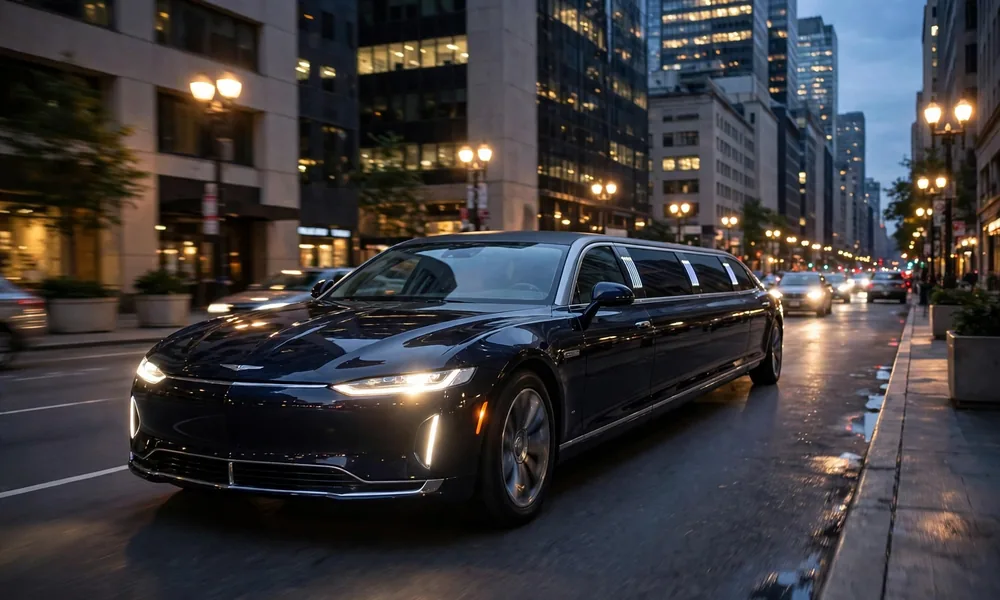
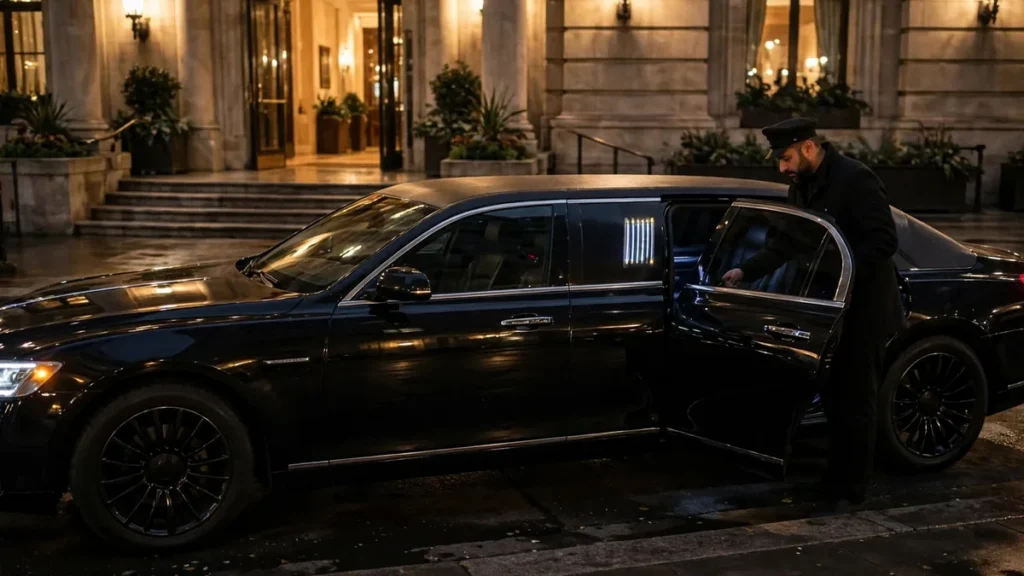
The door opens, and the first thing you notice is the quiet. No engine ticking, no exhaust smell, just soft light, cream leather and enough legroom to stretch out properly. A luxury electric limousine is not really a car with a big back seat; it is a small lounge that happens to have wheels, built for people who would rather arrive rested than arrive fast.
That lounge has to work while moving, which is harder than it looks. The car must be silent at speed, smooth over broken roads, and cool in summer traffic, all while carrying a battery big enough for a long day of driving. The engineering is therefore hidden, from the motors that you never hear to the suspension that you never feel.
To understand one, sit in the back and follow the systems around you: the battery under the floor, the motors at the axles, the air that keeps the cabin perfect, and the chauffeur’s quiet controls up front. This is how a luxury electric limousine works, from the charging plug to the passenger’s first stretch of legroom.

How a Luxury Electric Limousine Works
Step 1: The battery carries a long day of driving
Under the limousine’s floor sits a large battery pack, bigger than a roadster’s, because a limousine must cover a long day of airport runs, meetings and evening events without stopping to charge. The pack is made of hundreds of cells grouped into modules, cooled by liquid channels and monitored by a management system that watches every cell’s voltage and temperature. Its weight sits low in the car, which helps the ride, and its case stiffens the body, which helps the silence. The pack is sized for range first and speed second, because a limousine that must stop to charge in the middle of a booking has failed its passenger. The same battery-first thinking shapes other large electric cars, as our guide to how a luxury electric car works shows.
Step 2: Two motors move the car in silence
Power flows from the battery through inverters to two electric motors, one at each axle, giving the limousine all-wheel drive and a smooth, effortless pull. The motors are chosen for quietness as much as for power, mounted on soft bushings and sealed against noise, so the only sound at speed is the tyres and the wind. There is no gearbox to shift and no engine to rev: the motors spin up instantly, and the car gathers speed the way a lift gathers height, steadily and without fuss. Passengers notice none of this, which is exactly the point: the car should feel like it is gliding, not driving.
Step 3: Air suspension irons out the road
The limousine’s ride comes from air suspension, a system of air springs at each corner that can soften or firm up in a fraction of a second. Sensors read the road ahead and the car’s body movement, and the system adjusts each spring to keep the cabin level over bumps, potholes and speed humps. The suspension works with active dampers that absorb sharp jolts before they reach the seats, and the whole system is tuned for the rear cabin, where the passenger sits, rather than for the driver. A limousine that transmits the road to its passenger has not done its job, and the air suspension is the main reason it never does.
Step 4: The rear cabin is a lounge, not a back seat
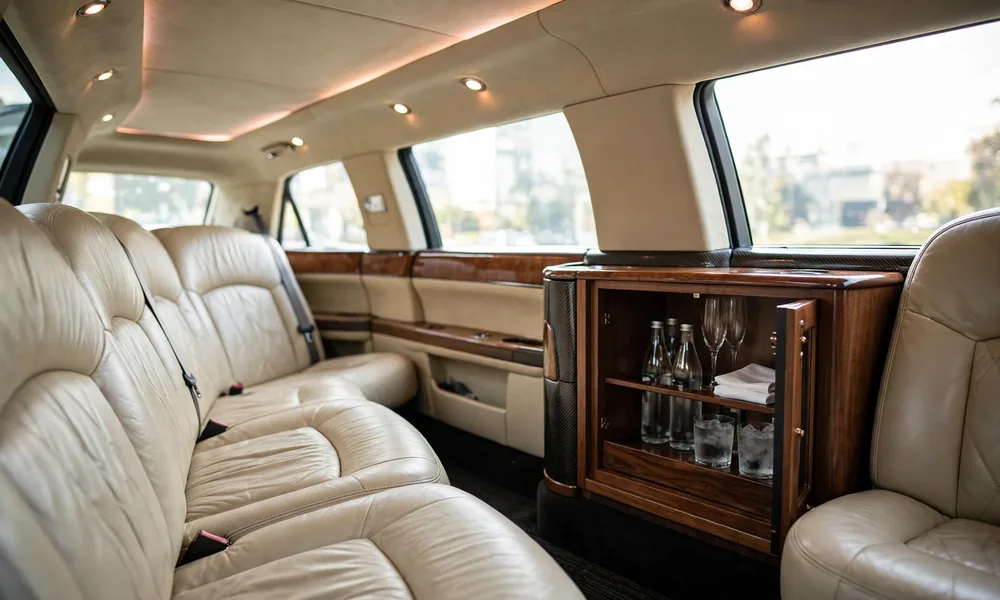
Step into the rear cabin and the car becomes a room. Two wide seats face forward, with heating, cooling and massage built in, and a centre console holds controls for the climate, the lights and the window blinds. There is a small refrigerator for drinks, a fold-out table for a laptop, and reading lights that can be dimmed to a warm glow. The windows are double-glazed, which keeps out traffic noise, and the rear glass can be darkened at the touch of a button. The cabin’s air is managed by a four-zone climate system, so the passenger can set their own temperature without affecting the chauffeur. The luxury saloons that share this cabin philosophy include the electric sedans, as our guide to how a luxury electric sedan is made shows.
Step 5: The chauffeur’s controls stay discreet
Up front, the chauffeur’s cabin is deliberately plain. A slim screen shows navigation, range and charging, a small display behind the wheel shows speed, and the controls are kept simple so the driver can focus on the road. The car assists quietly: it keeps its distance in traffic, holds its lane on the motorway, and warns of hazards, but it never takes over with a flourish. The chauffeur can also control the rear cabin from the front, adjusting the temperature or the blinds when the passenger asks, and a discreet intercom lets the two talk without raising voices. The open-top cars that share this quiet electric hardware are a different kind of pleasure, as our guide to how a luxury limousine works explains.
Step 6: Charging, servicing and the next booking
When the day is done, the limousine returns to the depot, where it is charged, cleaned and checked. Fast charging can add a useful share of range in under an hour if a booking runs long, but most charging is done slowly overnight, which is kinder to the battery and cheaper too. Servicing is simpler than a petrol limousine’s: there is no oil to change, no exhaust to inspect and no gearbox to service, though the battery cooling, the brakes and the air suspension are checked on a schedule. By morning, the car is clean, charged and silent, ready for the first pickup of the day, and the passenger who steps in will never know how much quiet engineering went into the night before.
Luxury Electric Limousine Specs
| Specification | Typical range |
|---|---|
| Battery | About 100 to 120 kilowatt-hours |
| Range | About 500 to 650 kilometres |
| Power | About 500 to 650 horsepower |
| Motors | Two electric motors, all-wheel drive |
| Zero to 100 km/h | About 4 to 5 seconds |
| Rear legroom | About 1 metre or more |
| Suspension | Air suspension with active dampers |
| Weight | About 2,400 to 2,700 kilograms |
What Does a Luxury Electric Limousine Cost?
A luxury electric limousine is estimated to cost roughly $120,000 to $200,000, while a stretched flagship with a full lounge cabin is estimated at $200,000 to $350,000 or more. A replacement air suspension strut is estimated at $1,500 to $3,000 fitted, and a battery pack service is estimated at $2,000 to $5,000. Prices are estimates only and vary by battery, cabin and options.
A Rare Fact
Some electric limousines can be ordered with a partition between the chauffeur and the rear cabin that rises and falls like a window, complete with its own intercom. The idea is older than the car itself: horse-drawn carriages had speaking tubes and sliding panels for exactly the same reason, privacy on demand. The modern version is a sheet of electrochromic glass that turns from clear to opaque at the touch of a button, so the passenger can have a private conversation without ever asking the driver to raise a barrier.