The rider twisted the throttle on a cold morning in the hills, and the motorcycle simply went. There was no exhaust note, no vibration through the bars, no gear change to mark the acceleration, just a smooth, silent push that pressed him back into the seat. In a few seconds he was travelling at motorway speed, and the only sound was the tyres on wet tarmac. That is the strange promise of the luxury electric motorcycle: superbike pace delivered in near silence, wrapped in materials that belong more to aerospace than to the motorcycle trade.
Understanding the machine means looking past the headline horsepower figure and following the power instead. It starts in the battery, flows through a controller that shapes it thousands of times a second, and arrives at a motor that turns electricity into torque with no gears, no clutch, and no waiting. This is how a luxury electric motorcycle works, from the battery under the rider to the back wheel on the road.

How a Luxury Electric Motorcycle Works
A luxury electric motorcycle works in six stages: the battery stores the energy, the controller shapes it, the motor turns it into motion, the drivetrain delivers it to the wheel, regenerative braking recovers some of it, and the cooling and electronics keep the whole system safe. Each stage depends on the one before it, and the best machines are the ones where the stages are tuned together, not just bolted together.
Step 1: The battery stores the energy
The battery is the heart of the machine and the single most expensive part, often accounting for a third or more of the total cost. Premium motorcycles carry packs of roughly 15 to 22 kilowatt-hours, made of hundreds of lithium-ion cells grouped into modules and packaged low in the chassis, where they also act as part of the frame. The pack is sealed against rain and road spray, and a battery management system watches every cell for voltage, temperature, and charge, balancing them so none is overcharged or left behind. An EV battery pack is built on the same principles, but the motorcycle pack is smaller, lighter, and shaped to fit a machine the rider straddles.
Step 2: The controller shapes the power
The battery’s direct current cannot drive the motor directly, because the motor needs a rotating magnetic field, and direct current does not rotate. That is the controller’s job. It is a box of power electronics, usually mounted near the battery, that switches the current on and off thousands of times a second, sending pulses to the motor in a carefully timed sequence. It reads the throttle to decide how much power to send, and it limits the current so the motor does not overheat on a long climb.
Step 3: The motor turns electricity into torque
Most luxury electric motorcycles use a permanent magnet motor, a compact unit where coils of copper wire surround a rotor fitted with powerful magnets. When the controller sends current through the coils in sequence, each coil becomes a magnet that pulls the rotor around, and the rotor turns the output shaft. The motor delivers its full twisting force from a standstill, which is why even a modestly powered electric motorcycle feels violent off the line. There is no clutch to slip, no gearbox to shift through, and no waiting for an engine to reach its power band: the torque is simply there, the instant the throttle moves.
Step 4: The drivetrain delivers it to the wheel
The motor’s output reaches the back wheel through a simple drivetrain, usually a belt or a chain, with a single fixed gear ratio. There is no gearbox, because an electric motor spins happily from a standstill to its top speed, so the machine needs only one ratio, chosen to balance acceleration against top speed. The belt is quiet and clean, the chain is stronger and easier to replace, and both are enclosed or guarded against road grit. Luxury electric motorcycle specs list the power and range that come out of this drivetrain, but the feeling of it, instant and silent, is what riders remember.

Step 5: Regenerative braking recovers energy
When the rider closes the throttle or pulls the brake lever, the motor reverses its role and becomes a generator. The spinning back wheel turns the motor, the motor turns motion back into electricity, and that electricity flows into the battery. The effect is a smooth, strong engine braking that slows the bike without touching the brake pads, and on a long downhill it can add useful miles of range. It is the same idea as regenerative braking in an electric car, tuned for a machine that weighs a fraction as much.
Step 6: Cooling, safety, and the rider’s electronics
All of this power makes heat, and the luxury motorcycle manages it with liquid cooling. Coolant flows through channels in the battery case and the motor housing, carrying heat to a small radiator at the front, while temperature sensors watch every part of the system. If anything gets too hot, the controller quietly reduces the power rather than letting a component fail. Around the edges, a suite of electronics keeps the rider safe: traction control that stops the rear wheel spinning, lean-sensitive braking that works even in a corner, and a dashboard that shows range, battery temperature, and charge. The best electric motorcycles of 2027 all share this electronic safety net, and it is part of what makes the silent pace usable every day.
Luxury Electric Motorcycle Specifications
| Specification | Typical figure |
|---|---|
| Motor type | Permanent magnet synchronous |
| Power | 100 to 160 kilowatts |
| Torque | 190 to 280 newton-metres |
| Battery | 15 to 22 kilowatt-hours |
| Range | 120 to 200 miles, mixed riding |
| Charging | 0 to 80 percent in 30 to 60 minutes, fast charge |
| Weight | 220 to 280 kilograms |
What a Luxury Electric Motorcycle Costs
A luxury electric motorcycle typically sells for an estimated $25,000 to $45,000, with the most exclusive hand-built machines reaching an estimated $60,000 or more. The battery is the biggest single cost, followed by the motor, the controller, and the carbon fibre bodywork, and the hand finishing adds more on top. Running costs are low: electricity for a full charge typically costs an estimated $3 to $6, and servicing is mostly tyres, brakes, and software, with no oil, no clutch, and no valve checks. The expensive surprise is the battery, which can cost an estimated $8,000 to $15,000 to replace out of warranty, which is why buyers check the warranty, usually eight years, before they sign.
A Rare Fact About Luxury Electric Motorcycles
Some luxury electric motorcycles are built without a single gear, chain adjuster, or clutch lever, and their riders never touch a gearbox in the machine’s whole life. The rarest machines are built in runs of fewer than a hundred, each one numbered, and some are delivered by the person who built the battery pack. On a quiet road, at full throttle, the loudest thing about them is still the wind.
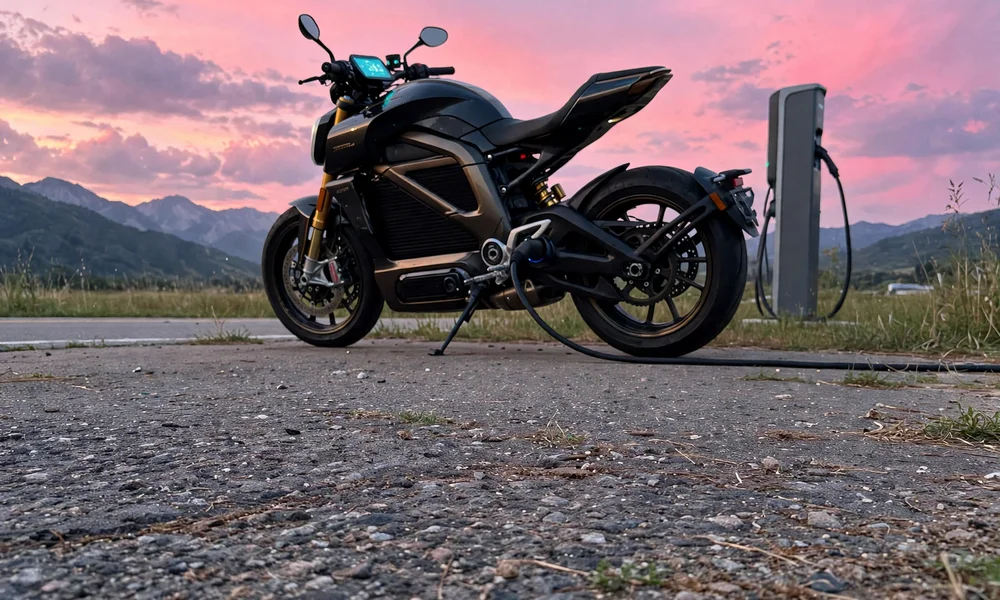
A luxury electric motorcycle is not a petrol motorcycle with the engine swapped out. It is a different kind of machine, one where the battery is the frame, the controller is the gearbox, and the motor is silent. Riding one feels strange for the first mile and obvious by the tenth: the power is always there, the machine never waits, and the road arrives without noise. That silence, paired with pace, is the whole point, and it is why the riders who try one rarely go back.


