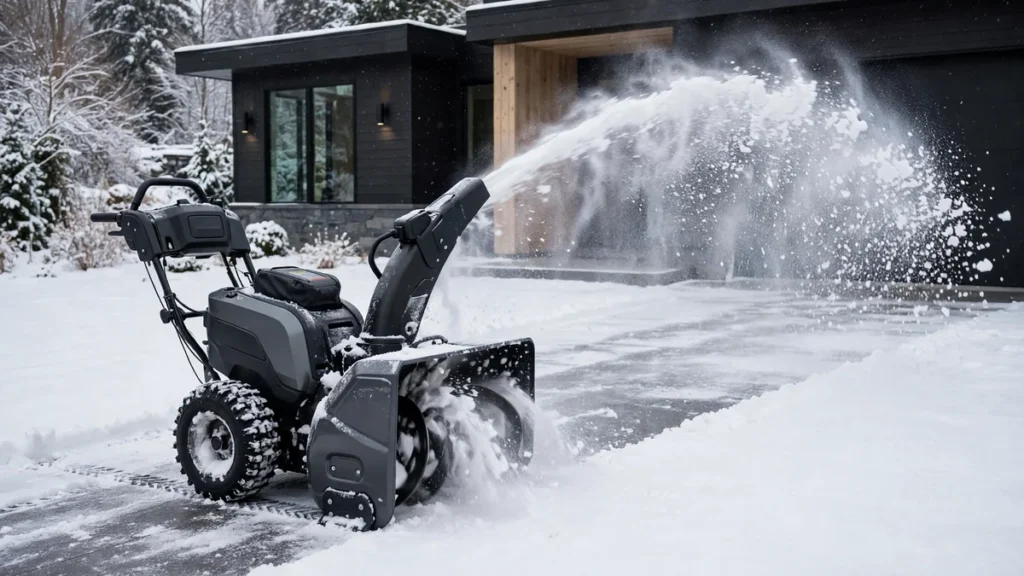
On the first heavy morning of winter, a driveway can hold a ton of snow before breakfast, and clearing it by hand is a slow, back-breaking job. A luxury electric snow blower turns that job into a short walk behind a humming machine, throwing the snow in a neat arc onto the lawn while its owner stays warm and dry.
The best battery snow blowers are no longer the weak cousins of petrol machines. Big lithium batteries, brushless motors and steel augers have made them strong enough for deep, wet snow, and they start with a button instead of a pull cord. This is how a luxury electric snow blower is made, from the steel that meets the snow to the battery that powers it all.

How It’s Made
Step 1: The steel housing is formed
Everything starts with the housing, the wide scoop at the front that gathers the snow. Sheets of heavy steel are cut, pressed and welded into a curved shell that is strong enough to scrape over frozen ground and ice without bending. The edges are reinforced, because the housing takes every knock the machine meets: hidden kerbs, frozen ridges and the odd stone. A good housing is also shaped to feed snow smoothly towards the centre, like a funnel, so the auger never has to fight a jam. Once welded, the steel is coated against rust and salt, since a snow blower spends its life in the wettest, saltiest conditions a garden machine ever faces.
Step 2: The auger and impeller are built
Inside the housing sits the auger, a horizontal steel screw with serrated edges that chews into the snow and drags it towards the middle. The auger is made from thick steel, balanced so it spins smoothly at high speed, and its teeth are hardened to bite through ice crust. Behind it sits the impeller, a fan that catches the snow the auger delivers and hurls it up through the chute. The impeller spins far faster than the auger, and the two work as a team: the auger collects, the impeller throws. On a luxury machine the auger is steel rather than rubber or plastic, because steel keeps its edge through season after season of hard use.
Step 3: The electric motors are fitted
A luxury electric snow blower has no petrol engine at all. Instead it uses brushless electric motors, one to drive the auger and impeller and another, on self-propelled models, to drive the wheels or tracks. Brushless motors have no brushes to wear out, so they last longer and run cooler, and they deliver full torque the instant they start, which is exactly what a snow blower needs when it meets a deep drift. The motors are sealed against snow and meltwater, and they are mounted on rubber bushes that soak up vibration, so the machine hums rather than rattles. The electric leaf blower uses a smaller version of the same brushless idea, but a snow blower’s motors are far bigger and built to work in freezing cold.

Step 4: The battery pack is built and tested
The battery is the heart of the machine, and it is built like one. Dozens of lithium-ion cells are welded into a sealed pack, with a management system that watches every cell’s voltage and temperature, balancing the charge so no cell is overworked. The pack is insulated and heated, because lithium batteries lose power in the cold, and a snow blower has to work at minus twenty. Each pack is tested before it leaves the factory: charged, discharged and charged again, while sensors check for any cell that behaves differently from the rest. A pack that fails the test is taken apart and rebuilt, never shipped. On the biggest machines two packs work together, giving enough energy to clear a long driveway on one charge.
Step 5: The chute, controls and lights are added
With the working parts in place, the machine gets the pieces the owner touches. The chute, which aims the thrown snow, is fitted on a rotating base so it can be turned from the handlebars with a lever or a small motor, and its deflector sets how far the snow flies. The handlebars carry the controls: a lever for the auger, a lever for the drive, and buttons for the heated grips and the LED headlight that lets the owner clear snow before dawn. The headlight is not a luxury extra on a winter machine; in northern winters the sun rises late, and much snow clearing happens in the dark. Everything is tested in a cold room, where engineers check that levers still move and buttons still click with gloved hands.
Step 6: Assembly, cold testing and the final check
The finished blower is assembled on a line, with each station fitting and torquing its own set of parts, and then it is rolled into a cold chamber and run through a full test. Engineers feed it with real snow, check how far it throws, how much it clears in a pass, and how long the battery lasts under load. They also check the safety systems: release the auger lever and the auger must stop within seconds, and the machine must not creep forward on its own. Only after the cold test passes is the blower cleaned, boxed and shipped, with its battery charged and ready for the first snowfall. A luxury electric snowmobile is tested in the same cold chambers, but a snow blower has to prove it can work, not just move, in the deep cold.
| Specification | Typical luxury two-stage model |
|---|---|
| Clearing width | 61 to 76 cm (24 to 30 in) |
| Intake height | Around 50 cm (20 in) |
| Throw distance | Up to 15 metres (50 ft) |
| Battery | Two lithium-ion packs, 56 to 80 volts |
| Drive | Self-propelled, wheels or tracks |
| Weight | Around 45 to 60 kg (100 to 130 lb) |
A luxury electric snow blower typically costs an estimated $1,500 to $3,500, depending on the clearing width, the battery size and whether it runs on tracks, and that is an estimate for the machine with its batteries and charger included. The price buys quiet running, push-button starting and no petrol, oil or exhaust to deal with. The electric chainsaw shares the same battery platform idea on many brands, so one set of packs can power the whole winter and summer toolkit.
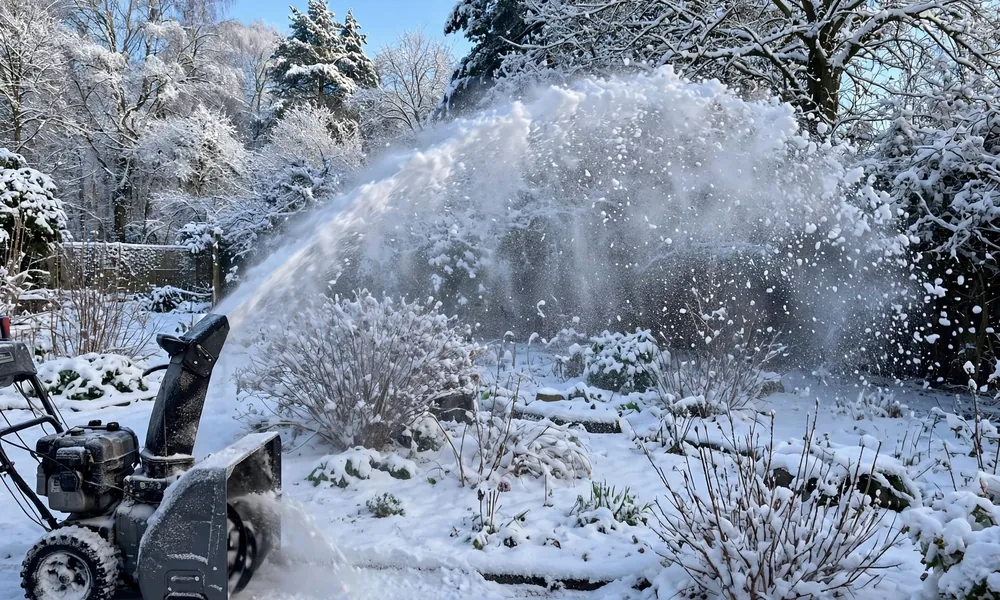
Here is a rare fact: a two-stage snow blower can move more than a ton of snow a minute, and the impeller at its heart spins fast enough that the snow leaves the chute at well over 100 kilometres per hour. The machine does not so much push the snow aside as pick it up, accelerate it, and throw it over the fence.
When the next storm buries the driveway, the owner of a luxury electric snow blower does not reach for a shovel or a pull cord. They press a button, the auger bites in, and the snow flies in a clean white arc while the machine hums quietly through the cold. It is a small piece of heavy engineering, built to turn the worst morning of winter into a ten-minute walk, and it does the job without a drop of petrol or a cloud of exhaust.